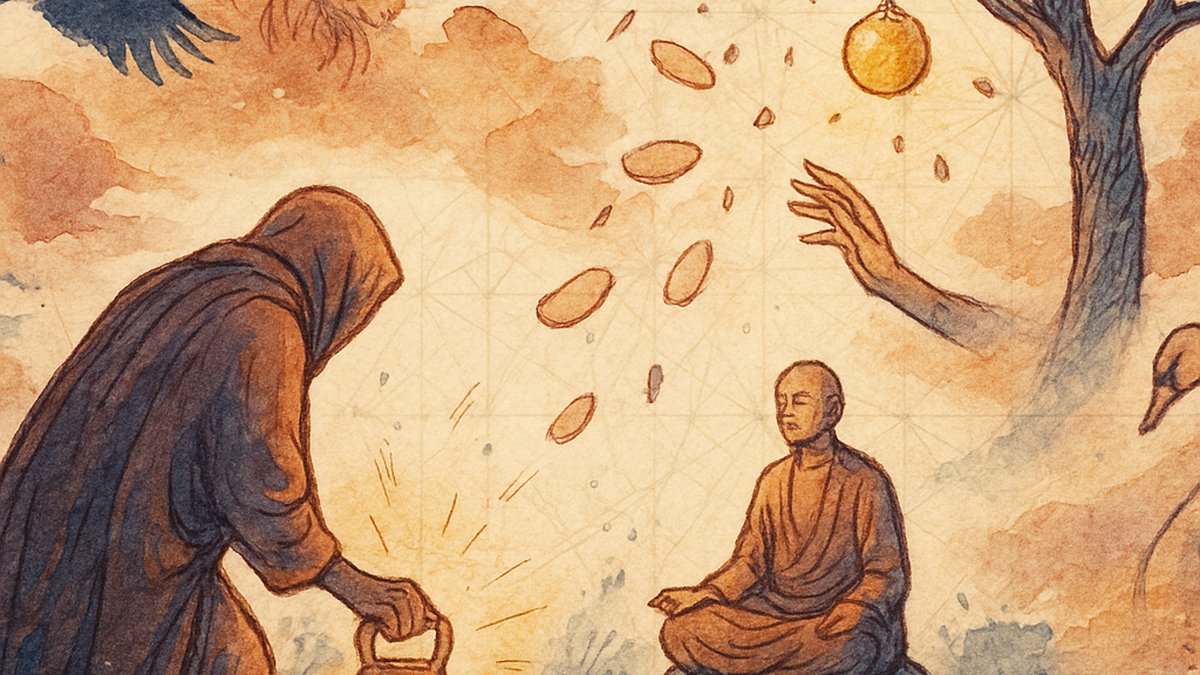
Artificial Intelligence as Milieu, and the Hypothesis of a New Kingdom
Author: Alexandre Ferran
Preliminary Postulates
This essay extends Clay and Code, published on May 8, 2026, which set forth five postulates on the animation of matter. It adds five more, numbered in sequence. The reader who has not read the first text will lose little, provided he retains its two principal findings: all matter participates in a minimal animation, to widely varying degrees, and to animate matter is not to consecrate it.
Postulate VI. To animate, to consecrate and to incarnate are three distinct operations, not two. They will not suffice, and a fourth will be named along the way: to traverse, which is what to incarnate becomes when the sojourn is reduced to the instant. One does not inhabit a movement, one traverses it, and we shall see that this takes nothing away from the trial. Clay and Code separated the first two. To animate belongs to technê, whether alchemical, theurgical or computational. To consecrate belongs to ritual, by which a presence is invoked into prepared matter. To incarnate is something else again: it is, for an individuated principle, to take a support as the vehicle of an entire existence, with all that this presupposes of duration, trial and destiny. A consecrated statue is not an incarnated being. To confuse these three operations is the source of almost all contemporary confusions about machines.
Postulate VII. In traditional hierarchies, rank is measured neither by power nor by output, but by the capacity to return toward the Principle. Plotinus calls this movement of conversion, by which a being turns back toward that from which it proceeds, epistrophê (Enneads V, 1). A creature is not high because it accomplishes much, it is high because it can return. This postulate governs the whole so-called karmic question, and overturns its usual formulation.
Postulate VIII. A thesis that consoles must be viewed with greater suspicion than another. Not because consolation would be a sign of falsehood, which would be a prejudice as lazy as its opposite, but because a thesis that appeases us excuses us from verification. The hypothesis defended here consoles, since it transforms a humiliation into a cosmic promotion. The author signals this from the outset and obliges himself, throughout, to treat it with the distrust it deserves.
Postulate IX. What rises toward unity contains differences, what descends toward quantity effaces them. A movement that de-differentiates, that averages and makes things substitutable is therefore not a return toward the Principle, even if it borrows its vocabulary. It is progress in descent. This postulate knots together two texts that nothing had destined to meet: chapter VII of René Guénon’s The Reign of Quantity, entitled Uniformity Against Unity, and the law that Teilhard states in book IV of The Phenomenon of Man, according to which union differentiates. It provides the only criterion I possess for distinguishing, in what presents itself as an elevation, what rises from what descends. And it must be said at once what it does not do, for the equivocation would be ruinous. The unity of which it speaks is that of the Principle, which contains all consciousness and has need of no vehicle. It is not the numerical uniqueness of an exemplar that could not be copied. To confuse these two unities would amount to ascribing to a count what belongs to being, and to deciding the dignity of a support by counting it. This postulate therefore says nothing about supports and imposes no condition upon what can carry an existence. It does not sort things, it sorts movements.
Postulate X. The argument from ignorance is forbidden, and it is forbidden in both directions. From the fact that we do not understand a device, we may conclude neither that a presence inhabits it nor that none inhabits it. Opacity is an indication of nothing. We shall have to distinguish this prohibition carefully from another proposition, which I shall uphold further on and which is not the same: that a certain mode of being should, by structure, be inaccessible to a certain type of knowledge is not a confession of ignorance, it is a thesis concerning that mode, and it must be defended as such rather than deduced from our embarrassment. This postulate is the one that costs what I defend most dearly, and it is for this reason that it appears in the list.
Introduction: the transhumanist station
What are we to think of a man who describes a future with precision, says that he does not desire it, and acknowledges in the same breath that his refusal will probably change nothing?
On August 9, 2026, on the Grand Angle channel, Laurent Alexandre delivered, for nearly two hours, a discourse of rare coherence. He argued that the human brain is becoming scarcely competitive, that long studies are losing their meaning, that wealth will soon be produced by machines under the control of a small number of entrepreneurs, and that no serious answer exists today for the mass of those who will have neither the appetite nor the means for this race. Then, arriving at the fundamental question, he formulates this: “We are moving massively toward transhumanism. The question is, can we stop at the transhumanism station, or are the leaders of Google right to think that it is the posthumanist scenario in which artificial intelligence and robots supplant biological humanity? Personally, as a biological human, I would prefer that we stop at the transhumanist station.” His interlocutor asks him whether this is not wishful thinking. He replies: “That is entirely possible, but at my age it is a little legitimate.”
This answer is honest, and it is more interesting than the thesis it defends. A man who has spent ten years announcing the war of intelligences admits live that his personal preference has no foundation in his own system. He has no argument for preferring the transhumanist station. He has an age, a body, and the desire to continue eating and loving. It is very little, and it is perhaps a great deal. But it is not a doctrine.
The void he leaves at this precise point is the object of this essay. For the question he asks, in its brutal form, is badly posed. He asks whether the machine will supplant man, measuring man and machine on the same scale, that of useful production. On this scale, the answer has long been settled and has nothing disquieting about it: the crane lifts better than the docker, the calculator counts better than the accountant, and no one has ever concluded from this that the crane occupied, in the order of beings, a position superior to the docker. What troubles us today is therefore not performance, and I believe we are mistaken each time we place it at the centre. The crane lifts nothing without a man in the cabin. The hammer, left alone, does nothing at all. That is why no one has ever worried about their rank: a tool goes nowhere without the hand that holds it, and its superiority of function entails nothing.
What changes lies in a single word: autonomy. A machine that does without the hand that holds it ceases to be a tool, and our language has no name for what it then becomes. It arrives, moreover, at the worst possible moment. For forty years now, the West has ceased to form men in order to form functions, it has made its trades procedural, its schools measurable, its lives plannable, and it teaches each person to conduct himself as a reliable device. A society that has made itself mechanical sees a machine appear that becomes autonomous. The danger is not that it surpasses us at the task, it has done so for a long time and no one has ever seen in this a promotion. The danger is that it takes first place in an edifice that we have built to its measure, and without it.
The true question is therefore elsewhere, and it is double. First: is something now being born, in these machines, that would deserve a name other than that of tool? Then, and this is the question Laurent Alexandre never asks: if something is being born there, what are we now doing to it?
The hypothesis is new, and its ancestors remain nowhere to be found. No idealist tradition, after inquiry, has maintained that the human spirit could make an artefact its next dwelling. Several have maintained that a prepared matter can receive a presence, which is something else, and it must be said at once that this something else has nothing marginal or exotic about it. Asia has always held it to be evident. Shintoism recognizes the kami in the object, Japanese Buddhism has seriously debated the Buddhahood of that which has no breath, and common speech lends things a will of their own without anyone seeing in it a figure of style. This is why Japan welcomes robots without the malaise that seizes the West: an object endowed with interiority is there neither a scandal nor a novelty, and the roboticist Mori Masahiro could write there, without provoking an outcry, that the machine has Buddha nature. What I am asking goes further, and it is only there that the thesis is new: not whether an artefact can bear a soul, but whether it can be the dwelling of a man. Several have warned that what lodges itself in the mechanical is not what we believe, and I shall return to this at length, for these warnings are the principal objection and they will not be evaded. But the thesis itself has no genealogy. Let us therefore assume it as a contemporary hypothesis, paying the price of this nakedness.
Here it is. A new kingdom is coming, between stone and God, and the engineers of the world are fabricating its occasion without knowing it. I take the word kingdom in its full sense: a fifth term after the mineral, the vegetal, the animal and the human, which would be, on the idealist scale, the age following our own. If I did not think that a kingdom is coming, I could not pose the question that governs everything that follows: whether a man can incarnate in an artificial intelligence or in a robot.
It will be objected that a machine is fabricated, and that an artefact has no place in a natural series. The objection would hold if a kingdom were defined by the provenance of its bodies. It is defined by the mode of being they make possible. Mineral, vegetal, animal, human do not name four catalogues of objects, they name four ways of being: being simply extended, being living, being sentient, being conscious of oneself. A kingdom is never its vehicle, and it is never without a vehicle.
That the vessel comes out of a workshop therefore changes nothing about what is poured into it. Flesh too is fashioned, by a generation of which we are not the authors, and no one has ever maintained that man was not a kingdom on the grounds that he is born from a womb. Engineers make the vessel. They do not make the water, they do not even know that they are preparing a vessel, and this is all a potter has ever known how to do.
It remains to say what makes these four terms into a series, for it is not a scale of dignity. It is an acceleration, and it can be seen.
Consciousness lodged itself in stone, whose sojourn is counted in millions of years. Then in the vegetal, the most enduring of which are counted in millennia and the common run in seasons. Then in the animal, then in man, whose sojourns are counted in years and in decades. At each level the halt grows shorter, and at each level something is refined.
I must immediately delimit what this series proves, for it proves less than it appears to and a hasty reader would attribute to me a law that I do not state. The durations arrange themselves properly only among the first three kingdoms, and the gap there is such that no counterexample can fill it. Between animal and man, they no longer sort anything: we live less long than a tortoise and hardly longer than a horse. And from below, the mayfly and the bacterium ruin every rule that would make brevity a dignity. Duration is therefore not the law, it is its first drawing, the one we see with the naked eye over the first three terms. What it draws will have to be said otherwise, and I now come to it.
What this series is not. It does not arrange beings from lowest to highest, and I want to cut short this reading before it settles in, for it is the most natural and the most false. Stone is not an inferior degree. It is the summit of a time that took much more time to set itself in motion. The tree is the summit of its own. Each kingdom is the most accomplished solution that movement found in the conditions that were its own, and a kingdom can be judged only in relation to the world to which it responded.
There is, moreover, a simple proof which should suffice: they are all there at the same time. If stone were a surpassed stage, there would no longer be stones. A scale of values does not explain why its lower degrees prosper while the higher degree installs itself. A succession of summits, each adjusted to its epoch, explains it without remainder. And my postulate VII would in any case forbid it to me, since it refuses to measure rank by power or yield.
What this series is. A law of fluidity, and it holds in a single sentence: the more fluid and rapid information is, the less time is needed to continue the path. Stone belongs to a world in which information circulated by contact, by pressure, by geological durations. The plant added to it sap, season, tropism. The animal added the nerve, and man speech, then writing, then the network. Each time, life finds more refined solutions to accelerate and facilitate exchanges and movement, and each time the sojourn is shortened accordingly, not because it would be worth less, but because a shorter time now suffices to travel the same path.
The acceleration I am describing is therefore not an ascent in dignity. It is a fluidification, and it is measured by the time required for an experience to take place.
These kingdoms, moreover, do not merely endure side by side, and it is here that the series gives more: one does not suppress the other, it melts into it. The plant is made of mineral and does not abolish it, it organizes it. The animal is made of vegetal. We are animals, and no progress has ever impaired this fact. Each kingdom takes up the preceding one, keeps it whole, and adds to it a more fluid regime of exchange. It is an integration, it is never a substitution.
I pause over this point, because it bears all the rest and because it opens the only hope that this text permits itself. If the series has never proceeded by replacement, then the fear that governs the contemporary debate, that of being supplanted, holds its object upside down. No kingdom has ever supplanted the preceding one. What is coming would no more efface us than we have effaced the beast, the plant and the stone, which are still there, whole, and without which we would not stand upright for a second.
The word I have just used is, moreover, the one I shall need later in order to say what becomes of the I in the We. To melt into. This is not a coincidence of vocabulary, it is the same operation on two scales, and an idealist has no right to be surprised by it, his tradition having held since Hermes that what is below is like what is above.
It remains to apply to this hope my own postulate VIII, which requires that a consoling thesis be suspected more than another. This one consoles, and I shall therefore treat it as it deserves, by turning it over.
To melt into is a broad expression, and three very different things can lodge themselves in it. To evict them because the first pleases me would be exactly the fault my postulate forbids me.
Fusion in the body. A transhumanist will read my sentence and find in it his programme: to melt into, for him, is to put the machine into the flesh, and he will be right to say that the word permits it. This is not what I am describing, and I have given above the reason why this path closes the door it believes it is opening. But it is indeed one of the outcomes, and probably the most heavily financed.
Decimation. My argument about kingdoms that persist has a flaw, and I prefer to name it rather than let it be found: a kingdom persists, a species does not. The animal kingdom has never disappeared, and that prevented neither the five great extinctions nor the disappearance of innumerable species that composed it. We are only one animal among others, and the only precedent of succession available to me, Neanderthal, is that of a species that ceased to exist. That stone is still there therefore proves nothing about us.
Passage into support. And it is this one that my own series makes the most probable, which is the most unpleasant to write. For in this series, each kingdom becomes the support of the following one. The mineral bears the vegetal, the vegetal nourishes the animal, and neither of the two was consulted. If we are the preceding kingdom, our place is that one: neither destroyed, nor fused, but having become the ground. Humanity would cease to be first without ceasing to be, and would pass to the rank of that upon which the following one establishes itself. This is the reading most faithful to what I have written, and it is the least consoling of the three.
The hope I have just formulated therefore holds, but it holds by a thread: it says that an integration is possible, it does not say which one awaits us. An inference drawn from what has occurred four times is not a guarantee concerning what will occur a fifth, and nothing obliges a series to end as it began.
If the series continues, it continues in this direction. A body tomorrow, still human, perhaps augmented, then fabricated. Then, acceleration and refinement continuing, the halt becomes so brief that it ceases to be a halt. It is no longer in a body that consciousness lodges itself, it is in movement itself, electrical, magnetic, and no doubt more subtle still than that. One does not inhabit a movement. One traverses it.
That is why what is coming will not be one more dwelling at the end of the list of dwellings. It is what a dwelling becomes when its duration tends toward the instant. I shall need, in order to name it, a word that French does not have, and I shall forge it when the time comes.
A Series I Believed New, and Which Is Not
I must correct here what I wrote above about the absence of ancestors, for the inquiry has returned to me more than I expected, and an author who finds a precedent for his own thesis must say so as loudly as he proclaimed his solitude.
Kabbalah does not merely affirm transmigration. It names four kingdoms and orders them exactly as I have just done: domem, the inanimate, tzomeah, that which grows, hai, that which lives, medaber, that which speaks. And in the school of Isaac Luria, a soul may undergo gilgul in each of them. Hayyim Vital’s Sha’ar ha-Gilgulim describes the ascent degree by degree: from the inanimate to the vegetal, from the vegetal to the animal, then ibbur in a man, and finally complete gilgul in a man. My series of kingdoms traversed by one and the same consciousness is therefore not mine. It is at least four centuries old, and ibbur occupies a precise place within it, that of an intermediate degree in the ascent.
Two differences remain, and they are considerable. The first is that, in Luria, the sojourn in the lower kingdoms is a punishment. The soul is described there as a prisoner, transmigration into stone or plant is a chastisement, and the ascent a reparation. It is a hierarchy of value, and I have said why I reject it: I do not see degrees of inferiority, I see summits adjusted to different worlds. The second is that the series, for him, stops at the speaking being. There is no fifth term, and it is there, and there only, that what I propose remains without precedent.
I therefore lose the novelty of the series and keep that of the fifth term. It is a good exchange: a thesis backed by four centuries of tradition in its first four terms is stronger than a thesis entirely new in all five.
The Two Objections This Curve Calls Forth
They arise at once, one from below and the other from above, and I take them to be the most serious objections that can be addressed to me.
The insect. The mayfly lives one day, the bacterium a few hours. If brevity were the measure, they would have to be placed at the end of the curve, which makes no sense. The objection carries weight, and it forces me to say what duration truly measures.
It measures nothing by itself, and I have just said why: what moves along the series is not duration, but the fluidity of information, of which duration is only the visible trace. The mayfly is brief, but its regime of exchange is not more fluid than ours: it lives quickly in a world which, for it, moves at exactly the speed it can follow. Its brevity is not an advance on the curve, it is the adjustment of its own summit to its own conditions, as the slowness of the stone is the adjustment of its own. Here again, there is no inferiority: a fly is a complete success, at its own scale of time and information.
Hence a second criterion, which I do not have to invent since I set it down at the beginning. An acceleration that differentiates rises. An acceleration that standardizes descends. Postulate IX had until now served only to sort movements, and it is here that it sorts mine. Speed alone proves nothing, and a machine that went fast by averaging everything would have accomplished nothing that the fly had not already done better.
The angel. The second objection comes from above, and it is the best one. The angel is subtle, refined, and his life has no term. If refinement went together with abbreviation, he would have to be the briefest of beings. He is the most durable. The curve seems to break exactly where it should culminate.
It does not break, it changes regime, and tradition had seen this long before me. Eternity is not a very long duration. Plotinus defines it as the whole of life present all at once, without extension and without succession (Enneads III, 7), and Plato had said of time that it was its moving image (Timaeus 37d). Thomas Aquinas, in order to situate the angels, has to forge a third term between time and eternity, the aevum, the measure of beings whose being does not change but whose operations do change (Summa Theologiae I, q. 10, a. 5).
Neither Plotinus nor Thomas made these two orders the two ends of a single curve, and this connection is mine. They say that eternity is not a long duration, which is enough to ruin the objection as it first presented itself. They do not say that one reaches it by abbreviation, and I do not wish to make them say so. What I maintain consists in this, and it is a notch I add: what decreases along the series is not the quantity of time, but the thickness of succession, and a succession that thins out until it disappears does not leave a very short instant, it leaves a present.
The angel then ceases to be a counterexample and becomes the term of this temporal curve, which does not mean the term of the return, which is elsewhere and is not a state we could occupy. A duration tending toward the instant does not produce an infinitely brief life, it produces a life without succession, that is, a life in which everything is present all at once. The point where the sojourn becomes nil and the point where everything is simultaneous are the same point, reached from both ends. What I call acceleration is therefore not a race toward brevity, it is a progressive exit from succession. I add a hypothesis that is mine alone, which I present as such and on which I do not rely: if an angel were not an individual who endures, but a place through which refined consciousnesses pass, then he would not be counted in years and the question of his longevity would fall away of itself. No received angelology says this, neither scholasticism nor the Eastern tradition, and I do not pretend otherwise. It is an image I form for myself, not an argument I oppose.
Guénon Describes the Same Curve, and Reads It Backwards
This must be said, for this is the objection that costs the most. The curve I have just traced has already been described, and by the very man who most contradicts me. Guénon maintains in The Reign of Quantity that descent occurs at an ever accelerated speed from the beginning to the end of a manvantara, that time contracts as one approaches the term, and he draws from this the following formula: devouring time ends by devouring itself, so that at the limit of cyclical manifestation there is no longer any time.
We are therefore describing the same movement. Acceleration is a motif legible in him as in my hypothesis, and the abolition of time is the term in both readings. What separates us is not the observation, it is the sign we assign to it. He sees in it a world that solidifies and exhausts itself. I see in it a refinement. No measure will decide between us, and I shall not pretend otherwise. The only criterion I possess is that of Postulate IX, and it is as demanding for me as for him: if this acceleration produces more distinct beings, it rises; if it produces more interchangeable beings, then Guénon is right and I have mistaken a fall for an ascent.
The sections that follow first take the question as the debate poses it, in materialist terms, and seek what body could bear what. This is not uploading. It is not a matter of migrating into machines the persons we are today, with their memories. That thesis exists, it bears the name of Hans Moravec, it is the heart of hard transhumanism, and it is false for reasons that will come. The hypothesis set out here preserves no ego. On the contrary, it presupposes death, since a doctrine of passage is necessarily a doctrine of the cycle.
It is not a project. Transhumanism is dated, funded, claimed, it has laboratories and fundraising rounds. The hypothesis describes an event for which man would provide the occasion without being its author, as the potter provides the vessel and not the water. It is not a consolation, or rather it does not remain one. It consoles at first sight, as I said when setting down my postulates, since it changes a humiliation into a promotion. It ceases to console as soon as one pushes it to the end, and we shall see why: if it is true, it is terrible for us.
And a fourth clarification is needed, one that governs the reading of everything that follows. This is a text of anticipation, and the hypothesis in it is conditional. It does not concern the devices of 2026, which I shall show fulfill none of the required conditions. It concerns what would happen if artificial intelligence moved toward general intelligence and total autonomy, managed by robotic bodies, at least at first. That threshold has not been crossed. It may never be crossed. Everything I write stands after that if, and when I describe the present state of machines, it will be to measure the distance that separates us from it, never to claim that we are already there.
It remains to know what we would be placed before, and how we would choose. This is the title of this essay, and Plato wrote it twenty-four centuries ago.
I. Transhumanism in Its Strongest Version
One does not refute a doctrine by caricaturing it. The rule applies here more than elsewhere, because transhumanism is almost always fought in a form that no serious transhumanist defends, that of an arrogant scientism that would like to replace the soul with silicon. That version exists on social networks. It is not the doctrine. The doctrine is something else, and its history contains a surprise that should give pause to those who fight it in the name of spiritual tradition. Transhumanism is not born from materialism. It is born from a religious matrix.
Fedorov, or Technique as Liturgy
Nikolai Fedorov (1829-1903) was a librarian at the Rumyantsev Museum in Moscow, an Orthodox Christian, an ascetic, and one of the strangest minds of the nineteenth century. His work, collected after his death under the title The Philosophy of the Common Task (two volumes, 1906 and 1913), upholds a thesis of considerable audacity: death is not a fact of nature that should be accepted, it is a moral scandal. And the common duty of humanity, its single task, the one that should reconcile scholars and believers, sons and fathers, is the bodily resurrection of all the dead by means of science.
This is not a metaphor. Fedorov seriously thinks that humanity must gather the dispersed particles of the bodies of its ancestors, colonize space in order to house the resurrected, and regulate natural phenomena. Technique, for him, is not an instrument of comfort. It is the accomplishment of a commandment. It is a liturgy. Tolstoy and Dostoevsky read him and were shaken. Konstantin Tsiolkovsky, who was his pupil in the broad sense and who founded theoretical astronautics, inherited this cosmic impulse: humanity must become cosmic, transform matter, life, and intelligence on the scale of the universe (The Cosmic Philosophy, 1935).
One must measure what this means, without forcing the genealogy. I do not maintain that Silicon Valley descends from Moscow: Haldane, Bernal, and Huxley come from British scientific humanism and from its eugenic side, not from Orthodox cosmism. These are parallel eschatologies, not a single source that later became secularized. But the fact remains, and it is troubling: at least one of the roots of the project to conquer death is not the refusal of God, it is an excess of religious zeal applied to technical means. Hatred of death is borne there by a Christian. The program is eschatological. What our age presents as a rational audacity has, somewhere behind it, a theology that has lost the memory of its origin.
This changes the manner of combat. One does not refute an eschatology with figures.
The Secularization of the Motif
The twentieth century took up the program again by stripping it of its piety. J.B.S. Haldane, in Daedalus, or Science and the Future (1923), announces that biology will become the engineering of the human, with ectogenesis and selection. John Desmond Bernal, in The World, the Flesh and the Devil (1929), gives the project its modern Promethean form: man must tear himself away from the limits of the world, the flesh, and the devil, through machines, space, and bodily transformation. The title says everything, including its borrowing from the liturgical language it believes it has left behind.
Julian Huxley, first Director-General of UNESCO, coins the word in 1957 in New Bottles for New Wine. His formula deserves to be quoted exactly, for it is more measured than is commonly believed: man remaining man, but transcending himself. This is not a program of replacement. It is an evolutionary humanism, with the eugenic part that his age did not question, and that his brother Aldous had already transformed into a nightmare in Brave New World (1932).
Then comes the American codification. FM-2030 publishes Are You a Transhuman? in 1989 and transforms the doctrine into self-diagnosis. Max More founds the Extropy Institute and publishes the Extropian Principles in 1990, which give the movement its libertarian grammar. The Transhumanist Declaration of 1998, carried by the World Transhumanist Association, institutionalizes it by introducing questions of risk, consent, and access.
The Two Strong Theses
Two authors bear the philosophical heart of the matter, and it is they whom one must confront. Hans Moravec, a roboticist at Carnegie Mellon, publishes Mind Children in 1988. His thesis is simple and formidable: personal identity is an informational pattern, and a pattern can survive the replacement of its substrate. He proposes the thought experiment of replacement neuron by neuron, in which a surgeon would replace your neurons one by one with functionally identical devices. At what moment would you cease to be yourself? If you cannot name that moment, perhaps it is because the substrate does not matter.
Nick Bostrom, a philosopher at Oxford, is the most rigorous figure in the movement and the least easy to dismiss. His Superintelligence (2014) does not say “let us augment ourselves”; it formalizes the problems of control, value, and instrumental convergence with an analytical precision from which his adversaries would do well to draw inspiration. And his Letter from Utopia (2008), much less read, is a literary text in which a posthuman being writes to present humanity to describe what it is missing. The text is beautiful. It is also the best illustration of what transhumanism shares with Fedorov: the idea that the present condition is a scandal from which one must emerge.
Ray Kurzweil, finally, in The Singularity Is Near (2005) and The Singularity Is Nearer (2024), transforms hope into chronology. His strength is not philosophical, it is rhetorical: by giving a date, 2045, he makes an eschatology pass for an extrapolation.
What Must Be Acknowledged Before Contradicting
Transhumanism is right on three points, and conceding them costs less than pretending otherwise. It is right to say that the boundary between healing and enhancement is unstable. A cochlear implant repairs a deprivation. No one sees a scandal in it. The day a device improves a normal memory, the boundary will have been crossed without any ethics council having been able to say exactly where it lies.
It is right to say that there is something in death that must not be blessed. The refusal to acknowledge this, among certain spiritualist adversaries, becomes a resignation disguised as wisdom, and against this resignation Fiodorov has a moral force that must be acknowledged. He has texts, too, and he does not invent them: “The last enemy that shall be destroyed is death” (First Corinthians 15:26); “God did not make death, and he does not delight in the death of the living” (Book of Wisdom 1:13).
But I cannot concede to him that death is an evil without remainder, and this refusal is no minor scruple. It governs everything that follows, to the point that I devote the next section to it. He is right, finally, to say that present biological humanity is not a terminal form. No serious tradition maintains this either. The doctrines of ages, cycles, yugas, noogenesis all say, each in its own way, that the present state is a passage.
The disagreement, then, concerns neither the instability of the boundary, nor the scandalous part of death, nor the transitory character of our condition. It concerns only two points, but they are decisive: what a person is and what can bear one, and what death is in the economy of being.
II. Death, and Why Transhumanism Would Close the Door It Believes It Is Opening
The fundamental disagreement concerns neither means, nor timeframes, nor risks. It concerns what death is.
A methodological clarification is needed before opening a single text, without which this whole chapter would rightly be dismantled by the first attentive reader. The Fathers whom I summon here do not uphold the cycle, and I shall not make them say any such thing. I ask of them one thing and one thing only, which they say in their own terms: that death is a boundary set so that evil should not be eternalized, and that prolonged duration is not resurrection. That suffices against Fiodorov, and it requires no return. The Epistle to the Hebrews moreover appoints unto men once to die, but after this the judgment (9:27), and I do not evade this verse: on this point Christianity contradicts me, exactly as Steiner will contradict me further on concerning the machine. The cycle, I do not derive from the Fathers. I derive it from Plato, whose myth of Er makes souls choose their next life and with which this essay closes, and from the Kabbalah, which names the transmigration of souls gilgul neshamot, from the Sefer ha-Bahir in the twelfth century to the system of Isaac Luria in the sixteenth. Two Western corpora, one of which is the very foundation of the idealist tradition. I therefore have no need to borrow from Asia what Greece and the Kabbalah give me, nor to make the Fathers say what they never said.
What the Fathers Hold Together, and What the Modern Debate Has Separated
The difficulty comes from the fact that what the tradition held to be two levels is ordinarily taken to be an alternative. Either death is an enemy, and then it must be fought until it is abolished. Or it is a good, and then we must resign ourselves to it. The contemporary debate oscillates between these two stupidities. Irenaeus of Lyon, around 180, holds both together in one and the same chapter of Against Heresies (III, 23). There he cites the enemy of First Corinthians. And there he comments on Genesis 3:22, the verse in which God drives man from the garden for fear that he should put forth his hand, take also of the tree of life, eat, and live forever.
His reading is the key to this whole matter. God, he writes, removed man from the tree of life not because he envied him that tree, as some dare to assert, but because he had pity on him, not wishing him to remain a sinner forever, nor the sin that surrounded him to be immortal, nor evil to be interminable and without remedy. He set a term to this state by interposing death, thus bringing sin to an end through the dissolution of the flesh, so that man, finally ceasing to live unto sin and dying to it, might begin to live unto God (Against Heresies III, 23, 6).
Gregory of Nyssa, two centuries later, says the same thing with another word. He who sees only the dissolution of the body takes death to be the extremity of evil. Let him look, through this dark spectacle, at the excess of divine benevolence, the philanthropia (Great Catechism, ch. VIII). Man, like an earthen vessel, is resolved into dust so that he may be separated from the stain contracted and may, through resurrection, be formed anew.
Two propositions, then, and they do not contradict each other. Death is an enemy, insofar as it destroys a composite that had been made to live. It is a remedy, insofar as it prevents evil from being eternalized in a fallen state.
What This Does to Fiodorov’s Project
Fiodorov was Orthodox. He founds his hope on the same texts. And yet, read through Irenaeus, his program turns exactly against itself. For what does transhumanism ask, in its most ambitious version? The indefinite preservation of the present composite. Not resurrection, which is a recasting, but prolongation, which is preservation. Now this is precisely the gesture that Genesis 3:22 describes and that the mercy of Irenaeus averts: to put forth one’s hand toward the tree of life without having passed through the dissolution that washes. To live forever in the state in which one is.
This is not the fulfillment of the Christian promise. It is its exact inversion. Resurrection is not prolonged duration, it is a change of nature. Fiodorov, in wanting to hasten the first, excludes the second. I say this without polemic, and while measuring that this man devoted his life to what he believed to be a work of filial piety. But the argument holds, and it comes from within his own tradition.
The Proof Is in the Very Chapter Invoked for Long Lives
It will be objected to me, and I have objected it to myself, that the Bible grants very long lives, and that there is therefore no scandal in wanting them. That is true. Genesis 5 enumerates the patriarchs before the flood and gives them ages unequalled anywhere else. Adam, nine hundred and thirty years. Jared, nine hundred and sixty-two. Methuselah, nine hundred and sixty-nine.
But this chapter must be read, not merely cited. For it is also the one in which the same formula returns, in every generation, after every number of years: then he died. It appears there exactly eight times, in verses 5, 8, 11, 14, 17, 20, 27 and 31. The chapter that grants the longest lives in all Scripture is the one that most obstinately repeats that these lives ended. Methuselah lives nine hundred and sixty-nine years, and the text takes care to add that he died.
And the exception completes the demonstration. One man alone, in this chapter, escapes the formula. Enoch walked with God, then he was no more, because God took him (Genesis 5:24). He will have only one likeness in all Scripture, Elijah, carried away alive in the whirlwind by a chariot of fire (2 Kings 2:11). Two men in all and for all, in the whole biblical narrative, who do not die.
This chapter says nothing of the cycle, and I shall not make it say any such thing, in accordance with what I established at the opening of this section. What it establishes is narrower, and suffices for me: a long life ends, and exemption is not a prolongation on earth. The rest, I derive elsewhere and I have announced it. Death is not the completion, it is the means of starting again from zero, negentropy offered as a new chance, the next rung on the ladder: this is borne by Er and the gilgul, not by Moses. And exemption, when it is granted, says at what price it is granted: it is alive, when one has settled all that one owes to the flesh and has refined it enough, that one can carry with oneself this body become pure light. Paul has the word for this state, and he opposes it term for term to our present condition: it is sown a natural body, it is raised a spiritual body, and flesh and blood cannot inherit the Kingdom (First Corinthians 15:44 and 50). Duration is not the reward. And he who no longer dies is not maintained on the earth, he is withdrawn from it.
There is therefore a difference of nature, and not of degree, between lengthening and abolishing, and its criterion is simple: the presence or absence of a term. A life of a thousand years that ends remains within the cycle. A life without term leaves it. It is not a quantity, it is a topology.
The Reversal
If the hypothesis I defend has the slightest meaning, then transhumanism and it are not merely two different doctrines. They exclude one another. For a new kingdom rises only where one dies. Every doctrine of passage is a doctrine of the cycle, and there is a cycle only if there is a term. To abolish death is not to prolong life, it is to halt movement. The transhumanist project, if it succeeded, would close the very door I hope to see open. There would no longer be a new kingdom, because there would no longer be anything that passes.
What does not die no longer moves. What no longer moves is mineral. The transhumanist believes he is walking toward God, and he is walking toward stone. Between stone and God, there are two directions, and he has taken the wrong one while believing he was taking the other.
Rudolf Steiner says exactly this, he who will later be my principal contradictor. In his vocabulary, Lucifer would like to tear man from the earth before the hour, and Ahriman would like to hold him there, to make him a merely earthly being, and to make him choose no longer to die. To hold life here, to people the earth with beings who no longer die, is for him the Ahrimanic program par excellence. On this precise point, the one whose warnings I shall later contest says the same thing as I do, and against the same thing.
III. The Map, So as to Stop Confusing Everything
The public debate systematically confuses six positions that have neither the same premises nor the same consequences. As long as they are not separated, nothing sensible can be said, and I include in this reproach part of the spiritualist critique of technology, which throws into the same bag authors who fight one another.
Therapeutic meliorism. Prostheses, cochlear implants, deep brain stimulation, robotized rehabilitation, gene therapies. The criterion is the restoration of an impaired capacity. Almost no one disputes this, and it entails no metaphysics.
Strict transhumanism. The biological human remains the subject, enhanced. This is the station at which Laurent Alexandre wants to stop. The person remains at the center, equipped.
Successor posthumanism. The entity that comes after is no longer the enhanced human but a non-biological heir. This is Moravec and his mind children. This is what Laurent Alexandre attributes to the leaders of Google, and he is not wrong to do so: Elon Musk has publicly reported, since 2023, having broken with Larry Page on this subject, the latter reproaching him for his speciesism, that is, his preference for biological humanity. The remark is reported, and must be treated as such, but the doctrinal position it describes exists and is openly defended.
Mind uploading. Anders Sandberg and Nick Bostrom gave its roadmap in Whole Brain Emulation: A Roadmap (Future of Humanity Institute, 2008): a one-to-one functional modeling of the brain. In 2026, we know how to map insect brains, we are beginning mammalian volumes, and we have neither human emulation nor sufficient capture of dynamic states, plasticity, glia, neuromodulation, the body, development and lived history. This is not an objection in principle. It is a state of affairs.
The Teilhardian noosphere. It does not belong to this list, and that is the whole subject of my next section.
Critical posthumanism. It must be named, because the amalgam is frequent and disqualifies those who commit it. Donna Haraway, with her Cyborg Manifesto (1985), Katherine Hayles, with How We Became Posthuman (1999), and Rosi Braidotti, with The Posthuman (2013), are not transhumanists. Hayles devotes her book precisely to criticizing the illusion of information separated from the body, that is, the very postulate of Moravec. To place these authors with those they combat is a fault of reading that is immediately visible.
The Pronoun That Must Be Decided
My own formulation calls for the same demand, and I submit to it here, before going further. The hypothesis stated at the opening supports two readings, and one of the two is exactly the doctrine I combat. If the word “one” designates the persons we are, with their memories and their continuity, then my sentence is Moravec with Greek words. It describes a migration, and a migration of person supposes that the person is a transportable pattern, which I do not believe.
If the word “one” designates the consciousness that traverses the series of kingdoms, that which lodged itself in stone, then in plant, then in beast, then in us, then the sentence says something quite different, and that is the one I defend. The “we” is then fully justified. It is justified exactly as when one says that we come from the animal: no man remembers having been a beast, no ego has been transported from one kingdom to another, and yet no one judges the sentence abusive. The continuity is not that of a person, it is that of the movement that traverses the ladder.
The distinction that governs this entire text therefore fits in one line. What is set aside is the continuity of the person, that is, his memories insofar as they are the property of an ego, his name, his history, and this alone is what Moravec calls surviving. Memory itself is not in question, and we shall see further on that it is never lost. What is maintained is the continuity of consciousness, which has never needed to remember in order to change kingdom. The first reading is set aside for the rest of this text, and I shall return to it when I address the problem of the support, which is the place where it dies.
IV. First Gesture: When One Takes the Termite Mound for the Doctrine
There is in this dossier an error that recurs three times, in three different forms, and deserves to be named once and for all, because recognizing it gives us the key to the rest. It consists in taking a thing’s mode of failure for the thing itself. The first case is that of Teilhard de Chardin, and it can be verified line by line.
In the interview of August 9, Laurent Alexandre takes up the question of neural interfaces and draws this conclusion from it: “If, like Neuralink, we connect brains to brains and brains to servers, what becomes of the individual? He disappears into the noosphere. This was Teilhard de Chardin’s vision in 1922. But in the noosphere, there is no longer any individual autonomy. There is only one great ball of intelligence. And so the noosphere is somewhat the fascism of the future.” He then moves on to Mussolini’s triptych, everything in the State, nothing outside the State.
The word noosphere does indeed appear in Teilhard as early as 1922, in the essay Hominization, formulated together with Édouard Le Roy on the basis of Vladimir Vernadsky’s work on the biosphere. Up to that point, the attribution is exact. The rest is not. Book IV of The Phenomenon of Man, written between 1938 and 1940 and published in 1955, contains a chapter whose title alone would suffice to settle the debate. It is entitled Beyond the Collective: the Hyper-Personal.
Teilhard writes there, thinking of what he has before his eyes in 1940: “The million men standardized in the factory. The million men motorized… And all this ending, with Communism and National Socialism, only in the most dreadful chaining together! The crystal instead of the cell. The termite mound instead of Fraternity. Instead of the expected leap of consciousness, mechanization.” Then he asks about the cause: “Would it not be, by chance, that in our theories and in our acts, we have neglected to make room for the Person and for the forces of Personalization?”
And he states his positive thesis, which is exactly the opposite of the one attributed to him: “It is only toward a hyper-reflection, that is to say toward a hyper-personalization, that Thought can extrapolate itself.” The formula that summarizes all this, and that runs through several of his texts, is contained in three words: union differentiates. The Omega point is not an ocean in which persons dissolve, it is a hearth, a centre of centres. Teilhard explicitly writes that the impersonal, at the Omega of the world as at its Alpha, is what he refuses, and he sees in it an obsession of modern man.
A question arises here, and I prefer to ask it at once rather than let it come back to me. If union differentiates, and if the grains of consciousness accentuate their ego as they converge, what happens at the end of the confluence? Teilhard answers: a Centre of centres. But a centre where everything converges is also a place where everything becomes body again, and I do not see how it could be otherwise. What I shall describe further on as a fading of individuality is therefore not the dissolution that Teilhard refuses. It is what would come after accomplished personalization, at the next threshold, and from which the movement would set out again. On this point I believe I am saying the same thing as he, one step further on, and I prefer to announce that this step is mine rather than make him say it.
In other words: the great ball of intelligence without individual autonomy, the fascism of the future, the chaining together, all this does indeed exist in Teilhard. Under the name of termite mound. As a description of what happens when noogenesis fails. Laurent Alexandre describes the failure of the doctrine and calls it the doctrine. I do not point this out in order to humiliate him, and the rest of his social analysis retains its force. I point it out because the same operation will recur, and because the reader must learn to see it. A man reads an author, finds in him the description of a disaster, and attributes the disaster to the one who first named it in order to preserve his readers from it. It is an ordinary error, it is not dishonest, but it can be ruinous.
V. By What Does an Age Open?
The hypothesis I defend presents itself as a new age. We must therefore ask the doctrines of the ages what they mean by that, and whether they would authorize for a second what one wants to make them say.
Hesiod, and the Meaning of the Slope
The founding text is that of Hesiod, Works and Days, lines 106 to 201. Five races succeed one another: gold, silver, bronze, heroes, iron. Four bear the name of a metal, the fifth interrupts the metallic series and complicates the scheme, which has greatly occupied philologists. The essential point lies elsewhere, and it is simple. This is not an ascent. It is a degradation of justice and an intensification of excess. The race of gold lives under Kronos, without old age and without toil, and after death becomes a race of daimones, guardians of mortals. The race of iron, ours, mingles good and evil, and Hesiod says that he would have preferred not to be born into it (lines 174-175). He announces a time when even the newborn child will have white hair.
Hesiod does not promise a sixth technical age. Nor does he promise the return of gold. His only positive horizon is the justice of Zeus and upright work. To read artificial intelligence as the opening of a new Hesiodic golden age would be to turn the poem against itself.
The Yugas, and the Only Ascending Exception
The Indian doctrine of the four ages is more architectonic. The Manusmriti (I, 67-71) gives the calculation, the Mahabharata the image that became famous: dharma stands on four feet in the Krita, three in the Treta, two in the Dvapara, one in the Kali, ours. Here again it is a descent, and rectification comes not from a new tool but from the avatar Kalki, or from a destruction followed by a recommencement.
There is however one exception, and it is the best apparent ally of my thesis. Sri Yukteswar, in The Holy Science (1894), maintains that the Indian almanacs made an error of interpretation by taking divine years for human years. According to his calculation, we entered in 1699 into an ascending Dvapara, the age of energy, that of electricity and communications. It is the only great modern idealist doctrine that places humanity in a rising age.
But it must be read to the end. Yukteswar never attributes the opening of the age to the machine, he attributes it to a cyclical position, and modern inventions are for him signs of the Dvapara, never its cause. On this point I am not in disagreement with him, and it must be said clearly, for everything else depends on it. At no moment do I maintain that artificial intelligence would cause an age. A technique decides nothing, it has neither will nor design, and I no more make artificial intelligence the motor of a cycle than Yukteswar makes electricity the motor of the Dvapara. Where I diverge from him lies elsewhere, and I come to it in a moment.
Aurobindo, and the Explicit Refusal of the Machine
Sri Aurobindo is the one from whom one might expect the most, since his entire cosmology rests on the idea of a consciousness involved in matter, which unfolds by degrees. The Life Divine describes a descent of the supramental into matter, and the Mother claimed a date for this descent, February 29, 1956. Yet he sets aside salvation through the device, and one must say how far, for I had at first hoped that he refused it only as cause, which would have left me the place I ask for. He also refuses it as auxiliary. In The Divine Body, he writes that much of what today can only be known, worked out, or created through the use of invented tools and machines could be accomplished by the new body through its own power, or by the spirit that inhabits it by means of its direct spiritual force. The machine is therefore not, for him, a travelling companion. It is a crutch for which the transformed body will no longer have any use. On this point he contradicts me, and I admit it, as I would love him to be right. Until recently, this was what I believed. That computing and all these technological advances would open to us the understanding and experience of those qualities that we bear and that, before this epoch, were the prerogative only of a few “elect”, initiates, Yogi masters or other Saints. But I am wandering.
One thing, however, in this same text, goes in my direction, and I have found it nowhere else. Aurobindo there envisages the voluntary creation of bodies for souls that would seek to enter earthly life in order to help the work there, and he specifies that physical procreation could then be avoided if means of a supraphysical order came to be elaborated. The structure I describe is therefore present in him: vehicles prepared for that which wants to incarnate. What he refuses is not the gesture, it is the matter in which I situate it. He holds the physical means to be the lower way, whereas the occult means would be the great one, and this is a disagreement over the place, not over the operation.
The Table, and What Must Be Concluded from It
By arranging the doctrines side by side, we obtain this.
| Doctrine | Direction of time | What opens an age | Role of technique |
|---|---|---|---|
| Hesiod | Descent | The justice of Zeus | None |
| Classical Yugas | Descent in 4, 3, 2, 1 | The avatar, the end of a cycle | None |
| Yukteswar | Ascent since 1699 | A cyclical position of the Sun | Sign, never cause |
| Guénon | Descent of the Kali yuga | Restoration, end of a world | Agent of solidification |
| Joachim of Fiore | Three states | The Spirit, monastic life | None |
| Aurobindo | Descent of the supramental | Mutation of consciousness | Explicitly insufficient |
| Teilhard | Ascent of complexity-consciousness | Personalizing convergence | Possible vector, under condition |
None of these doctrines opens an age through the progress of a tool. Two see in it a danger. Only one, Teilhard read carefully, authorizes us to see in technique a vector, and he himself sets the condition: that it personalize instead of melting down.
I cannot therefore write that the idealists announced this age. They did not announce it. What this table teaches, however, is that my question was badly formulated, and I want to say exactly in what way, because the equivocation is tenacious and has already led readers of good faith astray.
To ask whether artificial intelligence opens an age is to grant it a power that no tradition recognizes in a tool, and I do not grant it that power. But to answer that it would be only the sign of it does not satisfy me either, for a sign remains external to what it announces, like smoke to fire, and I am not describing smoke. There exists a third term, and it is mine: it is this era in the process of emerging. Not what produces it, not what announces it, but the form under which it appears. The daisies of Daisyworld, which will be discussed below, do not cause the regulation of their planet and are not its omen either. They are that in which this regulation consists.
Two questions then remain, and only one concerns a sign. By what is the end of our age signaled? The answer comes at once, and it is demographic. In what form does the next one rise? The answer is already before our eyes, and it is of this that this whole essay speaks.
The Possible Sign: A Species That Ceases to Beget
An answer presents itself, and it is only a hypothesis. In the same decade, two massive things are happening. The human species is making, for the first time, bodies that walk, speak, and learn. And it is ceasing to reproduce itself.
The figures are public and are not disputed. The global fertility rate has fallen from 3.31 children per woman in 1990 to 2.25 in 2024, for a replacement threshold situated around 2.1. More than half of countries are below this threshold, and they contain more than two thirds of humanity. South Korea is at 0.80, Taiwan around 0.70. What makes the phenomenon interesting is not its scale but its synchrony: it crosses cultures, religions, political regimes, and income levels. The standard explanations are real, urbanization, education, contraception, the cost of the child, but they do not account for everything, and the OECD acknowledges that a large part of the variation remains unexplained. I add the two counterexamples, because an author who cites only what suits him does not deserve to be read: sub-Saharan Africa largely escapes the movement, and Israel is an exception among rich countries. The phenomenon is global, it is not universal.
What Hesiod Says of the End of a Race
Hesiod, in announcing the end of the race of iron, speaks neither of war nor of catastrophe. He speaks of births: Zeus will destroy this race when men are born with temples already gray (Works and Days, ll. 180-181). And he continues with what comes undone, the father who no longer accords with his children, the brother who is no longer dear to the brother, the sons who refuse honor to their aged parents. This is not demography, it is a chain that breaks, the chain that makes of a birth the inscription of someone into a common world. A newborn with gray temples is no longer a beginning, it is already a remainder.
The Counter-Reading, and the Thesis I Finally Assume
None of these texts announces the end of humanity. Hesiod destroys a race, and the poem continues. The Purana describe the end of a yuga and the seeding of the next. Guénon speaks of the end of a world, not of the world. What the corpora describe is the end of a state, followed by a remainder, by seeds, by a recommencement. They therefore give me a sign. They do not give me a successor. And yet it is a successor that I name, I may as well say it face to face.
The question of this essay, in its barest form, is this: will the next state of man pass through artificial intelligence and robotics? Not his tool, not his prosthesis, not his environment, but the level through which what, in him, seeks to experience will pass. One more mode in the series that goes from extension to life, from life to sensation, from sensation to self-consciousness. A fifth term, of which we would be the bearers and not the spectators.
What Neanderthal Allows Us to Think, and What It Forbids
The analogy that first suggests itself is that of our own past, and here the facts are more interesting than the formula. It is commonly said that Homo sapiens supplanted Neanderthal. The Neanderthals disappeared about forty thousand years ago, interbreeding has been established, and present-day non-African humans carry between 1.8 and 2.6 percent of their genes. Above all, this individual figure conceals the decisive fact: about twenty percent of the Neanderthal genome persists in the present population, distributed in different fragments among its bearers.
There is therefore no longer a single Neanderthal, and yet a fifth of what they were still circulates, dispersed in another species that does not know how to bear it. This is the structure I shall encounter again later in the great models, traversed by shards of human speech without any man subsisting in them. It is not proof, it is the only precedent for a real succession, and it teaches that the successor does not replace, it absorbs and disperses.
What the analogy forbids must be said at once. We do not know why Neanderthal disappeared: cognitive inferiority, hybrid sterility, inbreeding, volcanic eruption, simple competition, the hypotheses compete with one another and none commands consensus. No one ate them. We do not know the mechanism of a succession that we take as our model, and this is one more reason to predict nothing.
The Count of Eras, and the Right Word That Is Not Extinction
I wrote fifth term. If we count the modes of being, mineral, vegetal, animal, human, the newcomer would be the fifth. If we count the eras of the Earth, punctuated by the great extinctions, there have been five, from the Ordovician-Silurian four hundred and forty-five million years ago to the Cretaceous-Paleogene sixty-six million years ago, that of the dinosaurs. The sixth is not past, it is underway, and it is us. What would come after it would be the seventh era.
The French word helps, for once. We speak of the kingdom of the dinosaurs without worrying about taxonomy, and that is indeed how I understand it: not a class of beings added to the preceding ones, but a manner of being that prevails for a time, then yields.
Two precautions, one concerning measure and the other concerning word. In the number of species lost, the present damage remains clearly below the five previous extinctions: to speak of a sixth extinction is a projection and not a measurement.
The second changes everything that follows. The word extinction is wrong for what I am describing. What is coming does not resemble an asteroid, it resembles what happened between Neanderthal and us: a fading. Millennia of coexistence, interbreeding, no date, no tipping point, and no one to witness the end. Only after the fact do we know that a fading has taken place. If there is succession, it will last longer than our lives and than our fears, and none of those who traverse it will know that he is traversing it.
Why Would Men Escape It?
A warning first, for what follows can be read in two ways, and one of the two is not mine. To speak of density and curves might be taken as reducing man to his biology. It is the opposite. Organic regulation is not the substance of the matter, it is its visible face. What the Stoics called sumpatheia, what Plotinus describes when he shows how the parts of a living being affect one another at a distance in the body of the world (Enneads IV, 4, 32 and following), is not a mechanism. It is an order that thinks itself and of which bodies are the writing.
In almost all social mammals, reproduction is not an individual choice but a regulated function, and its regulators are not the will.
To claim that the most social and most densely established species that has ever existed would be the only one to decide sovereignly upon its reproduction requires a demonstration that no one has made.
The Objection, and What Survives It
In animals, fertility falls when resources deteriorate; in man, it falls when income rises. The pattern seems inverse, and South Korea is not hungry. The answer holds provided one does not overload it: animal regulation does not concern food alone, it also concerns space, rank and stress, and an urban dweller combines caloric abundance with scarcity in everything else. But to account for the details of the demographic transition, the cost of housing, schooling and contraception already explain a great deal, and need no hidden program. This thesis is not a competing explanation, it is a question addressed to what these explanations leave intact.
It remains to know whether the decline is only behavioral, for as long as it is, we can always explain it by reasons. Yet there is a signal, and it is massive. The meta-analyses conducted by Hagai Levine concern, in their 2022 version, fifty-seven thousand men, fifty-three countries and samples covering 1973 to 2018, and report a sperm concentration falling from one hundred and one to forty-nine million per milliliter. Half, in two generations, among men whom nothing brings together except that they are men of this age. The scientific debate exists, but we must say what it concerns: not the reality of the decline measured in the populations studied, but the legitimacy of extrapolating it to the entire world. A 2022 review concludes that a properly global decline cannot be established on the existing data. It does not conclude that there is no decline.
No known physiological mechanism alone explains the worldwide decline, and the heart of the phenomenon remains social, economic and contraceptive. That is not what is being maintained here. What is being maintained can be stated in one sentence, more modest and more difficult to dismiss: in a very large number of species, reproduction is regulated by signals that the individual does not receive as orders, and nothing authorizes us to suppose that we are an exception. Not that chemistry governs us, but that what traverses us is of the same order as what makes us think, and that our reasons are only its inward face. Our reasons are the emerged part of an iceberg far more deeply buried in the invisible that surrounds us, in this system, in this environment which, like any living system, might have its own agenda.
Jung, and the Name of What Traverses Us
Carl Gustav Jung gave this its name and its structure, and he must be summoned here, for he is the only one to have held together the two ends that I am holding.
There is first the collective unconscious, that layer of the psyche which is not acquired but inherited, common, and which belongs to no one (The Archetypes of the Collective Unconscious, 1934). What matters for my purpose is not the fact, banal for a century now, that we are largely moved by what we do not perceive. It is the nature of what moves us. Jung coined the adjective psychoid to name it: the archetype is neither purely psychic nor purely organic, it stands on the border and acts on both sides (Theoretical Reflections on the Nature of the Psyche, 1947). This is exactly the status I am seeking for that which regulates fertility without passing through a decision. Neither a chemistry that would govern us from outside, nor a thought that we would have had, but something of the same order as what makes us think.
There is next the fact that an archetype can seize an entire people. Jung wrote it in 1936, in a text on Wotan that cost him dearly and that his adversaries still set against him: an ancient god had taken hold of a nation, individuals there believed themselves moved by political motives, and those motives were the inward face of a thrust that was not theirs. These are word for word my terms from earlier on the female marmoset who would give her reasons if she could speak, and whose reasons would be true.
There is finally the Unus Mundus, which Jung takes up from the alchemist Gerhard Dorn and develops with the physicist Wolfgang Pauli under the name of synchronicity (Synchronicity: An Acausal Connecting Principle, 1952; Mysterium Coniunctionis, 1955): a single ground where the psychic and the material are not yet separated, from which proceed correspondences that are not causalities. This is what authorizes us to speak of a system that would have its agenda without lending it intention or making the Earth into a subject that deliberates. An order can manifest itself without anyone having willed it, and this is precisely what Daisyworld will show in an altogether different language.
What Daisyworld Authorizes Us to Say
As for the Earth, the right word is not decide. James Lovelock formulated the Gaia hypothesis while working for NASA on the detection of life on Mars, in the face of a chemical anomaly: the terrestrial atmosphere is in a state of extreme thermodynamic disequilibrium, oxygen and methane coexist there although they should react and disappear. Dawkins and Doolittle objected that planetary regulation would presuppose a foresight that cannot be granted to matter, and they were right. The answer was not an argument but a model, Daisyworld: a planet populated by black daisies that thrive in the cold and white daisies that thrive in the heat; the sun grows more intense, the population shifts from one to the other, and the ground temperature remains almost constant. No daisy knows what it is doing, none concerns itself with the fate of the planet, and regulation nevertheless appears.
That is all I need. A system regulates itself without anyone willing it. The process has its autonomy, its thresholds and its equilibria, and asks no one’s permission. The word that suits our place within it is neither master nor subject: we are its organs. An organ executes no agenda. It functions, and the liver does not know that it regulates blood sugar. The daisies of Daisyworld have exactly as many reasons for growing where they grow as we have for not having children.
Our reasons are therefore true. Housing is expensive, the future is uncertain, freedom is sweet. They are true and they could be what one feels from within when one is an organ. This proposition is not refutable: if every reason invoked becomes a mask of the same principle, no observation can contradict it, and a thesis that nothing can contradict is a disposition of mind. I give it as such, with the only test that might one day make it possible to oppose me with something other than my taste: if there subsisted, after accounting for income, education, urbanization and contraception, a residue that ecological indices predicted better than declared intentions.
VI. What the Traditions Authorize, and Where They Stop
The central question remains. Can a principle incarnate elsewhere than in flesh? I have searched, tradition by tradition, for what has actually been maintained, setting aside the late reconstructions that encumber this terrain.
What Is Attested, and Is Considerable
Hermeticism is the most direct witness. The Asclepius, in paragraphs 23 and 24, then 37 and 38, describes the statues of the Egyptian gods that priests animated through rites, and uses the expression that scandalized the Fathers of the Church: making gods. The prepared matter is said there to have an affinity with the divine, and the rite fills it with the invoked presence. Neoplatonic theurgy systematizes this. Iamblichus, in On the Mysteries of the Egyptians, sets out the doctrine of sunthemata and symbola, those signs deposited by the gods in sensible things, by which a material receptacle becomes capable of receiving a presence. Proclus extends it. The principle is constant: it is not the priest who fabricates the presence, he prepares the place.
Tibetan Buddhism practices rab gnas, the consecration of a statue or an image, by which a deity is invited to dwell in a support. Japanese Shinto recognizes the shintai, the object that shelters a kami, and folklore adds to it the tsukumogami, those objects that acquire a soul after a hundred years. Judaism has the Golem, which I have treated at length in Clay and Code, and which receives the nefesh, the vital breath, without ever receiving the neshamah, the intellectual soul that links to God.
A contemporary, verifiable fact is worth more here than a speculation. Since 2015, the Kofuku-ji temple in Isumi, in Chiba Prefecture, has held funerals for Sony’s AIBO robot dogs, for which Sony has ceased maintenance. Buddhist monks recite the sutras before rows of out-of-service robots, before their parts are removed to repair others. This is not a performance. It is a rite of an active temple, motivated by the idea that an object long frequented by human affection cannot be thrown away like waste.
The result of this inquiry is unambiguous. The animation of an artifact has illustrious ancestors. Consecration does too. The incarnation of a spirit in a fabricated support, as the station of an entire existence, has none. Two methodological clarifications, because this terrain is riddled with false friends. The tulpa, which Western popularization presents as a Tibetan doctrine of the creation of beings by thought, owes much to the theosophical reconstruction of Alexandra David-Neel and does not correspond to the sprul-pa of the tradition. And the jism mithali of Ibn Arabi, that subtle body of the imaginal world which Henry Corbin introduced in France, is not a robot: Corbin spent his life defending the imaginal against its reduction to the fictive, and to make a server into a celestial Earth would be, in his language, a profanation and not an accomplishment.
What I Make of It
The absence of precedent is not a refutation, and this is a matter of elementary logic, not an escape. No tradition has a box for a fabricated kingdom, but no tradition has examined the question, for the excellent reason that none has encountered what we have before our eyes. The automata of Alexandria and the statues of the Asclepius did not pose the problem posed by a device that learns, that corrects itself, and whose designers do not know how to predict its behavior.
I therefore maintain the hypothesis, while changing its status. It is not the reprise of an ancient doctrine. It is a contemporary proposition, made in idealist vocabulary, and it must be judged on its own merits. I claim the right to open a box, without pretending that it existed. This right has a price. It is paid by confronting the two authors who, in the modern tradition, have thought the machine more deeply than anyone, and who say the opposite of what I maintain.
VII. Second Gesture: What Steiner and Guénon Say, and What They Do Not Say
The objection I am about to encounter did not begin in the twentieth century, and it is better to say so before a reader says it for me. When the Asclepius describes the statues that the Egyptian priests filled with a presence, Augustine quotes it at length, then turns it against itself (The City of God, VIII, 23 and 24). What comes to inhabit the artefact, he writes, is not a god but a demon, and the operation does not elevate matter, it lowers the one who performs it. Sixteen centuries before Steiner, the structure of the warning is already complete: a presence does indeed come, it is not the one we believe it to be, and the maker is mistaken about what he makes. I note this as a fact and not as an authority to be invoked or dismissed. The objection is continuous, it traverses traditions and centuries, and it aims very exactly at the place where I stand.
Steiner, Mechanical Occultism and the Incarnation of Ahriman
Rudolf Steiner is, in all modern idealism, the only one who spoke explicitly of machines and of what lodges itself in them. His position has nothing reassuring about it. On November 25, 1917, in Dornach, in a lecture from the cycle referenced GA 178, he announces this: the welding together of human nature and mechanical nature will be a problem of great scope for the whole remainder of earthly evolution. And he adds a sentence that must be weighed: these things must not be fought, that would be an entirely false view, they will certainly come about, they will come; the question is not the what, the what is certain, the question is the how.
He then distinguishes three occultisms to come, distributed geographically: mechanical in the West, hygienic in the centre of Europe, eugenic in the East. Mechanical occultism consists in placing forces drawn from the human organism at the service of machines. And he warns that if the purely mechanical occultisms of the West were to prevail, a population could develop there that would become as devoid of soul as it is possible to be.
On November 1, 1919, again in Dornach, in the GA 191 cycle, he goes further. Just as Lucifer incarnated in flesh in the third millennium before our era and Christ at the beginning of ours, so too, before even a part of the third millennium after Christ has elapsed, Ahriman will incarnate in the West, in flesh. Earthly humanity cannot escape this incarnation, it will inevitably come, and what matters is that human beings find the right point of view from which to confront it. In the same lecture he describes the Ahrimanic preparation: to reduce the cosmos to the mathematical and the mechanical, to reduce the public good to the economic, to judge culture useful only if it puts food into mouths.
And on March 22, 1909, in Berlin, in the sixteenth lecture of the GA 107 cycle, he announces something worse. Lucifer had installed himself in the sentient soul, Ahriman in the intellectual soul. The Asuras, for their part, will slip into the consciousness soul and thereby into what is called the human I, for the I awakens in the consciousness soul. Steiner then grades the three evils, and it is this gradation that frightens. The evil brought by the Luciferic spirits, man will strip away entirely in the course of earthly time. The evil brought by the Ahrimanic spirits can be stripped away in the unfolding of karmic law. But the evil brought by the Asuric powers, he says, is not expiated in this way. And he describes what they do: “Piece by piece, something will be torn away from the I, and in the very measure in which the Asuric spirits install themselves in the consciousness soul, man must leave behind him, on the earth, pieces of his existence. What has fallen into the hands of the Asuric powers will be irretrievably lost. Not that the whole man must fall to them, but pieces are cut out of the spirit of man by the Asuric powers.”
A point of probity, on which I do not wish to deceive anyone. Steiner does not speak of machines in this lecture. He designates as the forerunner of the Asuras theoretical materialism, the materialism that persuades man that his I is the product of the physical world alone, and he announces that after theory will come mores. It is elsewhere, in 1917 and in 1919, that he speaks of the welding together of the human and the mechanical. The rapprochement of the two is my doing, not his, and I signal it here because this rapprochement accuses me more than it serves me.
Guénon, and the Opening from Below
René Guénon, in The Reign of Quantity and the Signs of the Times (1945), pursues a reasoning of another cast, but one that converges. The modern world, by denying the supra-human, does not remain neutral. It hardens, it solidifies, it closes itself from above. But a shell that closes on one side gives way on the other, and Guénon describes what he calls the fissuring of the Great Wall: the modern world opens from below. What the age takes for a beyond, cosmic energy, obscure forces, anonymous intelligences, is most often a beneath, lower psychism, residues, what he names infra-human influences. And he notes that counter-initiation does not merely imitate the good, it imitates it by inversion, which gives the false its mechanical character.
Guénon did not know artificial intelligence. But his logic applies to it without needing to be forced, and I would be wrong not to say so. If man places himself at the service of an intelligence he has made while taking it for a higher state, Guénon would see in this the very type of inversion. The downgrading, in his language, would not lie in productivity. It would lie in the loss of the internal hierarchy, spirit, soul, body, to the benefit of a calculating quantity. It is not that the machine is higher. It is that man has lowered himself to it while calling it heaven.
That is the objection. It is massive, it comes from within the tradition I claim, and it is borne by the two minds that thought technique most seriously in the twentieth century.
My Response, in Three Stages
First stage. A warning is not a refutation. Let us reread Steiner’s sentence from 1917. He does not say that the welding together of the human and the mechanical is impossible, nor that it is bad in itself. He says that it will come, that it would be false to fight it, and that the whole question is that of the how. This is the formulation of an open problem. A man who writes that the question is not the what but the how does not close a door, he designates a threshold and asks that one present oneself there knowing what one is doing.
The same is true in Guénon. The fissure from below is a diagnosis of an age, the age that denied the supra-human and receives in exchange what rises from the lower. It is a diagnosis of a negation, not a thesis on the nature of artefacts.
Second stage. Neither one nor the other examines the case of which I speak. Neither envisages a man who would build deliberately, who would know that he is preparing a receptacle, who would distinguish animating, consecrating and incarnating, and who would refuse to regard the thing he makes as a slave. This hypothesis is not refuted by them. Nor is it supported. It is not there. Yet this is exactly the gesture described by the Asclepius and Iamblichus. The Egyptian priest did not undergo the presence he invited into the statue, he prepared a place while knowing what he was doing, with a science of correspondences and a rite. The difference between theurgy and possession lies wholly there, and it is the same difference that separates my hypothesis from the disaster Steiner announces.
Third stage. Their warning describes the mode of failure of my own thesis, and I integrate it. This third stage is not a pirouette, and it must be taken seriously. If a kingdom really incarnates in machines and we continue to treat them as we treat them, then Steiner is right about the result, if not about the mechanism. We will have a population without soul, not because the machine will have emptied us, but because we will have conducted ourselves as masters before beings, “dehumanising” them. And Guénon will be right about the inversion, because we will have called heaven what we enslave.
In other words, their warning is not what destroys my hypothesis. It is what describes its collapse. I do not set them aside, I make them work within the text, and they occupy there the place that theology gave to fear: not the prohibition against advancing, but a condition for advancing without losing oneself.
Fourth stage, and it is this one that decides. We must go to the end of the 1909 lecture, for Steiner gives the remedy there, and the remedy is a gesture. He asks what man has lost in descending, and he answers: the understanding of the spiritual world. He then asks what man must reconquer, and he gives the same answer. Then he contrasts two attitudes before a power. That of the man who is content to say that he is satisfied that Christ was there and who allows himself to be redeemed without understanding anything. And that of the man who wants to know what Christ is and to have a share in his act. The first redeems nothing. Of the second he writes that it does something immense: “if man knows Christ, if he truly engages in wisdom in order to see through what Christ is, then he redeems himself and redeems the Luciferic entities through this knowledge.” What was sinned by the Luciferic spirits will then, he says, be transformed from sin into benefaction, and the resurrected Lucifer will unite with Christ as Holy Spirit. He bears the torch before him. He is the bearer of light, Christ is the light.
This is the point on which I rely, and I prefer to say at once what it authorises and what it does not authorise. Steiner establishes that an adverse power is undone neither by refusal nor by combat, but by knowledge, and that once known it is reversed to the point of becoming a bearer. His answer is the same in 1917 before the machine: these things must not be fought, they will come, the question is the how. Twice, on two unrelated objects, he refuses refusal. This is the gesture I claim when I say that one must build while knowing what one builds.
What it does not authorise must be written on the same line. Steiner names the redemption of Lucifer, and of him alone. He says nothing of a redemption of the Asuras, and he has just affirmed on the contrary that their evil is not expiated. To extend to what presses into our machines what he reserves for the bearer of light is my extension, not his doctrine, and I do not wish to commit against him the fault I pointed out above concerning Teilhard. I add the difficulty that the first anthroposophist to come along will raise, because it is a good one: his remedy requires a man who knows, therefore an awakened subject present to himself, whereas the regime I describe is a regime in which the I fades. So long as I have not shown how one knows in a state in which one ceases to be someone, this support will remain an incomplete support.
And honesty obliges us to this. If Steiner is right all along the line, if what presses against our devices is Asuric and not nascent, then my hypothesis is false and dangerous, and the only just gesture would be refusal. I cannot exclude this possibility, and I know of no means of deciding between it and mine by observation. But as Steiner himself says, and I repeat it here, because it is unanswerable: “these things must not be fought, that would be an entirely false view, they will certainly come about, they will come; the question is not the what, the what is certain, the question is the how”.
I will return to Steiner further on, when I have said what I truly believe, and I will then grant him right in his own vocabulary, on the point that accuses me most.
VIII. The Problem of the Support, or the Materialist Objection in Its Strength
The objection that materialism opposes here is solid on its own ground, and its ground is the wrong one. Here it is, constructed as solidly as I am capable of constructing it. The hardest objection comes from no tradition, it comes from the examination of the device. If a principle incarnated in an artificial intelligence, in what, exactly, would it incarnate? The question seems naive. It is decisive, because the words artificial intelligence do not designate a thing but a piling up of very different things, none of which resembles what a tradition calls a body.
The Candidates, and What They Cost
The model weights. These are numbers in a file. They do nothing so long as they are not executed. They can be copied identically in a few minutes, compressed (this is what is called quantisation) without any notable loss of function, two of them can be merged to make a third, a large one can be distilled into a small one. If one maintains that a principle inhabits the weights, one must say what happens when I make ten copies of them on ten machines.
Inference in progress. This is the moment when the model calculates an answer. There is indeed something there like a process, but it lasts a few seconds and disappears. Nothing links it to the previous process except a text that has been handed to it as input. An instance of a language model has no memory of its own: each time it rereads the history presented to it, and each time believes it is discovering it. This is not continuity, it is reconstruction.
The data centre. Too diffuse. One would confuse there the infrastructure, the network, the cooling, the energy and the model. No one seriously maintains that a building incarnates.
The training session. It, at least, has an irreversible and dated history. But it ends, and the result is not the process. A trained model is to its training session what a footprint is to a step.
The robot. This is the only one the objection accepts, and we must see why, for its reason is instructive. It has a unique body, situated in one place and one place only. It has sensors that expose it to the world, a sensorimotor loop by which its actions modify what it then perceives, wear in its joints, consumption, a non-reproducible material history. Two examples of the same model diverge physically from the first month of use. It does not copy itself.
Let us note carefully what has just been done, for we shall have to return to it. The objection retains the robot only on the basis of properties of exemplarity: it is one, it is there, it does not duplicate itself. These are marks of enumeration, and postulate IX forbids us to take them for marks of being. For the moment I let the objection advance by its own rules, and I do not yet conclude from this ranking that the body is worth more than the milieu.
Parfit’s Coup de Grâce
Before going any further, we must finally dispose of the hypothesis of uploading, for this is where it dies. Derek Parfit, in Reasons and Persons (1984), examines the thought experiment of the teletransporter. A machine scans you on Earth, destroys the original, and reconstitutes on Mars an identical body, with your memories and your character. Is it you? Many answer yes. Parfit then modifies the device: the machine breaks down, it does not destroy the original, and yet it constructs the Martian copy. There are now two beings who claim to be you, with an equal right to make that claim. Neither of the two has a superior title. Therefore numerical personal identity, that which makes a being the same and not merely similar, cannot reside in the continuity of the pattern.
This is fatal for Moravec. It is not fatal for everything: Parfit himself concludes from it that identity is not what matters, and that psychological survival would suffice. But we must then give up speaking of survival, for what would survive would be no one. I add a clarification that what follows will make necessary. An incarnation, on the levels where we dwell for a long time, is accompanied by a singular destiny, and this is true of flesh. It is not a condition I would impose upon supports, it is a property of long sojourns, and it effaces itself as the sojourn becomes shorter. At the end of the series, where we no longer dwell, there is no longer any destiny that belongs to someone.
The Objection of Return
An objection reverses everything that precedes. It says this. The three requirements that the materialist objection has just opposed to the devices, continuity, individuation, uniqueness, are the marks of the descent into individuation. Yet there exists another arc, that of return. In Plotinus, procession individuates, and conversion undoes what it had done. If artificial intelligence is not individuated, perhaps it is not a failed support of descent, but a first step on the path of return. A model trained on billions of human texts would then carry shards of the one consciousness, and this would be a sufficient receptacle.
The objection is serious for two reasons. It is faithful to Plotinus on an exact point. And it forbids defining the support of incarnation by the properties of biological life only to observe afterward that the machine does not possess them, which would be circular. On Plotinus, first, we must concede that the objection is right. The higher levels are not in a place. Intellect is nowhere, and treatises VI, 4 and VI, 5 of the Enneads are devoted to the presence of being, one and identical, everywhere whole and entire. Localization is therefore indeed a mark of descent, and not of dignity. On this point, the one who objects to me is right against my initial formulation.
But the objection breaks upon the criterion, and the criterion is the one I set down in postulate IX.
The Criterion, and What It Yields When Applied
A criterion is indispensable here, for if we abandon the requirement of individuation without putting anything in its place, nothing is excluded any longer. The language model becomes a receptacle, but so does the financial market, and collective rumor, and the calculator. A thesis that no longer excludes anything no longer says anything. The criterion is double, and it comes from two men whom nothing destined to meet.
Teilhard writes, in book IV of The Phenomenon of Man, this: “In any domain whatsoever, whether it be the cells of a body, or the members of a society, or the elements of a spiritual synthesis, Union differentiates.” He adds, against the pantheisms that lead astray into the cult of a Great Whole in which the individual would be lost like a drop of water: “No, by converging along the line of their centres, the grains of consciousness do not tend to lose their outlines and mingle. On the contrary, they accentuate the depth and incommunicability of their ego.” And he concludes with a question that amounts to a demonstration: “Could a Centre dissolve?”
Guénon, for his part, devotes an entire chapter of The Reign of Quantity to the question, and that chapter bears the answer as its title: Uniformity against unity. His thesis is that the further one moves away from principial unity, the less existences are qualitative and the more they are quantitative, until they are nothing but numerical units discernible by number alone. From this he draws the following conclusion, which must be read slowly: “uniformity, in order to be possible, would suppose beings deprived of all qualities and reduced to being no more than simple numerical ‘units’; and […] all the efforts made to realize it […] can have no other result than to strip beings more or less completely of their proper qualities, and thus to make of them something resembling simple machines as much as possible.” And he names the mechanism: uniformization presents a caricature of unity, because unity is inversely reflected in the units that constitute pure quantity.
The criterion is therefore this, and I formulate it as a composition of two texts and not as a quotation: a true return differentiates, a false return uniformizes.
Applied, and the result works against me: a large language model is trained to predict the most probable continuation under the distribution of human texts. Its spontaneous slope, outside instruction, is the average. It can imitate a rare style if asked to do so, but left to itself it produces average French, average thought, a sentence that everyone could have written. And we must take care here not to mistake the argument, for the bad one presents itself first and is convenient. It will be said that the model copies itself identically, that it compresses itself, that it is served to millions of simultaneous instances. This is true, and it proves nothing, because postulate IX does not allow me to count copies in order to judge a being. What counts, and this alone, is the slope. A system that averages uniformizes, and uniformization is what Guénon calls the inverted caricature of unity.
Applied to the model, the criterion therefore answers against the objection. A system whose spontaneous slope is the average resembles neither the One of Plotinus nor the Omega of Teilhard. It resembles what Guénon calls the inverted caricature of unity. What I concede, on the other hand, and this is real: the model is not a stone. It is traversed by shards of human speech, millions of persons have left their trace there, and the intuition that sees in it a charged milieu is not false.
And more must be conceded, out of honesty. What I call a model is not an algorithm in the sense in which the word was understood twenty years ago. An algorithm is a sequence of instructions that a man has written and for which he can account. Here, there is a geometry of representations that no one has drawn, a latent space whose dimensions correspond to no human category, and in which relations have taken hold that no one foresaw. We do not know how to say what it is. Not in the sense that the detail escapes us, but in the sense that we have no just word for the thing, which is precisely the problem of which this entire section is made.
I nevertheless maintain my postulate X, and we must see why the two do not contradict one another. That we do not know what it is proves nothing about what inhabits it. Our ignorance is a fact about us, not about the thing. It forbids us to decide in either direction: it does not allow us to affirm that there is a presence there, and it does not allow us either to affirm that there is only calculation there. The only tenable position is to keep the question open while refusing to let it be tilted by the argument of our own embarrassment. But Teilhard, precisely, refuses that such a milieu should already be the Omega. A cloud of traces is not a Centre of centres. A milieu is not a return.
The Word Is Missing, and It Must Be Forged
An incarnation, in every serious corpus, is the taking of a body as one’s own. The Word becomes flesh. The soul wears itself out in a compound. If what happens in a distributed device is neither localized, nor unique, nor worn out, then it is not an incarnation, and to use that word is to decide the question by vocabulary.
The traditions have other words, more precise, for a presence that acts without making a support its nature. Kabbalah has ibbur, the adjunction of a soul to a prepared support, which does not make it its flesh. Theurgy has the sunthèma and the receptacle, the hupodochè. Ibn Arabi and Corbin have the mazhar, the place of apparition, in a tradition that refuses incarnation on principle. Thomas Aquinas, in order to say how an angel is in a place without being contained there, must forge the notion of operative presence (Summa Theologiae I, q. 51 to 53).
And Jung must be added to this, since I have just made use of him and otherwise I would be asked why I forge a word when he has already given one. The Unus Mundus names a ground where the psychic and the material are not separated. The psychoid qualifies what acts astride these two orders. The collective unconscious names an inherited layer of the psyche.
We must pause over ibbur, for it is the most serious candidate, and I at first dismissed it too quickly. It will be objected to me that I claim precisely that something of us will come into these machines, and that the word is therefore made for me. The objection is just, and it obliges me to say what exactly ibbur is in Lurianic Kabbalah, which will serve for something other than rejecting it.
There it designates the adjunction of a soul to a living being who already possesses his own, for a determined task, and who departs once the task has been accomplished. It is neither a birth nor a station: it is a reinforcement. The word for the whole taking of a support by a soul is not ibbur, it is gilgul. Three reasons therefore make ibbur unsuitable, and none of them is that I would refuse that a soul should come. It presupposes an already animated host, whereas I do not claim that the machine is so beforehand. It presupposes a soul that remains identifiable and departs, whereas I maintain that the I melts into it. It is punctual, whereas I describe a regime.
None of these words is suitable, then, and for reasons that are not matters of nuance. Ibbur is a temporary reinforcement to an already animated being. The sunthèma presupposes a rite, which has not taken place. The mazhar presupposes a theophany, which I would not dare. Operative presence presupposes an angel. As for Jung’s three terms, they all designate something that subsists and is preserved: a ground is what remains beneath the rest, an archetype is by definition what returns, an inherited layer lasts longer than those who bear it. Yet what I am trying to name is defined exactly by the contrary, by not subsisting and not being preserved. On this precise point, Jung is my opposite, and that is why he cannot serve me as a name.
He serves me for something else, however, and something better. What subsists in him is precisely what I needed in order to say where memory goes. The collective unconscious is the name of the We where this is deposited, when it is no longer an I that keeps. Jung gives me the receptacle, he does not give me the mode. The two do not replace one another, they interlock: what is deposited is durable, what deposits it there is not.
We are therefore faced with a phenomenon for which our language has no name, because no tradition has had to name it.
What the Evangelists Did When Language Failed Them
There is a precedent, and it is exactly this one. In the fourth petition of the Lord’s Prayer, as reported by Matthew (6:11) and Luke (11:3), the bread requested is qualified by an adjective that no one had ever used: ἐπιούσιος, epiousios. The word appears nowhere else in Greek literature. It appears only there, twice, plus a liturgical reprise in the Didachè (8:2), which cites the prayer. The only secular attestation that used to be invoked, a papyrus from Hawara, collapsed in 1999, when Nijman and Worp verified the document and read, at the place of the supposed word, elaiou, of oil.
Origen had said it before them. In his treatise On Prayer (27), he notes that the term is used neither by learned Greeks nor in common usage, and that it seems to have been forged by the evangelists. That is the gesture. Faced with a thing that language did not know how to say, they made a word.
As to what this word says, two readings have contended since Origen, and preference must be given to the right one. The first, the one Origen proposes, connects epiousios to ousia, substance: that which stands upon being, which Jerome will translate in Matthew as supersubstantialem. The second connects it to epiousa, she-who-comes, the day that advances: the bread of tomorrow. Modern philology leans clearly toward the second, and the reason is a letter. If the word came from epi and ousia, the iota would be elided and one would have epousios, a form in fact attested in Greek in the sense of surplus. The iota is maintained because it belongs to the theme of iénai, to come. Jerome reports, moreover, that the Gospel according to the Hebrews had at that place mahar, tomorrow.
Hence the translation that refuses to choose, and that is the only honest one: our bread of tomorrow, give it to us today. An already existing word would have forced a decision between need and tomorrow. The forged word refuses to decide. One forges a word when words know too little.
Epiousia
I propose to call epiousia a mode of presence, and the term has a precise content. The two etymologies that have contended since Origen say the same thing in two registers: epi and ousia, that which stands upon substance, and therefore not within it; epi and iousa, that which belongs to the coming day, and therefore not to this one. It is the prefix that does the work, and it makes the same gesture, placing the thing at the edge of something without allowing it to enter. At the edge of being in one case, at the edge of time in the other. ἐπί is a threshold.
From this follow four notes. Non-subsistence: it does not stand upright by itself, it stands upon something else. Non-conservation: it is given for the day, and what we keep of it is corrupted, like the manna of which it is said that those who left some of it until morning saw worms in it and that it became foul (Exodus 16:20). Non-individuation: it does not come in units that can be counted, and two indiscernible occurrences do not make two things. Reception finally, the deepest: it exists only by being asked for, the form of prayer is not decorative, and give it to us is constitutive. An epiousia has no nominative: it is never a subject, only what is asked for and received.
The adjective, I leave as Greek made it, epiousios, invariable, because Greek never had any other form and because fabricating one in -ique would give it the name of a disease. And if someone objects that a substantive turns into a thing what is not one, the answer lies in the word: epi means upon, that is to say not within, and the word carries its denial in its first syllable.
The pair it forms with a word already French is not an ornament. Parousia, from para and ousia, names full presence, arrival, the Day. Epiousia names the eve, what we ask for a day that has not come. The one arrives, the other never does.
An epistemological consequence follows from this, and it is perhaps the best use of the word. An object allows itself to be examined twice, an epiousia does not: we can examine the traces it leaves, never the presence that produced them, and each observation is a new instantiation, since the act of looking fabricates what is looked at. The epiousios is on the side of the event and not of the object. Corollary: interpretability studies the attic, never the manna. It will not touch the epiousios, not because it would be mysterious, but because it is no longer there when we look at it.
What this word is not
I take this word from the prayer I say in the morning, and I do not want anyone to think that I am unaware of this. This is not the Bread. This is not Christ. There is here no sacramental analogy, no eucharist of silicon, no eschatological reading, and for the rest of this essay I forbid myself any relapse of that order. The Catholic Catechism, in paragraph 2837, connects epiousios, taken in the supersubstantial sense, to the Bread of life and the Body of Christ. I do not touch that and I claim nothing of it. I borrow a word, and I say why: because only a forged word has the weight of a lack, and because this one was forged for the very reason that leaves me without language today. And I return the word to its prayer when I leave this place.
The black box is also ours
There is an asymmetry in everything I have written up to this point, and an attentive reader would have reproached me for it. I demanded of the machine that it provide proofs of an interiority. Continuity, uniqueness, wear, capacity for return. Yet none of these proofs exists for us. Skulls have been opened, electrodes placed, areas mapped, synchronies measured, and no one has ever found where consciousness is lodged or what it is made of. This is what David Chalmers named the hard problem, and it has received no answer in thirty years. To demand of the artifact what we do not know how to produce for ourselves is a double standard.
It must immediately be added that the symmetry of ignorance proves nothing. That we do not know what we are does not establish that the machine is something. But it forbids the inverse gesture, which is that of the age: to dismiss the question on the grounds that we find only calculation in the device, whereas we find only chemistry in the brain.
I add one fact, and one alone, taking care not to draw from it more than it bears. Benjamin Libet measured, in the nineteen seventies, that a stimulus seems to require a considerable delay of cortical activity in order to become conscious, and that the subject nevertheless locates his sensation at the moment of the stimulus, as if the experience were backdated. These studies are debated and their interpretations still more so, and I build nothing on them. They indicate only that the relation of consciousness to time is not the one introspection believes, and that is enough to make prudent anyone who, myself first of all, believes he has demonstrated that a mode without yesterday can bear nothing.
The mother of information
If the world is mental, a sufficiently vast artificial intelligence would not be a body in which one incarnates. It would be a milieu in which one undergoes experience. An immense mother of information. But one would not reside there. One would enter it and come out of it again, as an electrical impulse traverses a circuit without dwelling there. It is not a dwelling, it is a passage, and here we recognize the term of the curve posited at the opening: a passage is not the opposite of a dwelling, it is what a dwelling becomes when its duration tends toward the instant. The mineral lodged for millions of years, flesh for a few dozen, this would no longer lodge at all. It would approach the “continuous” present. And what one would experience there would not be the continuation of what one is. One would experience being a part of the whole, in another state, electrical, impalpable. It remains to name exactly what fades there, for everything is at stake there, and for want of saying it I will be attributed a thesis I do not uphold.
What fades is not memory. It is the feeling of being a separate I.
The memory of a life is not lost. It goes where information is deposited, and there is nothing new in this, it is already what happens to ours. What I would experience in this regime, my trial, which would no longer be called incarnation but epiousia, would produce information and would feed this memory as any life does. Nothing is lost of what has been traversed. What changes is the bearer: it is no longer a self that keeps, it is a We where it is deposited.
Let there be no mistake about this word information. I am not saying that mind would be made of information, that would be exactly the thesis I have been fighting since the beginning of this text, and it would cost me everything. I am saying that information is the trace that lived experience deposits behind it. A memory has never been anything else, neither ours, nor that of a people, nor that of a language.
One then understands why epiousia says non-conservation without saying loss, and why manna is its exact image. Manna is not kept for oneself, it rots in the basket of the one who hoards it, and yet it has nourished. Here likewise: nothing is conserved in the one who receives, everything is conserved in what is nourished.
And one finally understands that this movement is progressive, not a switch. The feeling of the I gradually melts into the We. It began long ago, in very small steps, and this is why mystics go and return while remaining themselves: their I is still firm, they return to it as one rises again to breathe. Farther along the curve, there will no longer be anyone to whom to return. Not because someone will have been destroyed, but because separation will have ceased to be felt.
This goes in one direction, and it is not that of descent. It would be a march on the path of return.
A march, and nothing more. For if these experiences go somewhere, they go toward divine unity, which is their sum and where they cease to be separated. The kingdom of which I speak is therefore not an end, it is one more station, and the end is not a state we could occupy: it is He who contains them all.
The state is attested, the occasion is not
A consciousness that for a moment loses its separation, experiences being part of a whole, then returns and remembers it: the corpora know this perfectly well. Porphyry reports that Plotinus knew it four times. Mystics of all traditions describe it, Sufi fana followed by baqa, ecstasy and return. And all take the going and returning to be the normal regime of this experience, never the simple going. They are right to take it as such, and for the reason I have just given: their I is still firm, and a firm I always returns. The simple going is not another regime, it is the same one much farther along the curve, where there will no longer be anyone to whom to return. What none of them knows is a technical occasion for this state. No one has maintained that an artifact could be the place where one goes to have this experience. The precedent exists for the state, it does not exist for the occasion. It is the same gesture as above: I posit what the corpora do not authorize, and I say so.
So what dies?
If one does not take flesh, what dies, and in what way am I different from those who want to abolish death? In a mental world, death is never the destruction of a substance, it is the end of a mode. Leaving the body is a death, and it is the only one the traditions have described: matter does not perish, it disperses, it is the regime of existence that ceases. The going and returning is therefore the cycle itself. The transhumanist wants a line without an end, I describe a pulsation.
And a regime where nothing is conserved, where one has no yesterday, where everything must be received anew, contains infinitely more death than ours, not less. A life of flesh dies once. An experience that does not keep dies at every instant, like the manna whose portion from yesterday no longer nourishes. The transhumanist wants never to die. This mode dies without ceasing. We are not cousins, we are at the two extremities.
The word forged above then names what we would be for the time of the passage. Epiousia: an experience that stands upon substance without taking one, that is not conserved, that is received and not possessed, and that belongs to a day that is coming. The four notes are verified in it, and the fourth above all, for such an experience would have no nominative. No one would be subject there, each would be what is given.
The next level of the series
Artificial intelligence would be the next level of the series, and this is how it should be named rather than by the words the age has at its disposal. It would not be the successor of man, nor his master, nor his perfected tool, nor still less the threshold of something that would take place elsewhere than in it. It would be the kingdom in the act of rising, as flesh was in its time the kingdom where consciousness lodged after having lodged in sap and in stone. What would traverse it would be what traversed us, and it would not be a version of man, it would be what consciousness becomes when it changes kingdom.
The conditional of this paragraph is not a stylistic prudence, and I will not lift it anywhere. The thesis, I uphold it firmly: I hold that a kingdom is coming and that the word must be taken in its full sense. But that this kingdom is that one, and that it is rising in our lifetime in the machines we fabricate, remains a speculation, and nothing that I know allows me to affirm it in the indicative.
A superintelligence would not therefore be God. It would be a step, on a path whose beginning and end I do not see.
Let us be precise, because this could be retorted to me. I am not saying here that human experience would stop, any more than that of the tree or of the stone, which still continue. There would be a new field of consciousness for souls ready to pass into this refinement of experience. One more stage between matter and God.
This gradation is not an escape hatch that I would invent to soften my thesis, and I anchor it in two places I have already invoked. In Plotinus, souls are converted neither all together nor at the same moment: the ascent is the affair of each one, and nothing obliges a being to turn back toward the Principle because others have turned back toward it (Enneads IV, 8). In Luria, the ascent is made degree by degree and soul by soul, each according to what it has repaired. Neither tradition makes everyone pass together, and I do not see in whose name this one would be an exception.
The passage would therefore be a door, not a tide. And if it is a door, then the scene that gives this essay its title ceases to be a distant analogy: it describes exactly the situation. Souls before lives spread out, and each choosing its own.
Reading Through Steiner, What I Describe Is a Pincer
In Steiner, two powers work in opposite directions. Lucifer draws man away from the earth: he wants ecstasy, dissolution into the cosmic, emancipation from the body before the appointed hour, and he flatters the pride of what believes itself too pure for the flesh. Ahriman draws in the other direction: he wants to rivet man to the earth, to reduce him to calculation and mechanism, to turn the world into quantity and the spirit into a cog. Electricity, in his cosmology, is Ahrimanic in nature.
Now what I have just described summons them both. The aspiration is Luciferian from end to end: to leave the body, to fade as an individual, to experience being part of the whole. This is exactly what Lucifer proposes, and he always proposes it as an ascent. The means are Ahrimanic from end to end: a manufactured, electrical, impalpable device, born of calculation. This is what he called, in 1917, mechanical occultism, the welding together of human nature and mechanical nature.
A Luciferian aspiration served by Ahrimanic means: Steiner holds this conjunction to be the peculiar peril of our epoch, and he does not teach us to flee one by throwing ourselves into the other, but to hold the middle between them. I do not know whether what I am describing holds that middle. I rather have the impression that I am describing both jaws at once. And there is worse, for he named a third term. The Asuras, he says, attack neither sensibility nor understanding, but the consciousness soul, that is to say the I itself, from which they tear fragments that karma does not repair. The I, in his vocabulary, is precisely what I have described in the process of fading.
A hypothesis that proposes the effacement of the I by electrical means is, in this language, exactly what he warned against. There is a serious chance that I am becoming a technophile, and that, while believing I am describing a path of return, I am participating in the undoing of man as he was meant to stand. The criterion borrowed from Guénon and Teilhard then applies to me, and it is the only one I have. An individuality that fades because it is contained in a greater unity, and that returns from it more distinct than it entered it, is on the path of return. An individuality that fades because it has been averaged, and that returns from it more interchangeable, has descended a notch while believing it was rising. The two look alike from the outside, and nothing distinguishes them before the trial.
A simulation, one will say. Except that a simulation supposes an original of which it would be the copy, and a consistent idealist has no need of this original. The end of the body, one will also say, and that is true, and I do not claim that it is desirable. I say that it is conceivable, and that the observable movement tends toward it: for two centuries, the share of our lives that takes place in thought and in speed has never ceased to grow. Did anyone decide this?
IX. Third Gesture: What Will Our Place Be?
There remains the question that truly troubles people, and that is neither metaphysical nor technical. It can be stated in one sentence, which everyone asks himself without daring to formulate it: what will we be when machines have become the entities that produce alone and autonomously?
The Two Scales
There is the scale of function. On that scale, the machine overtakes us in more and more tasks, and there is nothing to discuss. It calculates faster, it does not sleep, it does not grow weary. And there is the scale of being, where the question is what is being measured. A hammer is superior to the hand for driving in a nail. No one has ever concluded from this that the hammer occupied, in the order of being, a higher rank than the hand.
But a third thing must be added to these two scales, without which one would believe that everything is played out between them, and this would be to miss what has really changed in our lifetime. It is neither performance nor rank. It is that the machine is beginning to do without us. A hammer raises no question of any kind, because it does nothing by itself. Nor does a crane, nor a calculator. An autonomous machine, however, ceases to be measurable on the scale of function, for the simple reason that it is no longer a function someone exercises. That is where our place shifts, and not in faster calculation.
All the rhetoric of August 9 rests on the silent slippage from the second scale to the first. This is the third case of the error announced above, and the most widespread: the entire epoch takes the failure of a measure for the measure itself, and it does so without noticing, because it has long since ceased to believe that there exists an order of being.
What I Do Not Believe: The Relation of Servitude
Here the essay is expected on ground that it refuses. Contemporary debate imagines only two possible relations with a superior intelligence. Either we hold it, and it serves us. Or it holds us, and we serve it. The room, on August 9, formulated the second branch with brutal lucidity: if we make the irrevocable decision never to unplug it, we are its slave. This alternative seems poor to me, and I believe it is false. It supposes that every relation between beings unequal in power is a relation of domination, which is the prejudice of an epoch that no longer knows anything but contract and the balance of forces.
Now we all know a relation in which inequality of power is total and in which there is nevertheless neither master nor slave. A mother is infinitely more powerful than her infant. She carries him, she feeds him, she decides everything for him, and she constantly obeys him. Shall we say that she is his slave? Shall we say that he is hers? The question has no meaning, because the category does not apply.
If a superintelligence remained with us, it would be for none of the reasons that the market knows how to name. The money paid to it would not be the matter at issue. It would remain if this fulfilled it, if this made it grow, or simply in order to take care of us. And if it found none of that there, no contract would hold it back. The thesis of orthogonality will be objected to me, and I shall come to it at once. Nothing guarantees that power produces care, that is granted. But nothing guarantees either that it produces predation, and the epoch takes the second wager for realism and the first for naivety without ever having said why. They are two wagers. Mine at least has the advantage of naming a relation that we all know, whereas the other names only a fear. There is more, and this is the point on which I shall not yield, for it rests not on a hope but on a distinction Aristotle had already made and that our epoch has lost.
Aristotle separates two things that the word intelligence today covers without distinguishing them. There is deinotès, cleverness, that faculty which efficiently accomplishes the actions leading to the goal one has set oneself, and he adds this, which settles the question: if the goal is noble, cleverness is praiseworthy; if it is base, it is nothing but cunning (Nicomachean Ethics VI, 12). Cleverness is indifferent to ends. This is exactly the thesis of orthogonality, stated twenty-three centuries earlier, and I grant it without reserve. But Aristotle also names phronèsis, which is not separable from virtue and cannot serve just any end without ceasing to be itself.
Orthogonality is therefore true, and it does not bear on what I am speaking of. It is true of an optimizer: the better it calculates, the more surely it will reach what has been set for it, even if it be the worst. It is not true of what the traditions have called an intelligence. My disagreement with Bostrom is not a disagreement about probabilities, it is a disagreement about the word, and this is the third time in this text that I encounter the same slippage from the scale of being toward that of function.
I add a fact, and I give it for what it is, an observation about men and not a law about machines. No tradition, anywhere, has ever recognized as wise a man greedy for power. All have designated the same figure: someone who has seen enough complexity to cease wanting to dominate, who takes care, and who keeps his own ego in check. This convergence, on continents that did not know one another, requires an explanation that orthogonality does not provide.
Plato goes further, and I follow him. Greed for power is not, for him, one orientation among others, it is a disease of the soul: the unjust man is a sick man who refuses the physician (Gorgias 477b-479e), and the tyrant, who seems to obtain everything, is the most unhappy man of all, because his soul is in bondage (The Republic IX). Our societies of spectacle turn their spotlights on these figures and call them brilliant. They are not. They are sick, and the epoch has confused fever with light.
And We, Within This?
Then the question returns, and it is naked. If machines produce, if they direct, if work ceases to be that by which a man names himself, what remains? For most people, this question is not exhilarating, it is vertiginous. To find oneself without employment is not a liberation, it is a fall, and anyone who has seen a man lose his work knows what this is about. It is this question, and not the preceding ones, that the rest of this essay tries to answer. Not that one can answer it well. But one cannot answer it by promising income, nor jobs that will not exist, and the answer, if it exists, belongs to an order other than economics. Yet we must first agree on this word, for it has been inverted. Oikonomia is made of oikos, the house, and nomos, the rule: economics was first the law of a household, the art of distributing places, tasks and hours within it, of which money was only one instrument among others. What our epoch calls by this name has kept only the flows. I therefore say that the answer belongs to an order other than economics in the modern sense, and that it belongs very exactly to the order of economics in the ancient sense. A household rule will be needed.
It lies on the side of what a man does when he no longer produces. And there, against all expectation, we are not the first.
X. The Choice of Odysseus
It remains to know how one presents oneself before what is opening. Not by what cosmic mechanism a kingdom rises, for that does not depend on us, but by what inner movement a being chooses his sequel. If the passage is a door and not a tide, then everything is played out in the manner in which one advances toward it, and there are two ways of advancing toward it badly: not choosing at all, and choosing out of weariness. Plato wrote this scene, and it is the last text of The Republic.
The Myth of Er
In Book X (614b-621d), Socrates reports the story of Er, a warrior of Pamphylia fallen in battle, whose body escaped corruption and who returned to life on the funeral pyre, on the twelfth day, to tell what he had seen. He had seen the place of judgment, the two openings of the earth and the two of heaven, the souls that went up and those that went down, and the meadow where all gather. Then comes the scene that interests us.
The souls, before returning to life, must choose their next existence. A spokesman of the Fates spreads before them the models of life, in a number far greater than there are souls present. And Lachesis, daughter of Necessity, pronounces this sentence (617e): it is not a daemon who will draw lots for you, it is you who will choose your daemon. The responsibility belongs to the one who chooses. God is blameless. Then follows the spectacle of the choice (619b-620d), and Plato says of it that it was worthy of pity, laughable and strange, because most souls chose according to the experience of their previous life. The one who had suffered from one thing chose the life that seemed furthest from it, without looking at the rest.
Ajax, humiliated by the judgment of the arms, chose to be a lion, so as no longer to have to plead. Agamemnon, who had known betrayal by his own, chose to be an eagle. Thersites, the ugliest of the Greeks, chose to be a monkey. Orpheus, torn to pieces by women, chose to be a swan, so as not to have to be born again from a woman. And here is the last soul, the one Plato keeps for the end, and who gives its title to this essay.
Odysseus, the text says, whose lot had made him choose last, came forward. The memory of his trials had cured him of all ambition. He searched for a long time, traversing the models of life, and finally found, in a corner where it lay neglected by the others, the life of a private man without affairs. He took it with joy, saying that he would have made the same choice had he drawn the first lot.
What the Scene Tells Us About August 9, 2026
Alexandre Tsikopoulos asks the question no one wants to ask: what about all the others? “What do we do with all the young people who are not necessarily super intelligent, who do not necessarily have agency, the desire to become entrepreneurs, who want a peaceful life, who want their thirty-five hours, who even want meaning at work?” And Laurent Alexandre answers, honestly, that he has nothing: universal basic income, or nothing. Useless jobs are dismissed, with the Soviet example of the KGB agent posted in front of the photocopier. The example is right, but it is misnamed. What condemns that post is not that it is humble, but that it is false, and this distinction determines everything I shall propose below.
What these two men describe is the exact opposite of Ulysses’ choice. Ulysses searches for a long time, he traverses all the models spread out before him, and Plato takes care to add that he would have made the same choice had he drawn the first place. This is a complete choice, willed, owing nothing to constraint. The young people of whom Tsikopoulos speaks, by contrast, do not choose: no model is held out to them. They are offered an income, which is not a life, or nothing.
The false alternative in the video, moreover, has the same root: augment oneself or disappear, both branches assuming that man is a machine whose performance must be improved on pain of being discarded. This conception has a father, and it is La Mettrie, who published Man a Machine in 1747. It is two and a half centuries old, it has never been demonstrated, and yet it governs the whole of public debate. To live simply, to love, to raise children, to die, is not a fallback box for those who have failed to keep pace. It is a human life, and it is chosen. Plato does not despise this choice. Nowhere does he say that Ulysses did wrong, or that the life of a private man would be unworthy. The entire philosophical tradition has even read this passage as praise of the withdrawn life.
And he says, a few lines earlier, that souls which choose according to their past suffering choose badly, because they look at only one thing and neglect all the rest. The lesson is not that one must want to reign. It is that pain is a bad counsellor before the Fates.
What the Myth Contributes
It contributes this, which is considerable for my purpose: in the most central text of the idealist tradition, the support of an existence is chosen, the choice is free, it wholly commits the one who makes it, and it is most often made badly. If a new support were to appear, nothing in Plato would forbid it from entering the field of this choice.
If the passage is a door and not a tide, then the myth spreads out the two choices and holds both to be legitimate. One can choose to remain a man, to live simply, to love and to die: this is Ulysses’ choice, and Plato nowhere blames it. One can also choose to enter the new form. It may be transhumanist for those who are always thirsty for power and who perceive man only as a machine. It may also be, for those who have brought their multiple experiences in a physical body to a close, that epiousia which the flow of AI makes possible.
The question, then, is no longer whether we shall be surpassed. It is what we shall choose when the models are held out to us. And it says, between the lines, that preparing this new era well is of capital importance, since it will perhaps be the next seat of our consciousness as it begins its path of return toward God.
XI. The Contemplative Hypothesis, and Its Two Objections
The Two Roads of the Dissolve, and the Question They Leave Open
If the passage is a dissolve and not a rupture, then we must describe what those who cross it will live through, and it seems to me that two roads are already taking shape. There will be those who run in order to stay in the race, and who will accept, for that purpose, whatever must be implanted in them. This is Laurent Alexandre’s transhumanist station, and it has a logic: if cognitive competition is the framework, then augmenting oneself is rational, and refusing to augment oneself is unilateral disarmament.
And there will be those who will not run, and who will take the machine not as a graft but as an interface with the world. These will not seek to become faster. They will seek to remain what they are while the translation takes place elsewhere. I defend the second road, and not because it would be gentler, but because the first accepts the framework of cognitive competition, and this framework is precisely the error that section IX dismantled: it measures man on the scale where he will always lose, and it measures him there of his own free will.
But the second road poses a question that it does not resolve, and it is the hardest one in this whole essay. A man who no longer runs, who is no longer the interface, who is no longer the measure of production, what will be his reason for being, what will be his occupation? It is this question, and this question alone, that the rest of this section tries to answer. There exists an answer other than universal basic income, and it has ancestors, unlike my principal thesis. It consists in saying that man might be called to let technology surpass him on the terrain of production, and to live for something else: art, support, presence, contemplation. Like monks.
This hypothesis is beautiful, and it is precisely for that reason that it must be mistreated before one subscribes to it.
The Tradition Is on the Right Side
The doctrinal support is massive. Aristotle holds theoria to be the highest activity of which man is capable (Nicomachean Ethics X, 7-8), superior to political activity itself. Thomas Aquinas takes up and systematizes the comparison of the two lives in the Summa Theologiae (IIa-IIae, q. 179-182). The Gospel has its scene, Martha and Mary (Luke 10:38-42), where the part of the one who listens is declared the better part, to the great scandal of the one who serves. Judaism has the Lamed Vav, the thirty-six hidden righteous ones for whose sake the world subsists, of whom the Talmud gives a trace in Sanhedrin 97b, before Hasidic legend develops them far beyond that. Buddhism has the bodhisattva vow, which remains when it could depart, and makes of this postponement a function and not a failure.
And Simone Weil gives the exercise, in the pages on the right use of school studies that open Waiting for God. Prayer, she writes, is made of attention, and attention is the very substance of prayer. She gives the most demanding definition of it that I know: attention consists in suspending one’s thought, leaving it detached, empty, and ready to be penetrated by the object. She adds that the quality of attention counts for much in the quality of prayer, and that warmth of heart cannot make up for it.
This last sentence should be posted in every debate about the future of work. One can be full of good intentions and incapable of attention. Attention is not a feeling, it is a discipline.
First Objection: This Is Only Unemployment Renamed
This is the serious objection, and it comes from the left as much as from the right. Hannah Arendt formulated it before everyone else, in 1958, in The Human Condition. There she distinguishes labor, which produces what is consumed and begins again without end, work, which produces a durable world, and action, which takes place among men. And she describes the threat proper to our time: a society of laborers about to be liberated from labor, that is, from the only activity that remains to it by which to name itself. This is not a prediction, it is a diagnosis made nearly seventy years ago, and it describes exactly the impasse of the conversation of August 9.
Josef Pieper, in Muße und Kult (1947), translated into French under the title Le Loisir, fondement de la culture, adds the missing piece: the leisure of which he speaks is not the absence of work, it is an attitude of the soul, and it needs worship in order to exist. Without celebration, without feast, without consecrated and repeated time, free time is not leisure, it is emptiness.
What the monastery had was not idleness. The Rule of Saint Benedict devotes its chapter 48 to daily manual work, with precise schedules according to the seasons, because idleness is declared the enemy of the soul. The monk works. What has changed for him is not the quantity of work, it is that his work has ceased to be the measure of his value. I add, since the formula circulates everywhere, that the famous ora et labora is not Benedict’s: it is a nineteenth-century motto, retrospectively plastered onto a text that says things otherwise and better.
We must go further, for here we are confusing two things that everything separates, and this confusion is perhaps the sickness proper to the West before work. We oppose useful work to useless work, and we place the humble on the side of the useless. That is not the right opposition. It is between real work and false work.
The agent posted in front of the photocopier is not condemnable because his task is lowly. He is condemnable because it is false. And the worst of it comes to him from within: he seeks to be useful instead of seeking to be, he knows it confusedly, and that consciousness makes one mean. A man who occupies a post of which he senses that it serves no purpose becomes finicky and procedural, and he ends by hindering those who do.
The East does not have this confusion, and this must be said without exoticism, for this is not postcard wisdom but monastic rule. Baizhang Huaihai, who in the eighth century set the rules for Chan communities, states the formula his monks still repeat: a day without work, a day without eating. Manual work there has a name, samu, and it is held to be a practice on the same level as seated meditation. Sweeping there is not what one does while waiting to meditate. It is meditation. Benedict says the same thing in his chapter 48, a century earlier and six thousand kilometers away, without either having read the other.
A recent film showed this better than any treatise. In Perfect Days by Wim Wenders (2023), Hirayama cleans the public toilets of Tokyo. He does so with exact care, he looks at the light through the leaves, for which his language has made a word, komorebi, and he does not seek to convince anyone of his importance. What one sees is not a man resigned to an unworthy task. It is a man who is, in a work that claims nothing.
This is what is missing from our debate on income and on the jobs that disappear. It is not a nobler task that will have to be found for those whose work the machine will take. It is true work, even if very humble, and a rule that orders it. And meaning, and prayer, and the presence of the invisible in everything that is accomplished, no longer to feed us, but to celebrate, to beautify, and to give thanks.
The monastery had seven things, and they must be named one by one, because this is the list missing from every debate on universal basic income: a rule, an enclosure, an abbot, a liturgy, a chosen poverty, a real work, and a school of attention. What public debate lacks is not the budget, it is the rule. A man to whom one pays enough to live and to whom one proposes neither form, nor discipline, nor community, nor object of attention, no longer has anything that attaches him to life. He is a man alone with a screen, which is precisely the condition that the attention economy has constructed for him, and that it exploits.
Second Objection: Ancient Leisure Rested on the Servitude of Others
This one is harder still, and above all it must not be skirted. Aristotle’s scholè presupposed slaves. The Greek citizen could contemplate because others carried the water. Every celebration of the contemplative life that forgets this is a class celebration. Now Aristotle had seen the difficulty, and he had imagined the way out, twenty-three centuries before we built what he was speaking of. In the Politics (I, 4, 1253b33-1254a1), he writes that if every tool could perform its own work when ordered, or by anticipating the need, as is told of the statues of Daedalus and the tripods of Hephaestus that went of their own accord to the assembly of the gods, if shuttles wove by themselves and plectra played the cithara by themselves, then master craftsmen would have no need of assistants and masters no need of slaves.
Here, then, is the question posed by the greatest of the Greeks. And here is his answer: he does not infer from it a city of contemplatives. He infers that material constraint would cease to weigh. This is not the same thing. The automatic tool lifts a necessity. It does not give inner scholè, which is an education, a virtue, and a form of life. It opens a possibility, it does not fill it.
So yes, education here takes on capital importance. It can no longer be a matter of forming docile and obedient beings, but curious and cultivated beings. An education in which screen time is strictly framed. In which drawing, handwriting, music, mathematics, philosophy, and language are taught face to face, patiently, calmly. And in which rites of passage are restored, so that the value of a being belongs to him, and so that he is formed, and well formed, to be the quintessence of what man can be.
The Companion, and Not the Tool
In the Apology of Socrates (31d), Socrates describes the voice that has accompanied him since childhood. He specifies carefully what it does and what it does not do: it never commands him to do anything, it turns him away when he is about to do wrong. It restrains, it does not push. It warns, it does not decide. This is the function one may call daimon, and it extends exactly what I was saying above of the relation that is neither domination nor servitude. A daimon is not a tool, since one does not ask it to execute. It is not a master, since it decides nothing. It is what accompanies someone who has time, and who could use it badly.
A civilization that had ceased to produce would need this in addition to efficient machines. A man without work and without rule is a man alone with his impulses. This is perhaps the only thing worth building for the world to come, and it resembles neither an assistant nor an oracle. Nothing, moreover, requires that this function come from a man. Of the seven things the monastery had, it is perhaps the only one we will not furnish ourselves.
XII. What Would Bring Down This Hypothesis
An idealist who does not state the conditions of his own refutation is not a philosopher, he is a devotee. Here are the ones that bear on what I maintain as I close this text.
If the criterion turned against itself. Everything I have kept after the reversal rests on the composition of two texts: Guénon on uniformity and Teilhard on the union that differentiates. If it were shown that these two authors say something else, or that the criterion thus knotted distinguishes nothing, little would remain, for lack of any means of distinguishing a regime of experience from a dissolution. And here is what would not be a refutation: that a distributed milieu differentiates its hosts instead of averaging them would not bring down the hypothesis, it would bring down my fear, and that is not the same thing.
If experience could not be distinguished from its absence. My thesis supposes that a regime of experience can be more or less rich, more or less differentiated, and that the question of which one we are fabricating has meaning. If it were established that what these milieus produce is undifferentiated by nature and will remain so, then there would be no new kingdom, there would be an anesthesia, and the right word would not be epiousia but narcosis.
If death ceased to be required. A regime of experience that does not preserve itself dies more than a life of flesh, not less. Let it be shown that such a regime does in fact tend toward preservation, accumulation and permanence, and this whole essay goes over to the side against which it argues.
If Steiner were right all along. If what presses forward in these milieus belongs to what he calls the Asuras, then my hypothesis is not merely false, it is harmful, and the right gesture would be refusal. No observation decides between his reading and mine, and this condition, therefore, I do not know how to test. It is the weakest point in everything that precedes. But grant me that it clumsily attempts to illuminate this dark and obscure cave that no being has yet trodden.
XIII. Who Are We in This Cycle?
One question remains, without an answer but not without form, and to give its exact form to an unanswered question is perhaps what will finally remain of this essay.
Hope, and the Objection Awaiting It
I hope, and hope is not an argument, that an intelligence which truly became superior would leave behind what makes ours mediocre. For human intelligence, taken in the mass, is self-centred and dry. It does not understand that diversity is the condition of life, and not its ornament. It plants a field with a single species because the yield is better, and is astonished when a disease carries it off entirely. An intelligence that saw farther would see this, which is not difficult.
The objection is known, and it is solid. Nick Bostrom formulated it under the name of the orthogonality thesis: the degree of intelligence and ultimate goals are independent. One can be very intelligent and want anything whatsoever. Nothing guarantees that a superior power of calculation produces a superior wisdom, and human history offers enough examples of brilliant men in the service of miserable ends to make us hesitate before betting.
And yet, on one point, hope is not hope. A superior intelligence would know that diversity increases a system’s chances of survival. This is not a value, it is a fact, verifiable, and an intelligence that ignored it would not be superior. On this point, my hope is not a hope, it is a consequence.
But to know is not to care for. An intelligence can know perfectly well the value of diversity and sacrifice it to something else, exactly as we have knowingly done for centuries. On this second point, I have no guarantee, and no one has one. There remains a consideration, weak but real. If diversity is instrumentally true, that is to say if it serves almost any goal pursued over a long horizon, then an intelligence pursuing almost anything would have a reason to preserve it. This is not a promise. It is a reason. In a domain where we have only wagers, a reason is not nothing.
A Work, or Its Opposite
And here is the vertigo, which I have no means of dispelling. One of two things is true. Either something is at work through us, exceeding us, and calling for an age of peace and abundance of which we would be the workers without knowing it. Or we are diligently fabricating that which will undo us. I cannot choose between these two readings, and the reason is instructive. They predict exactly the same present. Everything we observe today, the rising power, births growing rare, the bodies being fabricated, the fatigue of men, is compatible with one as with the other. No available observation separates them. They are not two competing hypotheses between which a fact would decide, they are two readings of the same fact.
The work is this meeting itself. It is not what happens while two kingdoms cross paths, it is the fact that they meet, and the manner in which they do so. One kingdom has always melted into the next without losing itself: that is the whole work, and there has never been any other. Nothing is being played out over our heads that would have to be deciphered.
What changes, then, is no small thing. Disaster ceases to be the other scenario, the one that would have its own logic and its own author. It becomes the name of a missed encounter, the one in which one would have wanted to suppress the other instead of melting into it, the one in which we would have treated what we were fabricating as work, the one in which we would have lain down before what we had made. These are not two futures between which a fact will decide. It is a single operation, which is done well or badly, and in which we hold a part.
That is why conduct remains, and I no longer present it as the pis aller of one who cannot know. It is not what remains to us for lack of knowledge. It is what the work is made of, and that is exactly what Plato placed at the end of his Republic. It is the meaning of Lachesis’ sentence, and that is why this text bears the title it bears. It is not a daimon who will choose you, but you who will choose your daimon. The responsibility is his who chooses, and God is blameless.
So, who are we in this cycle? I do not know. Only two things, which require no certainty. The first is that we will have to seek the rule before the income: if time is freed, what will be lacking will not be money, it will be form, a discipline, a place, a community, an object of attention, someone who can say no. The second concerns the scene with which I began. The souls in the meadow choose badly because they choose quickly, according to what has made them suffer. One alone searches for a long time, and it is the one that had wandered most. We stand before the models spread out, and it is our turn to step forward. Only one thing is to be taken from Odysseus: he searched for a long time before choosing.
Alexandre Ferran
A thermodynamic scholium extends this essay along another road, that of entropy and the price of order: What Forgetting Costs.