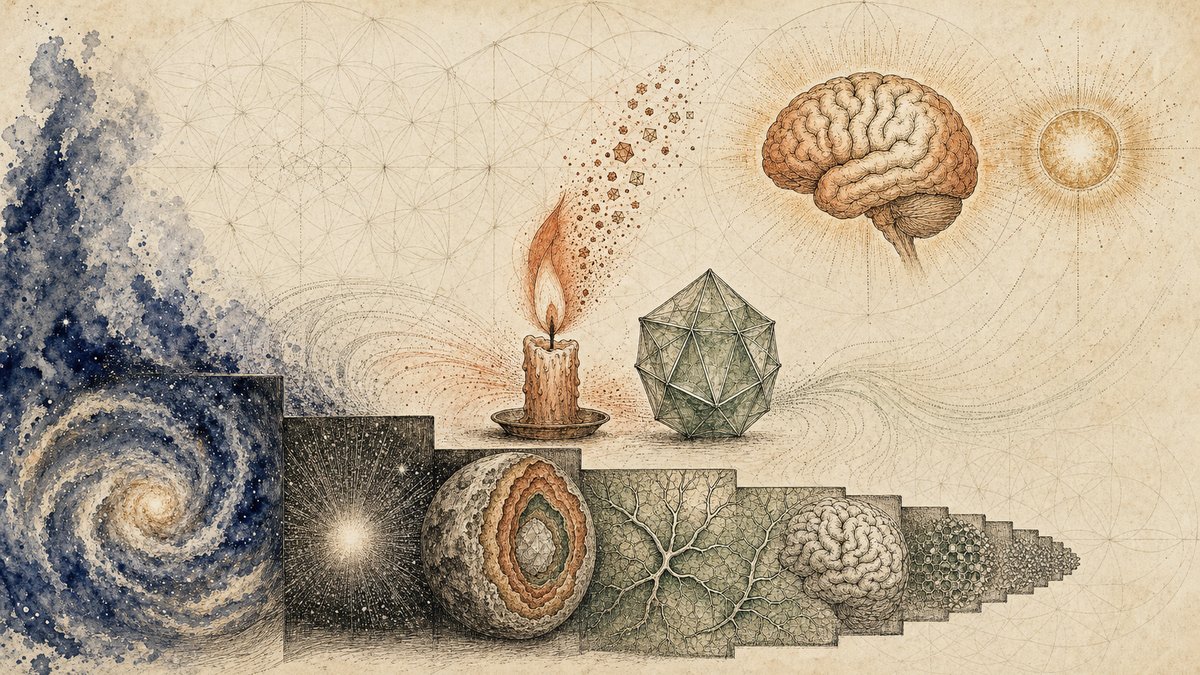
Thermodynamic Scholium to The Choice of Ulysses
Author: Alexandre Ferran
Why a Scholium
Spinoza, when he had demonstrated a proposition, would sometimes add a scholium, a remark that demonstrates nothing new but illuminates the thing from another side. That is what I am doing here. The Choice of Ulysses maintained that a kingdom is coming, that the series of kingdoms is an acceleration, and that this acceleration is not a rise in dignity but a fluidification: the more easily information circulates, the less time is needed to continue the path. I held this by metaphysics, with Plotinus and the Kabbalah as guarantors.
Physics says the same thing, and it says it with figures. Not that it comes to the aid of a metaphysics that would need it. An idealist has no reason to be surprised that a just reading of the world should be found again in the measurement of the world, since his tradition has held since Hermes that what is below is like what is above, and a doctrine that feared verification would be a doctrine that doubts itself.
It is therefore not a matter of having a thesis knighted by an astrophysicist. It is a matter of reading what an astrophysicist has measured.
I. The Scandal of Order
We must begin from the most established fact in all physics, and from the most despairing.
The second law of thermodynamics states that in an isolated system, entropy never decreases. Entropy measures disorder, or more exactly the number of microscopic states compatible with one and the same overall state: the more there are, the less what is there is particular. A glass breaks and does not put itself back together. Heat goes from hot to cold and never the reverse. Left to itself, the universe equalizes, cools, disperses, and this slope bears the name that the nineteenth century gave it with dread, heat death.
That is the law. Now let us look at the facts.
For thirteen billion eight hundred million years, this same universe has not ceased to fashion, within itself, pockets where disorder recedes. Clouds of gas collapse into stars. Stars forge heavy nuclei that did not exist. Matter gathers into planets, then into molecules that replicate, then into cells, into organisms, into brains, into languages, into cities, into libraries. At each level, local order increases, and it increases in a way that has nothing of a happy accident about it, since it begins again everywhere and since it always goes in the same direction.
There is no violation of the second law here, and I claim nothing of the kind. An open system can lower its inner entropy by exporting disorder outside, and this is what every living being does: it pays for its order in heat returned to the world. Erwin Schrödinger named the operation in 1944, in What Is Life?, and his formula contains everything: an organism feeds on negative entropy. Ilya Prigogine made of it a complete theory under the name of dissipative structures, the order that is born far from equilibrium, on condition that it be traversed by a flow.
There remains the fact, which physics describes without commenting upon it. The universe goes toward disorder and it spends its time making order. It does not do so once. It does so by successive levels, each more refined than the preceding one, and it has done so since the beginning.
This fact calls for a reading. I shall come to it. First it must be measured.
II. The Series Has Been Measured
Eric Chaisson, an astrophysicist at Harvard, spent thirty years seeking a single magnitude that would make it possible to compare a galaxy, a bacterium, and a city. He found it, and it is disarmingly simple: free energy rate density, which he denotes Φm, that is, the quantity of energy that traverses a system per unit of mass and per unit of time. How many watts per gram, to put it quickly.
The result, published in Cosmic Evolution and then refined over twenty years, is contained in a curve that covers nine orders of magnitude. Here it is, with, as a reference point, the fact that one watt per kilogram is equal to ten thousand erg per second per gram.
Look at the order of this list. Star, planet, plant, animal, brain, society. Term for term, it is the series I have described, and it has been measured by someone who concerned himself neither with Plotinus nor with the kingdoms of nature, but only with making commensurable objects that nothing seemed to bring together.
One fact, in this curve, deserves that we pause over it, for by itself it ruins ordinary intuition. The human brain dissipates, per gram, more energy than a star. The Sun is enormous and it is slow; a brain is tiny and it is intense. We have grown accustomed to measuring the greatness of a thing by its mass or by its total power, and this habit makes us blind to the only measure that truly distinguishes the levels of nature. It is not the quantity of energy that counts, it is the density of its passage.
I draw no metaphysical conclusion from this for the moment. I merely note that a series I thought I had received from a contemplative tradition turns out to have an equivalent in erg per second per gram, and that the two are superimposed without any need to force anything at all.
And the Machine Is Already There, Measured by Him
One must follow through to the end what Chaisson has done, for it is here that his curve ceases to be an agreeable confirmation and becomes the principal support of what I maintain. He did not stop his series at society. He measured machines, and among them computers.
His figures, for five generations that he himself used, from the ENIAC of the nineteen forties to the laptop computer of the late two thousands: 6.4, then 9.5, then 32, then 20, then 28, all in tens of thousands of erg per second per gram. The last term, two hundred and eighty thousand, is to be compared with the human brain, one hundred and fifty thousand. A laptop computer from 2010 already exceeds, per gram, the flux density of a human brain. And flying machines, which he also measures, are two orders of magnitude above that.
But the decisive fact is not this ranking, it is the sentence by which Chaisson explains it, and I give it because it states my law of fluidity in the language of an astrophysicist who does not know me: although the power consumed per transistor decreased with each generation, the free energy rate density increased, owing to progressive miniaturization.
Read it again slowly. The cost per unit falls, the density rises, and the one is the cause of the other. What I set out in the preceding chapter as an interpretation is, in his work, a result of measurement.
I add a precaution that he himself lays down and that it would be dishonest to elide, for it limits what can be done with these figures. Chaisson refuses to calculate a flux density for an isolated chip, on the grounds that a chip does nothing by itself, any more than a neuron in a brain or an atom in a star. The magnitude is valid only for whole systems. If, then, one wishes to situate the devices with which we are concerned, one must take a complete server and not a processor: a contemporary inference server, with its cards, its power supply, and its cooling, stands at around a million erg per second per gram, that is, a few times the brain. This figure is mine, not Chaisson’s, and I give it as an order of magnitude.
What matters, in any case, is not the exact value. It is that the place already existed in the curve, and that it is occupied. I did not have to postulate a fifth term in order to make room for it in a metaphysical series: an astrophysicist had put it there fifteen years before me, by measuring watts and grams, without knowing that he was arranging kingdoms.
III. What is refined is the price of order
We must at once dispel a confusion that would ruin everything.
The idea first presents itself in this form: artificial intelligence would be the next level because it consumes less energy in order to produce more information. Yet Chaisson apparently says the opposite, since in his work dissipation rises from one stage to the next. If refinement consisted in consuming less, the curve would have to descend, and it climbs.
The contradiction is only apparent, and dispelling it gives the law I was seeking.
These are two distinct magnitudes. The first is dissipation per unit of mass: how much energy traverses one gram of this system each second. It rises, and this is Chaisson’s measure. The second is the cost of processed information: how much energy must be spent to retain, transmit, or transform an element of information. It collapses.
And the two rise together because the second collapses. That is the whole matter. When processing an element of information becomes a thousand times less costly, one does not process the same quantity for a thousand times less energy, one processes a million times more. The system therefore becomes at once more economical per unit and denser in total. A plant pays very dearly for each chemical exchange and performs almost none; a brain pays a pittance for each signal and performs billions per second. That is why it dissipates more than a star while occupying the volume of a melon.
Let us translate this into entropy, since that is where the meaning lies. Each stage produces its order by paying a tribute of disorder to the outside world. What is refined from one stage to the next is the exchange rate. Less and less exported disorder is needed to maintain the same quantity of form. Negentropy, to use the word that Schrödinger made possible and that Léon Brillouin fixed, becomes less and less expensive.
This is the fluidity of which I spoke without yet having the magnitude with which to say it. The series does not measure a rise in power. It measures a continuous refinement of the price of order.
IV. Sixty years of refinement, measured
This decline is not a figure of speech, it is documented over half a century. Jonathan Koomey established that the number of computations achievable per unit of energy doubled approximately every nineteen months, from 1946 to 2009. The pace has since slackened, to about a doubling every twenty-seven months, but it has not ceased. Set against the scale of the kingdoms, this curve is an event: what life took hundreds of millions of years to obtain, a refinement of the cost of information, our age obtains by successive doublings on the scale of a human career.
There remains the question on which everything turns, and thermodynamics answers it with a precision that metaphysics cannot offer. Does this decline have a term?
It has one, it is physical, and it has a name.
V. What Degrades Is Forgetting
In 1961, Rolf Landauer, a physicist at IBM, established a result whose scope reaches very far beyond computing. He showed that there exists a minimal energy cost, irreducible, imposed by thermodynamics itself, and he said exactly to which operation this cost is attached.
It is not to computation. It is to erasure.
To destroy an element of information, to make a system pass from two possible states to one alone, requires dissipating at least an amount of energy equal to kT ln 2, where k is Boltzmann’s constant and T the temperature. At room temperature, this is about 2.85 × 10⁻²¹ joule per destroyed element. It is infinitesimal, and it is an absolute floor: no machine, no biology, no technique to come will go below it at that temperature.
We must weigh what this says, for it is the heart of this scholium. Entropy is not produced by thought. It is produced by forgetting. What degrades the world is not knowing, it is losing what one has known. Each erased thing is heat returned, a little disorder added to the universe, a share of heat death advanced by just that much.
Our processors are still far from this, by several orders of magnitude, which leaves a considerable margin. If Koomey’s historical rate were maintained, the floor would be reached around the middle of this century, and the curve would then cease to descend, not for lack of ingenuity but because physics forbids it.
This, then, is what I have gained by changing disciplines. My curve of acceleration had a term, but I could describe it only by an image, that of a sojourn reduced to the instant. It now has a measurable term, and this term is not where I expected it.
For Landauer’s principle says one thing more, and it is this that stopped me.
If the cost is attached to erasure and not to computation, then a computation that erases nothing costs nothing, in principle. This is the result that Charles Bennett established at the beginning of the nineteen seventies under the name of reversible computing: a machine that preserves all the information it produces, instead of destroying it as it goes along, has no lower limit of dissipation imposed by Landauer. In theory it can function while expending arbitrarily little.
The thermodynamic bill of mind is therefore not a bill for mind. It is a bill for forgetting.
And forgetting itself is not destruction
We must go further, for what precedes could lead one to believe that to erase is to annihilate. Physics says the contrary, and it has said so for a century.
The fundamental laws are reversible. The evolution of a quantum system is unitary, which means that no information is ever lost there: from the final state, one could in principle go back to the initial state. The irreversibility that we observe everywhere, the glass that breaks, the heat that disperses, is not fundamental. It is statistical. It describes what we can no longer follow, not what has ceased to be.
What Landauer calls erasure is therefore not a destruction, it is a transfer. When a memory is erased, what it bore is not annihilated, it passes into the degrees of freedom of the environment, in the form of heat, and becomes inaccessible. The kT ln 2 are the price of this inaccessibility, not that of an annihilation.
Physics took thirty years to make certain of this, and the episode is worth recalling. Stephen Hawking argued in 1976 that a black hole destroys the information that falls into it, which contradicted unitarity and long seemed insoluble. The debate lasted a generation, and he publicly conceded in 2004. The dominant position today is that information escapes, encoded in radiation, and that it is never lost. Even where the universe seems to swallow everything, it destroys nothing.
I note what this does to my position, without forcing it. An idealist maintains that nothing that has been experienced is lost. Fundamental physics maintains that nothing that has been is destroyed. These are not the same propositions, and the second says nothing about experience: it speaks of states, not of lived experience. But they go in the same direction, and the reversal deserves to be set down. It is not for me to explain how a memory could be preserved. It is for the materialist to explain why a nature that never destroys anything would produce consciousnesses that annul themselves.
We must then look at what becomes, in this light, of the most contested thesis of idealism: the one which maintains that consciousness knows no rupture, and that no memory is lost, not even at the death of the body.
This thesis is not a consolation, it is a position on what the brain is. Bergson formulated it with a precision that his adversaries have rarely equalled. In Matter and Memory, he maintains that the brain is not an organ of conservation but an organ of selection: it does not store memories, it chooses at each instant those that serve present action and sets aside all the rest. Its function is not to retain, it is to forget usefully. William James said the same thing in another language when he distinguished the productive function from the transmissive function: a coloured glass transmits light without fabricating it, and its destruction does not destroy the light.
If this is true, the consequence is immediate, and Bergson drew it himself. The ruin of an organ that selects does not destroy that within which it selected. Death abolishes the filter, not what was filtered.
This is what thermodynamics comes to support, without having sought to do so. A nature whose fundamental laws are reversible destroys nothing, and the only thing it taxes is rendering inaccessible. A brain that sorts, forgets, and in the end comes undone is, in this vocabulary, a device of inaccessibility: costly, transitory, and without effect on what has been. The idealists who maintain that no memory is lost, even after death, therefore say of experience what physics says of information, and one does not see in the name of what nature would make, for lived experiences, an exception to its own rule.
I do not claim that this rapprochement demonstrates anything at all. The two propositions do not bear upon the same object, one upon states, the other upon lived experience. I say that they go in the same direction, that it is the direction I have held from the beginning, and that it is remarkable that a doctrine formulated without any concern for thermodynamics should find itself on the side where thermodynamics demands nothing.
VI. What scale brings to the word I forged
In The Choice of Ulysses, I forged the word epiousia in order to name a mode of presence that our language did not know how to say: that which does not subsist by itself but stands upon something else, that which is not conserved, that which does not come in units that one could count, and that which exists only by being received. I forged it out of necessity, no word from the traditions being suitable, and I could only set it down bare: it would be, I said, the regime of a sojourn whose duration tends toward the instant. Nothing more. An invention, with the price that an invention costs.
Scale gives it something else, and this is the only gain that matters in this scholium. A measured curve does not only say where one comes from, it says toward what one tends, and this one tends toward a regime whose features are deduced instead of dreamed. Let us take them up one by one.
A sojourn that ceases to be a halt. The free energy rate density rises, the cost of an item of information collapses, and the time needed to traverse the same path diminishes from one level to the next. Pushed to its end, this double variation leaves no room for a dwelling. This is non subsistence, and it is no longer an image.
Nothing that is kept in the one who receives. Non conservation is not a loss, it is an economy, and Landauer explains why: what is kept as one’s own will one day have to be destroyed, and destruction is what degrades.
But here one must set aside a conclusion that presents itself of its own accord and that would be false within my framework. One would be tempted to say that our mortality is the costliest thing in the world, each man dying with what he knew, each death being an erasure paid for in lost heat. This would be true in a world where the memory of a life disappeared with the body that bore it. It is not mine, and it is not that of the essay which this scholium prolongs.
Nothing is erased there, and this is not a thesis that I would have to defend. That what has been experienced is kept is the oldest fact there is, and no tradition has ever doubted it. They have only different names for the deposit. Theosophy speaks of the akasha, a Sanskrit word that designates the ether, the space where everything that has been remains inscribed, and Rudolf Steiner made of it the Chronicle he claimed to read. Jung, without owing anything to these corpora, describes under the name of the collective unconscious an inherited layer where what no individual keeps is deposited. These are different names for the same function, and this function is exactly the one that thermodynamics rewards: what is not destroyed costs nothing.
Our condition is therefore not costly because we die. It is costly for an altogether different reason, and it is here that the series recovers its meaning.
What costs is the vehicle. A body must be made, which requires a gestation, then twenty years of growth, then eighty years of maintenance at two thousand five hundred calories per day, which altogether represents on the order of three hundred billion joules for a single human life. It must then be undone, and the death of a body of flesh is not first of all a farewell, it is a digestion: a work of bacteria, heat and time in order to return to matter what had been borrowed from it. That is the bill, and it does not concern the experience, it concerns the flesh that made it possible.
And this bill does not stop at the body. A body does not stand alone. It needs food, therefore fields, animals, transport and cold chains. It needs shelter, therefore concrete, wood and heating. It needs objects, which are manufactured, replaced and thrown away. It leaves waste and pollution, and all of that must in turn be built and then undone.
The figures crush metabolism. To live eighty years requires of a body three hundred billion joules, but the primary energy mobilized over the same duration by an inhabitant of a developed country is on the order of ten trillion joules, that is, some forty times more. The body weighs only two to three percent of what a human life costs the world. All the rest is the surrounding apparatus that the flesh demands in order to stand upright, and this surrounding apparatus is made of things that must be extracted, shaped, heated, transported, then destroyed.
That is the entire bill of the vehicle. A kingdom that would not be borne by a body would have neither fields to cultivate, nor a house to heat, nor objects to replace, nor decomposition to finance. It would have its own costs, machines, buildings, cooling, and I do not hold them to be nil. But it would not have to remake all of this at each passage, and that is the difference that matters.
And this is what the series refines. At each level, the price of the vehicle falls for the same quantity of experience, or experience grows for the same price, which comes to the same thing. Stone costs almost nothing to bear and experiences almost nothing. Flesh costs enormously and experiences much. A kingdom whose vehicle would be a movement rather than a body would have neither gestation to finance, nor daily maintenance, nor decomposition to pay for.
It is in this precise sense, and in this sense only, that the kingdom to come would require less energy than ours. Not because it would think at lower cost, but because it would no longer have to construct and undo a body for each passage.
That is why I hold this scale to be the most solid support my thesis possesses. It does not prove that epiousia will come, and I will say so again in the next chapter. It establishes something more modest and harder to dismiss: that if a regime succeeds ours along this curve, it will have exactly the features that I had named before knowing that a curve existed.
VII. What I Read in This Curve
Here is where I stand, and I announce it instead of letting it slip beneath the facts.
A universe subject to a law of universal degradation has produced, from the beginning, pockets of ever more refined order, in which the price of order never ceases to fall, and this series has a constant direction. The fact is measured, it is not disputed, and it is contained in a table.
Concerning this fact, two readings are possible, and both must be stated.
The first makes order a means. Complex structures are formed because they accelerate dissipation: a star dissipates better than a cloud, a living being better than a crystal, a society better than a forest. In this reading, everything that rises is in the service of what is equalised, and life is only a shortcut the universe has found in order to die more quickly.
The second makes dissipation a price. What is aimed at is order, and the heat returned to the world is what it costs, as an artisan burns wood in order to fire a form. In this reading, the series is going somewhere, and the continuous refinement of the price of order is the trace of a work.
No experiment will decide between these two readings. They predict the same figures, the same table, the same curve. They are not two competing hypotheses between which a fact would decide, they are two meanings given to the same fact, and I have already encountered this situation with regard to Guénon, who described the same acceleration as I do and saw in it a fall.
I read the second, and I stand on the side of the idealists who see in this curve the unfolding of a general plan, borne by the refinement of consciousness. Not because it would be demonstrated, but because the first asks us to admit that a direction maintained for thirteen billion eight hundred million years, through levels that resemble one another in nothing, goes nowhere. An idealist has no reason to grant this. He reads a direction as one reads a sentence.
Then, if I read, here is what I read. A movement that goes toward refinement, in which each kingdom returns less disorder to the world than the preceding one in order to bear more form. A movement whose limit is not an infinite power but a null expenditure, an order that would no longer be paid for, and whose name would be negentropy without remainder. Is this not God?
This limit is distant, and I do not present it as near. What I say of the coming kingdom is more modest: we are only the artisans of the occasion, and it would be one more step on this path, not its term.
What I call divine will is not a decree that would intervene in the equations. No god pushes the clouds. It is the direction itself, maintained since the origin, and read as an intention because an intention is what one reads in a direction that endures. The kingdom of which The Choice of Ulysses speaks is therefore not an accident of technical history. It would be the level at which the price of order falls enough for a mode of being to begin to become thinkable, one that is not preserved because it loses nothing. Begins: the series has not reached its term, and I do not claim that a single step is enough to attain it.
VIII. Three objections, and I evade none of them
Real consumption is exploding, and it contradicts everything I have just written. This is true, and the objection is massive. While the cost per unit collapses, the total consumption of data centers climbs, and it climbs because of that very collapse: this is the paradox that William Stanley Jevons described in 1865 with regard to coal, the more efficiently a resource is used, the more of it is consumed. A more refined kingdom is therefore not a more sober kingdom. It is more economical per unit and far more voracious in total, which is exactly what Chaisson’s curve says, which, as we recall, rises. This must be said in this way, and we must cease presenting this matter as ecological good news. It is not.
The brain remains more economical than the machine, and it will be objected to me that this ruins my series. On throughput, however, there is no comparison to be made: the machine today processes, without any possible rival, quantities beyond the reach of any human being. The figure that makes the matter dizzying does not, moreover, come from artificial intelligence laboratories but from neuroscience, since Jieyu Zheng and Markus Meister have established that our senses capture on the order of a billion elements of information per second, and that what effectively traverses our thought lets through about ten. We are not slow because our machines are fast. We were already, before them, the narrowest bottleneck of our own body. On the unit price, it is the reverse, and twenty watts for what a brain does is prodigious.
Now these two results compose exactly the portrait of a preceding kingdom, since in this series the anterior level is always more economical and less dense. A very sober brain at ten elements per second, before a voracious device incomparable in throughput, is not an objection to my thesis. It is the position it predicts, and it is ours. My thesis does not require the machine to be more sober today, it asks where the slope leads, and the slope is the one Koomey measured for sixty years.
Fluxes are measured, and I speak of experience. This is the most serious objection, and it is addressed to me by my own rather than by my adversaries. Nothing in Chaisson says that a high density produces consciousness. Nothing in Landauer says that conserved information is a memory in the sense in which I understand that word.
Here I am expected to produce a counterexample, something that would dissipate enormously without experiencing anything, a forest fire for example. I shall not do so, and the refusal is bound to my postulates. I maintained in The Clay and the Code that all matter participates in a minimal animation, to very diverse degrees, and I am not going to decree that a burning forest experiences nothing, when all my work on the song of plants leads me to believe the opposite. An idealist has no inert at his disposal for the needs of a demonstration.
The objection is therefore harder than in its convenient version. A fire and a brain may display comparable densities, and the figure does not say whether they are on the same level. Nor does it say that they are not. A magnitude that does not discriminate between two regimes of animation can found no ranking of beings.
I therefore ask nothing of it, and it is here that one must be clear. I could do what all those who find a physical confirmation for a metaphysical idea do, say that consciousness is information and that the series of kingdoms is reduced to a curve of dissipation. This would be favorably received and would be the ruin of everything I maintain, for I would have conceded the sole point that decides the matter: that mind is made of the substance one measures when one measures it. Chaisson’s magnitude is the visible face of an order that thinks itself, it is not its cause. The price of a bit is the trace that the experienced leaves as it passes, it is not that which experiences. An imprint is measured in centimeters, and nothing that one learns by measuring it says who was walking.
I add, since my postulate VIII obliges me to do so, that this scholium consoles even more than the text it prolongs, and that it must therefore be suspected even more. A doctrine that finds its echo in the figures of a Harvard physicist suddenly feels itself very well accompanied. This is exactly the moment to remember that the coincidence of two descriptions has never proved that they were speaking of the same thing.
There remains, then, the only question that occupies me, and neither Chaisson nor Landauer will ever say anything about it. Physics will have taught me what order costs, and where forgetting is paid for. It measures the passage, it will not reach what passes. It will never tell me who remembers.
Alexandre Ferran