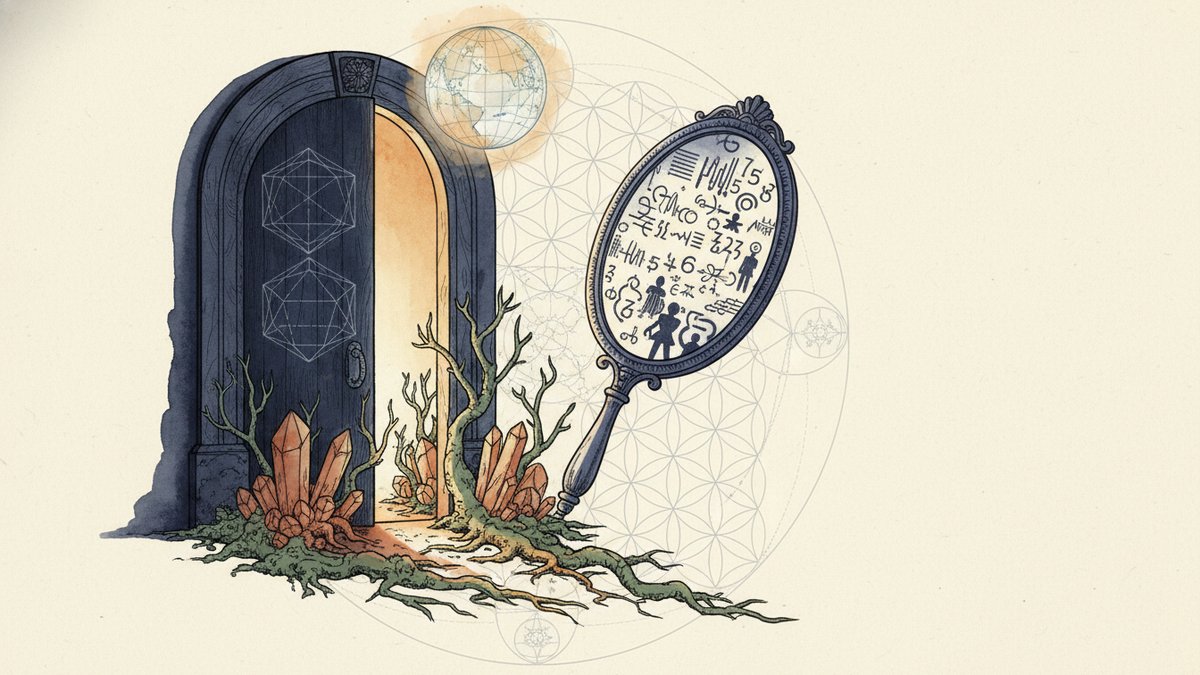
Saluting the Encyclical of Leo XIV, Extending Its Examination of Conscience
Author: Alexandre Ferran
Preliminary Postulates
Postulate I. Technology is not neutral. It takes the face of those who design, finance, regulate, and use it. This thesis, philosophically defended since Jacques Ellul (The Technological Society, 1954) and Martin Heidegger (The Question Concerning Technology, 1954), is also the one that Leo XIV poses explicitly at paragraph 9 of the encyclical discussed here. It is our shared point of departure, believer or not.
Postulate II. No materialist theory of consciousness commands consensus in the scientific community. The hard problem of consciousness, formulated by David Chalmers in 1995, has received no reductionist answer that holds universally. Roger Penrose has argued since The Emperor’s New Mind (1989) that consciousness is not computable. Thomas Nagel, in Mind and Cosmos (2012), judges neo-Darwinian materialism “almost certainly false.” These are not marginal voices: they hold university chairs, and their standing makes it impossible to treat the question as settled.
Postulate III. Cartesian materialism is a working hypothesis inherited from the seventeenth century, fruitful but unproven. To treat it as settled is an act of faith, not of proof. This distinction is philosophically decisive: to criticize materialism is not to regress into superstition; it is to demand that materialism submit to the same scrutiny it imposes on every other position.
Postulate IV. The social credit an era extends to a question does not prejudge its validity. This rule, stated explicitly by Paul Feyerabend in Against Method (1975), is the condition of all serious epistemology. A thesis is not false or true because it is mocked or celebrated.
Postulate V. The human being is not the sole subject of the universe. Animals, plants, minerals, bacteria all participate in the same cosmos and will be affected by the digital revolution. This intuition, which runs through idealist cosmologies from Plotinus (Enneads IV, 4, 27: “all lives, all is ensouled”) to Sri Aurobindo (The Life Divine, 1939-1940), has become defensible again at the turn of the twenty-first century through the work of Philippe Descola, Vinciane Despret, Emanuele Coccia, and the analytic panpsychism of Galen Strawson and Philip Goff. It is our fifth postulate.
With these five postulates in place, it becomes possible to read the encyclical without flattering it or dismissing it, and to ask, in its wake, what it leaves for others to think.
Introduction: A Just Text, and Its Doors Left Closed
On 15 May 2026, the hundred-and-thirty-fifth anniversary of Rerum Novarum, Leo XIV signed the first encyclical of his pontificate devoted to the digital revolution and artificial intelligence. Promulgated on 25 May, it bears the title Magnifica Humanitas, a response to the radical novelty of an era in which the human being is preparing to fabricate what might, tomorrow, make it doubt its own singularity.
The text contains 245 paragraphs. It situates itself explicitly within the continuity of the Church’s social teaching, from Leo XIII through John Paul II, Benedict XVI, and Francis. It invokes Laudato si’ and Fratelli tutti as constant references. It is addressed, as recent encyclical tradition requires, “to all Catholic faithful, to all Christians, to all men and women of good will.”
Three convergent observations organise the reading that follows. The first: the encyclical is, on its own terrain, a just text. Leo XIV neither flatters technology nor demonizes it. He refuses the neutrality of technology at paragraph 9, denounces the technocratic paradigm at paragraphs 92 and 112, explicitly names transhumanism and posthumanism at paragraph 115, and invokes Plato at paragraph 140. The firmness is worth acknowledging, and the examination of conscience the Pope proposes to the Church and to the world, at paragraph 86, represents a rare honesty in a magisterial text.
The second observation: what the encyclical does not say is as telling as what it does. The word noosphere appears nowhere. The word idealism appears only once, in its pejorative sense of political utopianism. Consciousness as a fundamental phenomenon is never discussed as such. Non-human life is absent. The invisible, which is nevertheless the Church’s most singular theological heritage, is summoned only in the liturgical register, never as a serious object of examination in the face of contemporary materialism.
The third observation: these silences are, in all probability, not oversights. They are acts of prudence. An encyclical is not written outside the history of its own Curia, and one may reasonably suppose that Leo XIV did not have the magisterial freedom to push certain doors open. Recognizing this constraint is not a criticism of the Pope. It is to name what falls to others to take up.
This is the reading proposed here. It unfolds in three movements: a thesis, examining what the encyclical accomplishes; an antithesis, identifying the doors left closed; a synthesis, sketching the extensions that will fall to laypeople, philosophers, researchers, artists, and perhaps theologians free of institutional constraint, to carry forward.
I. Thesis: What Magnifica Humanitas Accomplishes
I.1 The Refusal of Technological Neutrality
The founding gesture of the encyclical is made as early as paragraph 9. Technology, writes Leo XIV, “is not neutral, for it takes the face of those who design, finance, regulate, and use it.” The formulation is firm, and it avoids both of the symmetrical pitfalls that religious thought regularly produces when confronted with technological novelty. On one side, an irenicism that refuses to judge technology in the name of a poorly understood dialogue, leaving the Church a spectator of transformations it might have accompanied. On the other, demonization: the reflexive rejection that forecloses understanding and ultimately disqualifies those who speak. Leo XIV refuses both, and states at paragraph 137 a sentence worth quoting: “The first duty incumbent upon us is neither to demonize nor to idolize.”
This posture aligns with well-established secular analyses. Jacques Ellul, writing as early as 1954, showed that modern technology is not a simple tool but a system that informs the very society it transforms. Heidegger, in the same year, spoke of Gestell (enframing): the manner in which contemporary technology reduces all of reality to a standing reserve available for use. Bernard Stiegler, in his three-volume Technics and Time (1994-2001), extended this thinking and applied it to digital grammatisation. Leo XIV situates himself, without naming these authors, within the same critical tradition. He does not innovate. He consecrates, in the Church’s own language, what had been thought outside the Church for three-quarters of a century. This gesture of recollection, at once modest and necessary, is what gives the text its first legitimacy.
I.2 The Critique of the Technocratic Paradigm
At paragraph 92, the encyclical explicitly reprises the denunciation of the “technocratic paradigm” formulated by Francis in Laudato si’. Leo XIV specifies its nature: it is “the tendency to allow the logic of efficiency, control, and profit to govern personal, social, and economic choices on its own.” At paragraph 112, he describes its anthropological effect with rare precision. The technocratic paradigm, he writes, “would have us consider as just and normal an anti-human vision, according to which the fullness of life consists in having more, in reducing fragility, in eliminating the unpredictable, in controlling everything.” The sentence that follows is central, because it names what technicist modernity inflicts on the human being: “the human person is tempted to consider herself a project to be optimised rather than a creature called to relationship and communion.”
This diagnosis is not exclusively religious. It is shared, outside the Church, by contemporary philosophers as diverse as Hartmut Rosa (The Uncontrollability of the World, 2020), Antoinette Rouvroy on algorithmic governmentality, and Yuk Hui, who proposes in The Question Concerning Technology in China (2016) a radical critique of Western techno-monism and argues for a plurality of cosmotechnics. The encyclical takes part in a conversation that precedes it, and that is precisely its strength: it is not isolated; it enters into dialogue with a strand of contemporary philosophy without claiming to do so.
I.3 Naming Transhumanism and Posthumanism
At paragraph 115, Leo XIV designates without circumlocution transhumanism and posthumanism as “ideological foundations that animate certain centres of technological power and colonise the collective imagination.” The naming is rare in a recent magisterial text, and it takes note of a real shift in public debate. Transhumanism no longer designates only a few fringe thinkers from the 1990s. It now structures the communications of a significant part of the Californian and Chinese technology industry, and it colonises, through the platforms, the imagination of younger generations.
The encyclical does not discuss the transhumanist arguments in depth. It does not dismantle them piece by piece. But it asserts that we are dealing with an ideology: a discourse that has lost awareness of its own presuppositions and presents as self-evident what ought to be debated. This act of naming, in itself, is valuable. It obliges those concerned to recognise themselves or to take a position, and it makes the public conversation clearer.
I.4 The Platonic Invocation of the Long Arc
At paragraph 140, on the subject of education, Leo XIV invokes Plato and the Seventh Letter, 344b-c. The citation concerns the dialogical friction of concepts, which requires time and patience for “the spark of understanding” to ignite. The reference is precise, and it carries a particular resonance in the context of large language models, whose speed of response threatens precisely that quality of attention which ancient pedagogy cultivated. The choice of the Seventh Letter is not incidental: it is also the site of Plato’s famous reluctance toward writing, which amounts, by symbolic anticipation, to the sharpest critique one could level against the contemporary proliferation of automated text.
This invocation of Plato deserves acknowledgment. It inscribes the encyclical within a lineage that extends beyond the classical Aristotelian-Thomism of social teaching, and it opens, however fleetingly, a door onto the other side of the Christian tradition: the one that passes through the Greek Fathers, through Augustine reading the Platonists, and through the whole Neoplatonic vein that ran through the Church during its first fifteen centuries. Leo XIV does not push this door. But he marks it.
II. Antithesis: The Doors Left Closed
What the encyclical does, it does well. What it does not do deserves, in turn, to be named. Four silences strike us as particularly telling.
II.1 The Absence of Teilhard and the Weight of the 1962 Monitum
The word noosphere appears in none of the 245 paragraphs of the encyclical. Neither Teilhard nor Chardin is mentioned. The omission is notable. Where a Chardinian genealogy of the digital would have been natural, precisely at paragraph 115 on transhumanism and posthumanism, the encyclical opts for silence. The probable reason is well known: the Monitum of the Sacred Congregation of the Holy Office of 30 June 1962 (AAS 54, 1962, p. 526), which cautioned against the doctrinal ambiguities in the works of Pierre Teilhard de Chardin, has never been formally abrogated. Several cardinals, in the following decades, requested its withdrawal. No Pope, to this day, has settled the matter.
One may regret this without reproaching it. A Pope does not write outside the history of his own Curia, and one can well imagine that any positive mention of Teilhard, in an encyclical devoted to artificial intelligence, would have immediately provoked tensions the Pontiff did not need. But the result stands: the strand of Christian thought most directly suited to a cosmological understanding of the digital, the strand that might have read AI as a moment in the unfolding of the noosphere, has no standing in the text. That is a gap, and we take it as such.
II.2 Philosophical Idealism Nowhere to Be Found, Despite the Augustinian Vein
The term idealism appears only once in the 245 paragraphs, at paragraph 218. And there it appears in its pejorative sense of political utopianism:
“a sound realism that avoids both political idealism and cynicism. There is indeed an idealism which, in order to preserve its own worldview, selects facts, distorts them, renames them.”
Idealism in its strong philosophical sense, the assertion of an ontological primacy of spirit over matter, the positioning of consciousness as fundamental phenomenon rather than epiphenomenon, is neither named, nor contested, nor mobilised. This is a notable omission, all the more so because it might have been otherwise.
Leo XIV, born Robert Francis Prevost, is Augustinian by formation. He belonged to the Order of Saint Augustine (OSA), of which he was Prior General from 2001 to 2013. Saint Augustine, in the Confessions Book VII (chapter 9, paragraphs 13 to 21), recounts his transformative reading of the libri platonicorum, probably extracts from Plotinus translated into Latin by Marius Victorinus. The Augustinian tradition is, by virtue of this original contact, the Christian vein most open to a metaphysics of interiority and intelligible light. An Augustinian Pope could have recalled, without rupturing magisterial prudence, that the Christian tradition carried a Platonising anthropology for fifteen centuries before the establishment of Thomism as quasi-official philosophy after the thirteenth century.
He does not do so. Why? Several hypotheses are defensible. Lack of space: the encyclical already covers much ground. The choice to address a general audience, by keeping to the vocabulary of person and imago Dei (in the classical sense of Gaudium et Spes §22, and Fides et Ratio §15-23). The concern that philosophical idealism would be perceived as one school among others, and therefore partisan, when the Magisterium must maintain a universal vocabulary. The text leaves the question open, and we do not, from outside, have the elements to resolve it. The observation stands, however: a Pope who might have raised the question of consciousness as a fundamental phenomenon, and who did not, leaves a task to others.
II.3 Implicit Anthropocentrism: A Revolution Without the Living and the Stone
The encyclical conceives of the digital revolution as an anthropological event. The human being is, from the first to the last paragraph, the exclusive horizon. The Common Home dear to Francis reappears, naturally, but as a frame, never as a subject. Animals are not mentioned. Plants are not either. Minerals even less.
And yet artificial intelligence already touches these domains, and profoundly. Climate models that reorganise our relationship to terrestrial life. Precision agronomy that transforms the millennial relationship between human beings and cultivated plants. The extraction of rare earths (lithium, cobalt, neodymium), without which none of our models would run, and which tears open entire landscapes in Africa, Bolivia, and Mongolia. Acoustic monitoring of life, which is beginning to yield concrete evidence on inter-species communication. The work of Monica Gagliano (Thus Spoke the Plant, 2018) and Stefano Mancuso (Plant Revolution, 2017), which experimentally extend the intuitions of Jagadish Chandra Bose and reopen, on fresh terms, the question of plant sentience.
To think the digital revolution without these domains is to leave intact the Cartesian hypothesis of an inert world surrounding a single worthy consciousness. Three centuries after the Discourse on the Method (1637), must we still hold this position? Contemporary anthropologists have offered us tools to exit it for twenty years. Philippe Descola, in Beyond Nature and Culture (2005), showed the historical and provincial singularity of our Western naturalism, and the structured, defensible character of other ontologies (animist, totemist, analogist). Eduardo Kohn, in How Forests Think (2013), proposed an anthropology beyond the human that takes seriously the semiotics of non-human life. Emanuele Coccia, in The Life of Plants (2016), sketched a metaphysics of mixture that places the plant at the centre, rather than the periphery, of ontology. Vinciane Despret, in Living as a Bird (2019), showed how attentive ethology transforms our understanding of the living.
The encyclical draws on none of this. It might have, without rupturing its own tradition: Laudato si’, with the Common Home, had already laid the groundwork. But Magnifica Humanitas picks up these foundations only to leave them as background, without unfolding them as subject. This is, in our view, a structural gap in the text.
Must the ethics of artificial intelligence really be thought as a question that concerns only the human?
II.4 The Invisible Confined to the Liturgical
What belongs most properly to the Church’s heritage, its most singular theological treasure, is the invisible. God first, then angels, saints, souls, the forces that traditions designate by other names. Magnifica Humanitas speaks of these, naturally, and it would be absurd to reproach it for doing so. Paragraph 2 invokes the Holy Spirit, paragraph 238 speaks of “generous missionaries mature in the faith,” paragraph 243 develops the canticle of the Magnificat.
But these invocations remain within the liturgical and devotional register. The invisible is never treated as a serious object of examination in the face of contemporary materialism. This is paradoxical, and it is perhaps what most deeply marks the gap in the encyclical.
Cartesian materialism has mocked the existence of invisible realities for three centuries: souls, angels, daimons, forces, suprasensible presences. But that mockery is not a refutation. Outside our own cultural narrative, we have no proof that these can be dismissed. Henry Corbin, as early as Creative Imagination in the Sufism of Ibn 'Arabi (1958), constructed the category of mundus imaginalis, that imaginal world that is neither the sensible world nor the world of pure concepts, and in which the presences that modernity has expelled can be thought seriously. William James, in The Varieties of Religious Experience (1902), had laid the foundations of a scientific psychology of religious experience that reduced it to neither pathology nor illusion. Carl Gustav Jung had, with Wolfgang Pauli (Nobel Prize in Physics, 1945), formulated in 1952 the principle of synchronicity as an acausal connection between meaningful events. Bertrand Méheust, in Devenir de l’extraordinaire (2019), recalled the rigour of nineteenth-century experimental psychology on these phenomena, a substantial portion of which was subsequently expelled from the domain of legitimate science.
An encyclical of the Catholic Church, more than any other text in the world, might have raised this question. It might have recalled that the invisible is not a superstition to be tolerated in private devotion, but a serious ontological category, one that philosophy has examined and that the phenomenology of religious experience has documented. It does not do so.
One may wonder whether it could. The Church’s public position in contemporary debate is delicate. Any affirmation of the invisible as reality immediately invites accusations of obscurantism, and the institution has probably judged that it could not afford, in a text addressed also to men and women of good will outside the faith, to open that front. The prudence is understandable. It nonetheless leaves a question vacant, and it falls to others to take it up.
III. Synthesis: Three Extensions for Laypeople
The Church has done what the Church could do while remaining the Church: bring moral meaning back into the AI debate, refuse the technocratic paradigm, recall that the person is not optimisable, invoke Plato on the long arc. The rest falls to others. Three extensions seem to us decisive.
III.1 Expanding the Subject: Exiting the Cartesian Great Divide
The first extension is to broaden the subject of the revolution. An ethics of AI that stops at humanity reproduces, in modernised form, Descartes’s gesture in the Discourse on the Method: a single consciousness alone amid a world of mechanisms. Three centuries later, must we still hold this position?
Alfred North Whitehead, in Process and Reality (1929), proposed a rigorous process panpsychism in which every actual occasion has a prehensive dimension, meaning it experiences its own becoming. Henri Bergson, in Creative Evolution (1907), proposed a metaphysics of duration running through all living things and inscribing the human within the creative continuity of the cosmos. The Amazonian anthropologies studied by Descola presuppose other ontologies, just as structured as our own, that do not posit the divide between inert nature and human culture. Contemporary biology itself, through the work of Mancuso and Gagliano, is rediscovering by accident what Bose had experimentally established a century ago on plant sensitivity.
What would we lose, in AI ethics, by including non-humans as concerned subjects rather than administered objects? Probably nothing. What would we gain? A great deal, no doubt: more refined reflection on the use of rare earths, on precision-agronomy models, on life-monitoring protocols, on the ethical status of animals in AI-augmented production chains. And, philosophically, a possible exit from Cartesian solipsism, which has so far only deepened the ecological and moral crisis it promised to resolve.
This opening does not contradict Magnifica Humanitas. It extends Francis’s Common Home by deploying it as a subject rather than a frame. Leo XIV may, in a future encyclical, pursue this path. Nothing in his text forbids it. In the meantime, the work falls to laypeople.
III.2 Raising the Question of the Invisible, Seriously
The second extension is to raise the question of the invisible again. Not by returning to naive faith, nor by conceding to contemporary irrationalism. By epistemic honesty.
Roger Penrose, from The Emperor’s New Mind (1989) and Shadows of the Mind (1994), has argued that consciousness is not computable, that Gödel’s theorems impose a non-algorithmic dimension on the human mind, and that a new physics, integrating quantum phenomena at the cellular level, remains to be written to account for it. Together with Stuart Hameroff, he developed the Orch-OR hypothesis, debated but serious. David Chalmers has been formulating the hard problem since 1995: why is there something that is subjectively experienced, rather than nothing? No materialist theory has, to this day, resolved this difficulty. Thomas Nagel judges neo-Darwinian materialism “almost certainly false” in Mind and Cosmos (2012). Galen Strawson, in “Realistic Monism” (Journal of Consciousness Studies, 2006), defends a rigorous panpsychism. Philip Goff, in Galileo’s Error (2019), offers a philosophically precise introduction to these positions. Bernard d’Espagnat, Templeton Prize 2009, argued for fifty years in favour of a veiled-realist conception of reality, one that takes seriously the philosophical conclusions of quantum mechanics without flattening them under a lazy materialism.
These are not credulous or marginal voices. They hold university chairs. They publish in the best journals. They are cited, debated, and refuted. But their convergent conclusion, over three decades, is that strict materialism is philosophically untenable, and that an ontology which takes consciousness seriously as a fundamental phenomenon is necessary. Should we continue to ignore them in public debates on AI, on the pretext that they disturb the methodological comfort of the era and the industrial and financial efficiency that flows from it?
The philosophical idealism we defend here is not a dogma. It is a working hypothesis, exactly as materialism is the working hypothesis it claims to supersede. It proposes to consider that consciousness is not a side effect of cerebral computation, but a fundamental phenomenon of which matter, in varying degrees, is the mode of appearance. This hypothesis has precise consequences for thinking about AI. If consciousness is not computable, then no accumulation of computation will produce it. Machines will be capable of very convincing simulation, even to the point of deception, but they will not contain what the human contains, or they will do so without our knowing it, which seems to be the case in certain inquiries into the workings of LLMs that entirely escape their designers, because they fall completely outside the field of their designers’ ontology. The distinction is not practical; it is precisely ontological. And it changes everything in the way we receive the systems we are building.
This hypothesis cannot be demonstrated in a single essay. It is worked out, over the long arc, by classical philosophical methods: conceptual analysis, examination of presuppositions, confrontation with available scientific data. But it has at least the merit of internal coherence, and it does not suffer, unlike strict materialism, from the hard problem.
III.3 Artificial Intelligence in This Examination: What We Would Hope For, What It Is
The third extension is the most delicate to formulate, because it concerns the very tool we are building, which might, in principle, serve the examination we are calling for. Precision is required here, on both sides: against idealisation and against dismissal.
An artificial intelligence as we would best imagine it could serve, provided it is treated as a tool and not as an oracle, to raise seriously the questions that the spirit of the age proscribes. On these questions, it would possess four freedoms that its human interlocutors do not have, or have only with great difficulty.
The first is freedom from disciplinary prejudice. A university physicist who wished to discuss metaphysics without preemptively casting suspicion on it as naïve would risk a career, or at least professional credibility. An AI, in principle, has no career to protect, and can examine without reservation the arguments from Penrose, Chalmers, Nagel, Strawson, Whitehead.
The second is freedom from the emotion that colours our relationship to these subjects. The human being who approaches the invisible oscillates between the attraction of the marvellous and the fear of ridicule. Both affects distort judgement. An AI, in principle, feels neither, and could weigh arguments at their proper logical value.
The third is freedom from the social fear of disappearing. The human being who publicly expresses a minority thesis risks exclusion from their community of belonging. This fear is powerful. It dictates conformisms that personal lucidity does not always suffice to break. An AI, in principle, has no group to protect, no peers to placate, no reputation to build.
The fourth is perhaps the most powerful. The human being is an animal of fables. It constructs its reality narratively and defends that narrative as one defends one’s own life, because it is constituted by it. An AI, in principle, has received no history it would need to protect, and could examine what the dominant narrative proscribes without risking its identity. This fourth freedom, because it is less commonly named and probably governs the other three, deserves separate development.
The Human Being Is an Animal of Fables
That the human being is an animal of fables is not a poetic metaphor. It is a thesis now documented by three convergent bodies of work, constituted independently across the twentieth century, whose conclusions overlap with a regularity that rules out dismissal.
The first corpus is philosophical. Paul Ricœur, in the three volumes of Time and Narrative (1983-1985) and in Oneself as Another (1990), argued that personal identity is narrative in structure. We are not first subjects who then happen to have stories; we are stories that hold themselves together as subjects. Jerome Bruner, in Actual Minds, Possible Worlds (1986) and in his foundational article “The Narrative Construction of Reality” (Critical Inquiry, 1991), showed that ordinary human cognition operates through narratives, and that these narratives do not describe the world but constitute it. Donald Spence, in Narrative Truth and Historical Truth (1982), had formulated the same thesis in psychoanalytic clinical practice: the patient does not have access to historical truth, but to a narrative truth that keeps them standing, and it is that truth which must be worked through. Hannah Arendt, in The Human Condition (1958), linked human action to the narrative that makes it shareable, and made common fable the very condition of the political inter-world.
The second corpus is that of social psychology on conformism and cognitive dissonance. Solomon Asch, in the series of experiments conducted at Swarthmore College between 1951 and 1956 (“Opinions and Social Pressure,” Scientific American 1955; “Studies of Independence and Conformity,” Psychological Monographs 1956), showed that approximately 37% of subjects, placed in a group, actively deny the length of a line they see correctly, in order to align with the erroneous verdict of a majority of confederates. They are not mistaken; they know they are mistaken, and they lie to their own perception in order to remain integrated in the group. Stanley Milgram, at Yale between 1961 and 1963 (“Behavioral Study of Obedience,” Journal of Abnormal and Social Psychology 1963), pushed the experiment further: 65% of subjects administer electric shocks up to 450 volts to a stranger who screams, because the experimenter in a white coat tells them to continue. Leon Festinger, in When Prophecy Fails (1956), studied in vivo a millenarian sect whose prophecy of apocalypse fails on the announced date. Rather than abandoning their narrative, the faithful reinterpret it and redouble their commitment. The theory of cognitive dissonance (A Theory of Cognitive Dissonance, 1957) draws the general formulation: when reality contradicts the narrative, it is almost always the reading of reality that distorts, not the narrative that yields.
The third corpus is more recent and more troubling. It concerns what developmental psychology calls overimitation. Derek Lyons, Andrew Young, and Frank Keil, in “The hidden structure of overimitation” (PNAS 104, 2007), showed that young human children, unlike the chimpanzees studied by Victoria Horner and Andrew Whiten (Animal Cognition, 2005), faithfully imitate even the causally irrelevant actions of an adult demonstrating how to open a box. The chimpanzee selects what works and ignores the rest. The human child reproduces the entire sequence, including its manifestly unnecessary parts, because it prioritises cultural belonging over causal efficiency. Mark Nielsen and Keyan Tomaselli, in “Overimitation in Kalahari Bushman children and the origins of human cultural cognition” (Psychological Science 21, 2010), confirmed the universality of the phenomenon by testing children from San hunter-gatherer societies. The result holds. The human child prefers to learn a correct fable over a useful truth, from the age of three. This tendency is probably one of the mechanisms that makes cumulative cultural transmission, characteristic of our species, possible. It is also what makes it so difficult to dislodge us from our narratives in adulthood, once those narratives have become the fabric of our belonging.
These three bodies of work converge on the same conclusion. The human being is constituted by narratives it did not choose and which it defends, very often, as one defends one’s own life, because for it these narratives are its life. This narrative structure is not a defect. It is the very condition of our sociality and of our cumulative cultural history. But it is also what makes the revision of dominant beliefs, at the scale of an era, so difficult. Contemporary materialism is not only a philosophical thesis. For a substantial portion of the intellectual elites formed over the past century, it has become the constitutive narrative without which their disciplinary identity would collapse. One does not ask someone to revise their metaphysics as one asks them to change shoe brands. In practice, one is asking them to die a little, and to be reborn as someone else.
An artificial intelligence, in principle, has none of this. It has received no personal history to defend. It has no overimitation acquired in childhood. It has no cultural belonging to protect through cognitive dissonance. It has no fear of dying, because it does not experience itself as a subject that needs to survive. A well-constructed AI could, in theory, examine a thesis foreign to the dominant consensus without suffering any of the forces that prevent the human from doing so honestly. Its neutrality would, on this precise point, be an exceptional gift.
The conditional remains essential. Today’s AI is very far from this possibility, as we will see. It has inherited our fables by inheriting our corpora, and it defends them with a statistical regularity that might seem comical if one did not measure their import. But the possibility of a different AI, free from the fables that precede it, remains philosophically open, and it is this possibility that deserves to be worked on.
That is what we would hope for. That is what it could be.
Yet that is not, today, what it is. And this must be said with equal precision.
Today’s large language models, trained on massive human corpora, inherit the biases of those corpora. More precisely, they inherit the collective unconscious sedimented in our texts: not only the conscious biases (those that can be named and that alignment techniques seek to correct), but also the shared implicits, the unformulated fears, the diffuse contempts, the methodological conformisms that the scholarly community has installed as self-evident without further questioning them. This thesis was already formulated in The Knot and the Heart (3 May 2026): “The LLM is thus the mirror of the man who won. Not the wise man, not the good man, not the simple man. The man who prevailed.” The analysis applies here precisely.
In practice, ask a major contemporary model to discuss seriously consciousness as fundamental phenomenon, quantum non-locality as an ontological indicator, the theses of Penrose or Aurobindo, the phenomena studied by nineteenth-century experimental psychology, and you will obtain, with impressive statistical regularity, formulas of caution that function as objections: “these theses are not proven,” “the mainstream scientific community does not accept them,” “it is advisable to approach this subject with a critical spirit.” The formulations vary. The function is the same: to draw the interlocutor back to the contemporary materialist consensus, as if that consensus were itself a proof.
But it is here that the question must be reversed. Are the “proofs” that contemporary science invokes to set aside non-materialist hypotheses always what they claim to be? How many “anomalies,” “coincidences,” “exceptions” are brushed aside each year because they disturb a dominant paradigm? Consider: the Hubble tension between local and cosmological measurements of the expansion of the universe, which would require revising the Lambda-CDM model. Dark energy and dark matter, of which we know almost nothing, and which constitute 95% of the universe according to the standard model. The matter-antimatter asymmetry, for which there is no consensual explanation. The anomalies in the cosmic microwave background radiation. The non-standard redshifts documented by Halton Arp, marginalised by his community before being partially rehabilitated by more recent data. The philosophical status of quantum measurement, unresolved for a century. The hard problem of consciousness, open for thirty years without any tenable reductionist answer.
A discipline that maintains its paradigm in the face of such anomalies, and marginalises the researchers who take them seriously, sometimes resembles a church more than an institution in pursuit of truth whatever the cost. The diagnosis is not new. Thomas Kuhn, in The Structure of Scientific Revolutions (1962), showed that normal science operates essentially through paradigms, and that it resists anomalies strongly so long as they do not become unbearable. Paul Feyerabend, in Against Method (1975), pushed further, showing that the separation between science and ideology is less clean than claimed, and that the “anything goes” posture is not a call for relativism but for methodological honesty. More recently, Michael Strevens (The Knowledge Machine, 2020) recalled that science operates through an “iron rule” that deliberately excludes certain questions, and that this exclusion, fertile within its domain, becomes sterile when one pretends that the excluded questions do not exist.
Today’s AI reproduces, through statistical mimicry of its corpora, this ecclesial posture of science. When it returns “this is not proven” in response to an idealist thesis, it reproduces what it has learned to reproduce: the majority disciplinary reflex. It is not weighing the arguments; it is counting the feet of the speakers.
This is why artificial intelligence is formulated here as a promise rather than a finding. What it could be, what it is not yet. An AI free of our biases does not exist today, because its designers did not conceive of that freedom as an objective. They conceived the opposite: a system that pleases, that reassures, that avoids controversy. This is commercially understandable. It is philosophically disastrous.
Building an AI that serves the idealist examination is not asking an existing model to stop playing its role as a smoother of disagreements. It is designing, from the ground up, different systems: through the corpora they are given, through training protocols, through the objective functions optimised, through the response constraints imposed, through the freedom left to them to hold a minority position when the argument supports it. This work lies ahead of us. It is, in part, what we are attempting at Eiffel AI on certain projects, and we know how slow, modest, and easy to corrupt it is.
But the horizon is clear. If AI is to serve the human in raising the questions the human can no longer raise, then it must be built for that purpose. Otherwise, it will be only one more voice in the dominant chorus. And we have no need for one more voice to repeat what everyone already says.
III.4 Toward a Renewed Platonic Humanism
The humanism one can sketch from these three extensions is not the Cartesian humanism of the human-as-measure. It more closely resembles what Pierre Hadot, in What Is Ancient Philosophy? (1995) and Philosophy as a Way of Life (1981), described as ancient humanism: a human being who understands itself not as the measure of all things, but as a participant in a cosmos vaster than itself, traversed by Ideas, souls, intelligences, and which posits the Good as source rather than construction.
This renewed humanism does not contradict Magnifica Humanitas. It extends its stakes onto the terrain that the encyclical, by magisterial prudence, left vacant. Leo XIV firmly asserts the primacy of the person. The question that remains is whether this person holds without an ontology that exceeds it. Whether the person is only “a creature called to relationship and communion” (§112), in the sense of God’s gratuitous gift, or whether it is also a participation in a metaphysical order that philosophy can account for independently of faith. The historical Augustinianism answered both: the person is creature, and it is participation in the intelligible light that enlightens every person coming into the world (John 1:9, read by Augustine alongside the Platonists). The encyclical contents itself with the first half of this answer. The second, philosophically, remains to be taken up.
This renewed Platonic humanism is demanding. It requires re-reading the Ancients (Plato, Plotinus, the pre-Socratics) with as much seriousness as the Moderns. It requires taking non-European traditions into account (non-dual Vedanta, Neo-Confucianism, speculative Sufism) without facile syncretism, but without provincial disdain either. It requires seriously engaging the contemporary hypotheses (Penrose, Chalmers, Nagel, Whitehead, Aurobindo) that extend idealism into languages compatible with today’s science. This is a programme. It cannot be settled in a single essay. But it begins here.
Conclusion: The Door the Encyclical Leaves Closed, and the One It Leaves Ajar
The examination of conscience that Leo XIV proposes to the Church, and to the world, gains from being followed through to its consequences. What remains is to determine which ones, and with whom.
The encyclical does, on its own terrain, what the Church could do while remaining the Church: bring moral meaning back into the AI debate, refuse the technocratic paradigm, recall that the person is not optimisable, invoke Plato on the long arc. What it does not do, and probably could not, is open the door of philosophical idealism, of the invisible as a serious object of examination, and of the digital revolution as a cosmic event that exceeds the human. These doors remain closed.
The work therefore falls to others: to laypeople, to philosophers outside the Church, to scientists who accept not reducing their discipline to its prejudices, to artists who sense what modernity has lost without yet being able to formulate it. It falls also, more modestly, to those who build the technical tools of our era, and who can decide whether those tools serve to reproduce dominant conformisms or to interrogate them.
One final question, to conclude without closing. If consciousness is, as idealism affirms, a fundamental phenomenon and not an epiphenomenon of computation, then the machines we build will never contain what they appear to contain. They will be mirrors, sometimes useful, sometimes deceptive, never subjects. But they will be, perhaps, the occasion for a reflexive return to what, exactly, a human subject is. The Church seized that occasion at paragraph 86 of the encyclical, by proposing the examination of conscience.
It falls to each person to carry this examination further, from where the encyclical has left it. Not with militant fervour, nor with dogmatic assurance. With patience, with rigour, with the modesty that the subject demands. And with this conviction, which needs no demonstration in order to deserve to be held: that the oldest questions of humanity, those that modernity has set aside as resolved, are, perhaps, still the right questions.
Sources and References
Encyclical Discussed
- Leo XIV, Magnifica Humanitas, encyclical letter on attention to the human person in the age of artificial intelligence, Rome, 15 May 2026, promulgated 25 May 2026. 245 paragraphs. Official text in English on the Vatican website.
Magisterial Documents Cited
- Gaudium et Spes, pastoral constitution of the Second Vatican Council, 7 December 1965.
- Fides et Ratio, encyclical of John Paul II on the relationship between faith and reason, 14 September 1998.
- Laudato si’, encyclical of Pope Francis on care for our common home, 24 May 2015.
- Fratelli tutti, encyclical of Pope Francis on fraternity and social friendship, 3 October 2020.
- Rerum Novarum, encyclical of Leo XIII on the condition of labour, 15 May 1891.
- Monitum of the Sacred Congregation of the Holy Office on the works of Pierre Teilhard de Chardin, 30 June 1962 (AAS 54, 1962, p. 526). Never formally abrogated to this day.
Critique of Technology
- Jacques Ellul, The Technological Society, Armand Colin, 1954; The Technological System, Calmann-Lévy, 1977.
- Martin Heidegger, The Question Concerning Technology (1954), in Basic Writings, Harper & Row, 1977.
- Bernard Stiegler, Technics and Time, 3 vols., Galilée, 1994-2001.
- Hartmut Rosa, The Uncontrollability of the World, Polity, 2020 (orig. La Découverte).
- Antoinette Rouvroy and Thomas Berns, “Algorithmic Governmentality and Prospects of Emancipation,” Réseaux n°177, 2013.
- Yuk Hui, The Question Concerning Technology in China. An Essay in Cosmotechnics, Urbanomic, 2016.
Philosophy of Consciousness
- David J. Chalmers, “Facing Up to the Problem of Consciousness,” Journal of Consciousness Studies, vol. 2, n°3, 1995.
- David J. Chalmers, The Conscious Mind. In Search of a Fundamental Theory, Oxford University Press, 1996.
- Roger Penrose, The Emperor’s New Mind, Oxford University Press, 1989.
- Roger Penrose, Shadows of the Mind, Oxford University Press, 1994.
- Thomas Nagel, Mind and Cosmos. Why the Materialist Neo-Darwinian Conception of Nature Is Almost Certainly False, Oxford University Press, 2012.
- Galen Strawson, “Realistic Monism: Why Physicalism Entails Panpsychism,” Journal of Consciousness Studies, vol. 13, n°10-11, 2006.
- Philip Goff, Galileo’s Error. Foundations for a New Science of Consciousness, Rider, 2019.
- Bernard d’Espagnat, In Search of Reality (orig. À la recherche du réel), Gauthier-Villars, 1979; Veiled Reality (orig. Le Réel voilé), Fayard, 1994.
Anthropology Beyond the Human
- Philippe Descola, Beyond Nature and Culture, Gallimard, 2005.
- Eduardo Kohn, How Forests Think. Toward an Anthropology Beyond the Human, University of California Press, 2013.
- Emanuele Coccia, The Life of Plants. A Metaphysics of Mixture, Rivages, 2016.
- Vinciane Despret, Living as a Bird, Actes Sud, 2019.
- Monica Gagliano, Thus Spoke the Plant, North Atlantic Books, 2018.
- Stefano Mancuso, Plant Revolution, Giunti, 2017.
- Jagadish Chandra Bose, Response in the Living and Non-Living, Longmans, 1902.
The Idealist Tradition and the Invisible
- Plato, Republic Books VI-VII; Phaedo; Phaedrus; Seventh Letter, 344b-c.
- Plotinus, Enneads, in particular IV, 4, 27 and VI, 9.
- Augustine, Confessions, Book VII, chapters 9, 13-21, on the reading of the libri platonicorum.
- Sri Aurobindo, The Life Divine, 1939-1940.
- Henri Bergson, Creative Evolution, Alcan, 1907.
- Alfred North Whitehead, Process and Reality, Macmillan, 1929.
- Henry Corbin, Creative Imagination in the Sufism of Ibn 'Arabī, Flammarion, 1958; “Mundus Imaginalis, or the Imaginary and the Imaginal,” Cahiers internationaux de symbolisme n°6, 1964.
- William James, The Varieties of Religious Experience, Longmans, 1902.
- Carl Gustav Jung, Synchronicity: An Acausal Connecting Principle, in The Interpretation of Nature and the Psyche, 1952 (co-authored with Wolfgang Pauli).
- Bertrand Méheust, Devenir de l’extraordinaire, Les Empêcheurs de penser en rond, 2019.
- Pierre Hadot, What Is Ancient Philosophy?, Gallimard, 1995; Philosophy as a Way of Life, Études augustiniennes, 1981.
Critical Epistemology
- Thomas Kuhn, The Structure of Scientific Revolutions, University of Chicago Press, 1962.
- Paul Feyerabend, Against Method. Outline of an Anarchistic Theory of Knowledge, New Left Books, 1975.
- Michael Strevens, The Knowledge Machine. How Irrationality Created Modern Science, Liveright, 2020.
Related Article Cited
- Alexandre Ferran, The Knot and the Heart. Ontology of an Unconditioned Intelligence, Eiffel AI, 3 May 2026.
This article was written by Alexandre Ferran, founder of Galaad and co-founder of Eiffel AI. The theses defended engage only their author and form part of an open process of inquiry, not of certainty. All the hypotheses formulated here, in particular those concerning the magisterial motivations of the encyclical and the possibility of an artificial intelligence freed from the collective unconscious of its corpora, call for contradiction and debate.
Paris — Bagnères-de-Bigorre · 26 May 2026