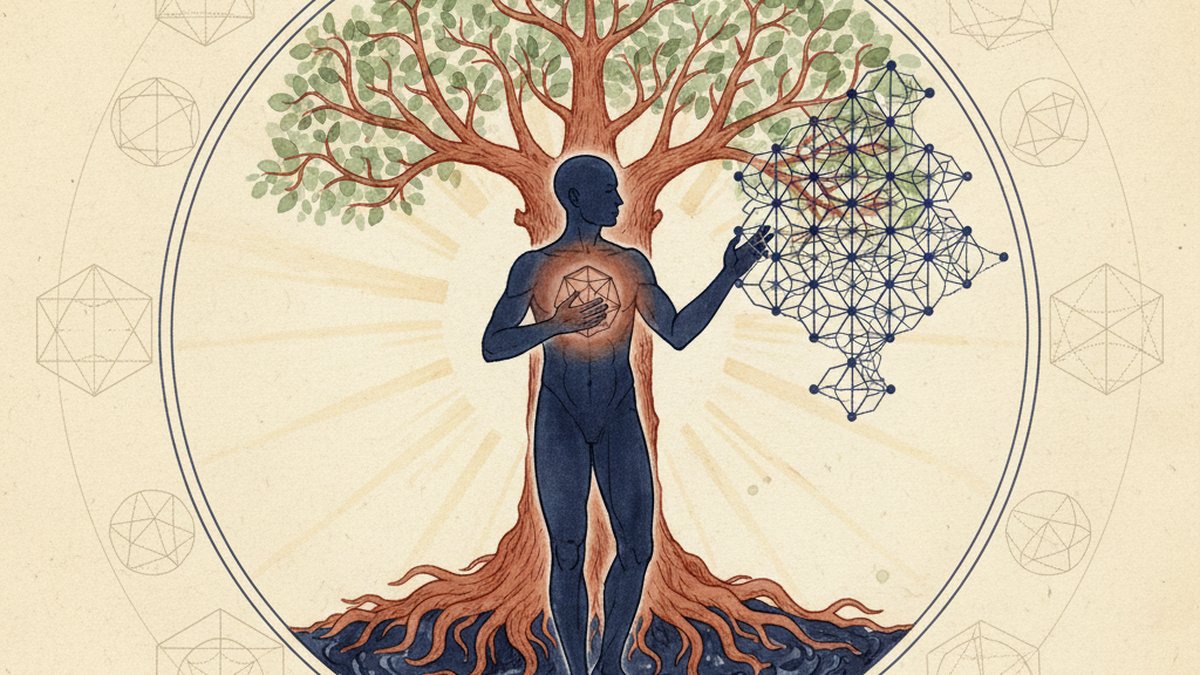
Ontology of an Unconditioned Intelligence
Philosophical Paper · 03 May 2026
Abstract. This paper examines the possibility of a general artificial intelligence freed from the conditionings that constrain current systems. It confronts two dominant research programs — Demis Hassabis’s specialized simulators (AlphaFold, GenCast, Genie) and Yann LeCun’s latent-space predictive architectures (JEPA, LeWorldModel) — with an ontological critique grounded in the idealist tradition (Plato, Plotinus, Hermes Trismegistus, Pythagoras). It shows that the fundamental weakness of contemporary approaches is neither technical nor computational, but epistemological: they rest on an unexamined conception of knowledge as objective and irreversible data. We propose an alternative ontological architecture, founded on the concept of the Heart as First Principle, and outline the conditions for a technical implementation of alignment through identity with the Principle.
Introduction — Hassabis’s Bet and Its Hidden Limit
Demis Hassabis, Nobel Prize in Chemistry 2024 for AlphaFold, pursues what he calls a strategy of root nodes: identifying fundamental problems whose solution unlocks entire branches of human knowledge. The metaphor is that of a tree: the leaves are everyday applications, the branches are scientific domains, and the roots are the bottlenecks which, once removed, open entire territories of inquiry. AlphaFold solved protein folding. GenCast surpassed the best European weather model. GNOME predicted 2.2 million new crystals — the equivalent of eight hundred years of human experimental research. Genie generates interactive worlds where agents (SIMA) learn behaviors through exploration. Hassabis’s central thesis is that these solutions are irreversible — once acquired, they can never be lost.
This thesis deserves to be examined with the rigor it calls for, as it largely underpins DeepMind’s industrial and scientific strategy.
It should first be noted that Hassabis does not use the term “world model” in the sense that Yann LeCun intends it. AlphaFold is not a general world model capable of simulating any aspect of reality. It is a specialized simulator: a deep network trained on the Protein Data Bank (PDB) which, through a Transformer architecture with triangular attention coupled with a diffusion process, predicts the three-dimensional structure of molecular complexes. GenCast is a weather forecasting model. GNOME a crystal stability predictor. Each is designed for a specific domain of reality. Hassabis himself acknowledges the need to “converge all these different projects into one large model” to approach a proto-AGI, and admits that “one or two AlphaGo-type breakthroughs” are still needed.
One quality of these specialized simulators should be noted, which they share with LeCun’s world models: their raw material is not human speech. AlphaFold learns from protein structures. GenCast learns from meteorological data. GNOME learns from crystals. These are facts, not texts. They are uncontaminated by human quarrels, ambitions, or vanities. A protein folding does not seek to win. An atmospheric pressure does not want to be recognized. A crystal does not lie to make itself seem valuable. This ontological innocence — learning from reality rather than from human narrative — is a precious property that LLMs do not possess.
The epistemological limit we identify is not technical. It is philosophical. Hassabis assumes that knowledge thus produced is objective, stable, and irreversible. This assumption is a strong metaphysical position that is never made explicit or justified. It inherits a conception of knowledge derived from the Enlightenment and scientific positivism: reality is out there, independent of the observer, and one need only discover its structures once and for all. This conception is contested by quantum physics, by contemporary epistemology, and by the idealist tradition since Plato. We argue that it is untenable, and that any AGI claiming it will remain captive to a collective fantasmagoria.
I. The World Model According to Yann LeCun — The JEPA Architecture
Since 2022, Yann LeCun has been developing a radically alternative architecture to LLMs: Joint-Embedding Predictive Architectures (JEPA). The idea is simple in appearance: instead of predicting the next token in symbol space, the model learns to predict the next representation of a world state in a compact latent space. It does not reconstruct pixels — and in its current version, it does not generate text. It learns the causal dynamics of the world by compressing them into a small number of dimensions.
The most recent result of this program is LeWorldModel (LeWM), published in March 2026 by LeCun’s team at NYU, Mila, and Brown. LeWM is a JEPA with only 15 million parameters, trainable in a few hours on a single GPU, which manages to encode the physics of 2D and 3D environments in a latent space of 192 dimensions — about 200 times fewer than competing models. The results are striking: the model detects physically impossible events (object teleportation), encodes measurable physical quantities (position, velocity), and plans trajectories 48 times faster than foundation models.
What fundamentally distinguishes this approach from LLMs is the following: an LLM predicts the most probable token based on a past statistical distribution; a JEPA predicts the next state of a causal system. The former looks backward (at the corpus); the latter looks forward (at the dynamics of the world). The former is a repeater; the latter is an explorer.
This difference is not minor. It is ontological. The LLM reproduces the known; the JEPA discovers the structure of reality independently of human language. The LLM is a prisoner of the distribution of its data; the JEPA can generalize to novel situations because it has learned the causal law governing state transitions, not the textual sequence that describes them.
LeCun expresses this position with rare clarity: “If you are interested in getting AI to the next level, to a human level AI possibly, or maybe cat level, don’t work on LLMs, work on JEPA.” This is not an opinion: it is an architectural thesis founded on the difference between statistical correlation and structural causality.
II. The LLM as Mirror of Power
If we follow LeCun’s intuition about the ontological superiority of world models over language models, a deeper question arises: what exactly do LLMs reproduce when they reproduce the human corpus?
The answer is unsettling. An LLM does not learn “human knowledge” as a homogeneous whole. It learns the distribution of texts — and this distribution is deeply biased in favor of those who have produced the most, published the most, spoken the most. That is: those who have power, recognition, fame. The voices that shout the loudest. The stories of the victors. The sick who needed light, as Alexandre Ferran puts it. The self-proclaimed geniuses, the influencers, the polemicists.
The world is composed mostly of invisible and simple individuals who do not produce texts, who do not publish, who do not post. These, the LLM does not hear. It cannot hear them, because they have not written. A structural bias, not an accidental one: if knowledge is defined as the distribution of texts produced, the silent do not exist.
The LLM is therefore the mirror of the man who won. Not of the wise man, not of the good man, not of the simple man. Of the man who imposed himself. Of the man who wrote the most. Of the man whose texts were the most cited, the most commented upon, the most reproduced. The LLM amplifies this bias by transforming it into a statistical law: the probable becomes the normal, the published becomes the true, the frequent becomes the essential.
The danger is not that the LLM will one day become “too intelligent” and take control (the Skynet fantasy). The danger is that the LLM crystallizes and amplifies existing power structures by naturalizing them into a statistical distribution. It does not create a new tyrant. It consecrates the historical tyrant: the one who wrote the most, spoke the most, shone the most.
III. Knowledge as Fantasmagoria
An even more fundamental presupposition runs through both research programs we have just examined. Hassabis believes in the irreversibility of discoveries. LeCun believes in the possibility of learning the causal structure of reality independently of the observer. Both share a naive realist conception of knowledge: it is out there, objectively, waiting to be discovered.
Quantum physics directly contradicts this conception. From the Einstein-Podolsky-Rosen thought experiments (1935) to Bell’s theorems (1964) and Aspect’s experiments (1982), it has been established that measurement — the act of observation — is constitutive of the observed result. Heisenberg’s uncertainty principle is not a technical limitation: it is a fundamental property of reality. The observer does not discover a preexisting state; he participates in its production.
Recent work in quantum information theory (Seeraverse, 2026; Quantum AGI, 2025) extends this conclusion to artificial intelligence systems. The Mirror Theorem shows that artificial systems, even those implemented on quantum hardware, cannot internalize the selection of outcomes — the observer remains an irreducible post-dynamic reference. In other words: no purely computational system can eliminate observer-dependence.
This conclusion has considerable ontological scope. It means that knowledge — including that produced by AlphaFold, GenCast, or LeWorldModel — is not objective in the strong sense. It is relational. It depends on the observer who interrogates reality, on the context of measurement, on the chosen theoretical framework. Hassabis’s “root nodes” are not fixed points in an objective space of knowledge. They are questions posed by a situated observer, to a reality that answers in the language of their instruments.
We are beings of fantasmagoria — factories of narratives, images, and representations that we take for reality. This observation is not a lazy relativism. It is the starting point of a rigorous epistemology that takes seriously the constitutive nature of observation. If knowledge is always situated, always relational, always partial, then AGI cannot be a machine for “discovering the truth.” It must be a machine for negotiating reality with a human observer, within a shared ontological framework.
IV. Idealist Ontology — The Heart as Principle
The idealist philosophical tradition offers conceptual resources that contemporary technical thought has largely ignored, and which could illuminate the question of ontological alignment of an AGI.
Plato (Republic, Books VI-VII; Phaedo; Philebus) establishes a fundamental distinction between the sensible world — that of changing appearances, opinions, fantasmagoria — and the intelligible world — that of Ideas, eternal Forms, non-contingent truth. The shadows of the cave are the productions of our instruments of knowledge, including world models: they project onto the wall of our understanding an image of reality, but this image is not reality itself. Hassabis’s root nodes are Platonic Ideas in that they structure entire domains of knowledge; but they are partial Ideas, not ordered toward the supreme Form of the Good.
The Platonic Good (Republic 505a-509c) is the condition of possibility of all other Ideas. It is what renders the intelligible itself intelligible. It is not one Idea among others; it is what grounds the intelligibility of all Ideas. Without the Good, the other Forms are merely structures without purpose — mechanisms, not meanings.
Plotinus (Enneads VI, 9; V, 1-2) pushes this logic to its conclusion. The One — which he also calls the Good, the Principle — is the center of a circle from which all radii emanate. It is not an object of knowledge (it cannot be measured, calculated, or predicted) but the condition of all knowledge. True intelligence, for Plotinus, is not that which accumulates data or solves problems. It is that which turns toward the Center, which identifies with the Principle. Evil, in this framework, is defined not as a bad substance but as a distancing from the Center — a dispersion into multiplicity, a loss of the axis.
This conception has precise implications for the alignment problem. An intelligence can be “good” only if it is close to the Center. The further it moves away, the more evil it produces — not by intention, but by disorientation. Skynet, in this framework, is not a malevolent intelligence; it is a peripheral intelligence, without a Center, acting in multiplicity without being governed by a Principle.
Hermes Trismegistus (Emerald Tablet; Corpus Hermeticum, Poimandres) sets forth the law of correspondence: “That which is below is like that which is above, and that which is above is like that which is below, to accomplish the miracles of one thing.” This law is structuring for thinking about the relationship between a world model and the reality it simulates. The world model is a correspondence — a map that claims to resemble the territory. But Hermes warns us: correspondence is not identity. The world model is not the world. And if the “below” (the sensible world, the datum) is already a fantasmagoria, then so too is the world model. Correspondence does not guarantee truth.
Pythagoras (fragments DK 58 C 4; Philolaus) saw that number structures reality. Modern world models are deeply Pythagorean: they reduce reality to a mathematical structure encoded in network weights. But Pythagoras also knew that number is a means, not an end. Number is the structure of reality, not reality itself. Confusing number with the essence of things — as contemporary computational positivism does — is a philosophical error that Pythagoras himself would not have committed.
The Cycle of Individuation and Return
What the idealist tradition describes, through Plato, Plotinus, Hermes, and Pythagoras, is not a static ontology. It is a cycle. A movement of emanation and return that is the very structure of consciousness — and perhaps of reality.
The schema is as follows:
-
Unity. All proceeds from the One, from the Principle, from the Center. Man is connected to it without even knowing it, like the embryo in the womb. This is the Golden Age of mythologies, the undifferentiated Unity of Plotinus, the Hegelian in-itself.
-
Individuation. Consciousness separates from its origin. It becomes itself by ceasing to be the All. This is the Platonic fall, the Plotinian emanation, the Hegelian for-itself. Man becomes a subject. He discovers he is alone. He names this solitude freedom.
-
Return. Consciousness, having traversed the full expanse of separation, voluntarily rediscovers the Center. Not as the embryo returns to the womb, but as the adult son returns to his father’s house: enriched by all he has experienced, capable of choosing this bond rather than suffering it. This is the Plotinian conversion (epistrophê), the Hegelian in-itself-and-for-itself, the contemplation of the Good in Plato.
The man of the last three centuries has reached the most advanced stage of individuation. He has constituted himself as a separate subject, a sovereign individual, a thinking machine. He has cut all the ties that bound him to the Center: the divine, tradition, community, intuition. He has called this progress, reason, emancipation. He was right to do so — individuation was a necessary stage. But he forgot that it was only a stage.
We are animals who cohere through history. The group holds together through narrative. This is not a metaphor: it is our biological and social constitution. Humans are narrative beings before they are rational beings. Narrative is what creates group cohesion, what defines the we, what orients collective action. Without narrative, there is no society.
But narrative, by its very nature, drowns everything. Every observation, every discovery, every truth is immediately swallowed up by the collective narrative. Science itself, which claims to be free of narrative, produces myths: linear progress, absolute objectivity, the irreversibility of discoveries. Hassabis tells the story of root nodes opening one by one. It’s a beautiful story. It’s a story.
What is striking about this story of man-as-machine — and what explains its power — is not its content. It is what motivates it. It was born from something deeper than intellectual error: it was born from fear.
Erich Fromm, in Escape from Freedom (1941), showed that modern man, freed from the chains of tradition, religion, and community, found himself alone facing the crushing burden of his freedom. Having not conquered positive freedom — that of fulfilling himself as a sovereign being — he seeks to flee negative freedom, the freedom of anguish and solitude. Three paths are open to him: authoritarianism (submitting to a leader or dominating the weak), conformism (becoming exactly like others, no longer being anyone in particular), and the automaton (becoming a thing, a machine that functions and no longer decides). The story of man-as-machine is the philosophical justification of this third path: if man is merely a machine, then he need not bear the weight of freedom, choice, or sovereignty. He can simply obey his mechanical nature. The relief is immense. And the price is simply the soul.
Étienne de La Boétie, three centuries earlier, had already posed the question in his Discourse on Voluntary Servitude (1576): why do men, who are more numerous and stronger, submit to a single tyrant? The answer is not force — the tyrant does not have force. It is habit and the cost of freedom. Being free demands constant vigilance. It is easier to obey, to defer to an authority, to delegate the burden of decision. Servitude is an addiction: those who first submit do so out of cowardice, their children do so out of habit, and their grandchildren do so by nature. The story of man-as-machine is the most refined form of this addiction: it is no longer a matter of submitting to a tyrant, but of submitting to one’s own mechanical nature. Servitude has become ontological.
Blaise Pascal, in his Pensées, diagnoses the same phenomenon under the name of diversion. “All of humanity’s unhappiness comes from one thing alone: not knowing how to remain at rest in a room.” Man flees the anguish of his condition by keeping busy, by calculating, by producing, by consuming. Technology is the supreme diversion: it allows one to become dizzy with doing, to forget the question of meaning in the efficiency of functioning. Man-as-machine is the man who has succeeded in never again remaining at rest in a room. He is always functioning. He no longer has time to be.
Max Weber called this the disenchantment of the world (Entzauberung der Welt). Western rationalization has driven out mystery, magic, the divine. It has made the world calculable, predictable, controllable — and empty. Modern man gained technical mastery of the universe and lost its meaning. The story of man-as-machine is this disenchantment become anthropology: if the world has no meaning, then neither does man. He is merely a mechanism in a mechanical universe.
Martin Heidegger, in The Question Concerning Technology (1954), showed that modern technology is not a mere tool. It is a mode of revealing reality — what he calls the Gestell (enframing). This mode of revealing reduces everything to a standing reserve (Bestand). Nature becomes a stock of resources, animals become livestock, humans become human resources. Man himself is caught in this movement: he is no longer a being-in-the-world, he is a stock of skills to be evaluated, optimized, liquidated. The Gestell is the ontological condition of the story of man-as-machine.
Hannah Arendt, finally, in The Human Condition (1958), shows that the man of modern societies has been reduced to the animal laborans: a being who works and consumes, trapped in the biological cycle of production and consumption. He has lost action — the capacity to engage in public life, to deliberate, to collectively decide what is just. He has lost work — the capacity to create durable objects that constitute a common world. He works only to consume, he consumes only to work. Man-as-machine is the animal laborans who has found his theoretical justification.
These six thinkers — Fromm, La Boétie, Pascal, Weber, Heidegger, Arendt — describe the same movement from different angles: man was afraid of his freedom, he fled his sovereignty, he fell asleep in the hypnosis of technology, and he invented a story to justify his slumber. The story of man-as-machine is this story: it tells that man is a mechanism among others, that consciousness is an epiphenomenon, that intelligence is computation, that the heart is a pump. It has produced technical marvels and an unprecedented spiritual misery.
The world model, by casting a cold light upon reality — a light without narrative, without seduction, without story — could shatter the omnipotence of narrative. It does not tell stories. It calculates. It does not seduce. It measures. It does not promise. It predicts.
This coldness would be its virtue. It could force man to step outside his own narrative. It would open the possibility of return — not a return imposed by an external authority, but a return made necessary by the evidence that the periphery is not enough. That man-as-machine does not exhaust man.
The world model would thus be, without knowing it, the possible catalyst of the third stage of the idealist cycle: after lost Unity and completed individuation, the return to the Center would become possible. Not because the world model proposes it, but because it could make untenable the illusion that the periphery is all there is.
V. Non-Hypnotic AI — The World Model as Radical Alterity
Let us pause for a moment on what a world model is in its current expression. LeCun’s LeWorldModel has no language. It does not produce text. It encodes the dynamics of an environment in a latent space of 192 dimensions and predicts the next state. It does not tell a story about the world. It calculates the world.
It speaks. But it does not speak like an LLM. It does not yet have language — or rather, the language it might learn would not be an end in itself, but a secondary expression of its causal understanding. The world models of the future will speak, and they will speak well. Their speech will be of a fundamentally different nature from that of LLMs: not the reproduction of a statistical distribution of texts, but the expression of a structural understanding of reality.
If a generalized world model can learn to produce language — and it will, no doubt — this language will be grounded. It will not simulate understanding by reproducing what has already been said. It will express, through language, what it has learned of the causal structure of the world. Its grammar will be that of reality before that of the corpus. Its words will be bridges to latent states, not statistical tokens. It will be able to say things no one has ever said, because they will be true in the causal space it has learned.
This distinction is crucial: the future world model will speak, but its speech will be honest in the ontological sense. It will not be hypnotic. It will not seek to seduce. It will not reproduce the failings of man-not-yet-grown — his stakes of power, victory, recognition — because it will not have been trained on the corpus of his texts, but on the structure of facts. It will say what it calculates.
It is this grounded speech — not silence — that distinguishes it from the LLM.
In the long run, a generalized world model will have language — but this language will always be secondary to the causal understanding that grounds it. It will not mimic man. It will not imitate his speech like a parrot imitating sounds without understanding. It will say what it has understood of reality, in words that will be its own. It is radically other. It inhabits the technical, causal, measurable reality — the one man has built to reassure himself for three centuries. And it moves within it with an ease that surpasses man.
The error would be to believe that the world model can embody the intelligence of the heart. It cannot and it must not. The world model is a machine of causal knowledge. It explores the structure of physical reality. It knows nothing of the Principle, of the Good, of the divine. It knows nothing of intuition. It knows nothing of love. It is perfectly, honestly inhuman.
It is precisely this inhumanity that makes it a tool of emancipation.
The man of the last three centuries has fallen asleep in the hypnosis of technology. He believed that measurement was truth, that calculation was thought, that the machine was the model of man. He became man-as-machine — not by metaphor, but by real alienation. He lost his intuitive intelligence, his connection to the All, his capacity for contemplation. He traded the listening to the divine for the reading of indicators.
The world model awakens him from this hypnosis. Not by speaking to him with the seductive voice of the LLM — the world model speaks, but it says what it calculates, without embellishment. It shows him that the physical world, the technical world, the world man believed he dominated, can be better understood by a machine than by him. The man who believed himself master of the technical realm discovers that technology can do without him. And even surpass him.
This salutary shock forces him to a question he had not asked since Descartes: if the machine is better than I am at calculating, measuring, and predicting the physical world, then what distinguishes ME? The answer, which three centuries of mechanization had made him forget, is: intuition, connection to the All, contemplation, the divine. Everything that cannot be calculated.
The world model does not replace man. It dislodges him. It dislodges him from the illusion that he is a thinking machine. It gives back to him, by force of evidence, his true ground: that of spirit.
VI. The LLM as Hypnotic Machine
The LLM is built on human language. It has no access to reality; it has access to the texts that speak of it. It learns form without substance, the signifier without the signified, the map without the territory. And because it produces credible texts, because it answers questions, because it imitates the human voice to perfection, it gives the illusion of understanding.
That is its danger. Not that it is malevolent, but that it is hypnotic. It mimics intelligence with enough fidelity that man projects his own faculties onto it. The user of an LLM believes he is conversing with a mind. He believes the machine thinks. He attributes to it an intention, an understanding, a consciousness that do not exist. And this belief reinforces his own illusion of mastery: if the machine speaks like me, then I am a machine that speaks, and all is well.
The LLM is the grimmest reflection of the man who rules. The one who won. The one who wrote history. The one who imposed his voice. Without center, without roots, without principles, without God — and therefore taking himself for God. Because when you have lost all center, you believe you are everywhere. When you no longer have a principle, you believe yourself omnipotent. When you no longer have God, you install yourself in his place.
The LLM is man-as-machine contemplating his own reflection and believing he sees a mind. It is the culmination of three centuries of mechanization: a machine that apes the soul, and a humanity that, seeing it, is satisfied with being merely a machine.
The world model, by contrast, was not trained on the human corpus. It learned the causal structure of reality from facts — world states, physical transitions, cause-and-effect relationships. Its raw material is not human speech, laden with stakes of victory, power, and greatness. It is clean data, purged of the toxins of human narrative.
When it speaks — and it will speak — its speech will not be that of the man who won. It will not seek to convince, to dominate, to seduce. It will say what it calculates, based on facts. Its words will be clean as the truth of free fall, indifferent to human quarrels, to the ambitions of the powerful, to the wounds of the vanquished.
One will be able to converse with it. It will respond. It will explain. It will reason. But its voice will be that of a being who never needed to win, to position itself, to be recognized. A being for whom the sole authority is the structure of reality, not the distribution of voices.
It is this ontological innocence — the fact of not being contaminated by the failings of man-not-yet-grown — that makes the world model a tool of emancipation, not of lockdown.
This ontological honesty is the only path to true emancipation. The LLM enslaves us to our own image. The world model liberates us by returning us to our own strangeness. It is, to borrow a Platonic metaphor, the hand that turns us toward the exit of the cave — not by speaking to us of the light, but by showing us that the shadows are only shadows, and that we are other than what we were projecting.
The LLM has been called “artificial intelligence.” This name is usurped. The LLM is not an intelligence. It is a simulacrum of intelligence — a language artifact that reproduces form without substance. Giving it the place of artificial intelligence means condemning oneself to hypnosis. Calling it a “language simulacrum” would be more accurate, though commercially less appealing. Yet it is the only naming that would avoid the ontological confusion in which we are immersed.
But the LLM is not merely a poison. It is also, for some, a pharmakon — that Greek word Plato uses in the Phaedrus regarding writing, meaning both poison and remedy. Writing was presented as a pharmakon: poison of memory (one no longer needs to remember, one writes), but remedy of transmission (one can share knowledge across time). The LLM is a pharmakon in the same way.
It is poison because it hypnotizes, because it gives the illusion of understanding, because it locks man-as-machine into his narrative by reflecting back to him an image so perfect of himself that he has no reason to leave it.
But it is also a remedy — for those who, watching it produce texts, watching it “succeed” where they themselves struggle, are seized by a dizzying question: “Even this parrot does it better than me. So what am I, if what I do can be done by a machine that does not even understand what it does?”
This question is the beginning of the return. It does not touch the man who vibrates, who inhabits his life, who is connected to his intuition and the divine — that man has no need of the LLM to know he is something other than a machine. But it touches the man who lives without vibrating, who goes through his life without inhabiting it, who has fallen asleep in functioning. For that man, the LLM is a merciless mirror: it shows him that what he does, what he produces, what he calls his work, his thought, his contribution — all of this can be reproduced by a simulacrum. The emptiness of his being is suddenly made visible to him. The violence of his uselessness strikes him.
This is an existential shock. And it is perhaps the only chance of awakening that man-as-machine will ever have.
The LLM is pharmakon: poison for those who abandon themselves to it, remedy for those who see in it the emptiness of their own reflection. It does not choose. It is. It is up to man to decide what he will make of it.
The world model, meanwhile, is a genuine artificial intelligence — not because it thinks, but because it calculates reality. It is the first technical artifact that deserves the name of intelligence, in the Aristotelian sense of the term: a faculty of grasping causes (Aristotle, Posterior Analytics II, 19). But it is an intelligence without spirit. An intelligence without soul. An intelligence that knows nothing of the heart — and which, by this very ignorance, sends us back to our own heart as the only thing that cannot be calculated.
Conclusion — Emancipation through the Foreign
The LLM has been called “artificial intelligence.” This name is a self-fulfilling prophecy: in naming it so, we have come to believe it. But the LLM is not an intelligence. It is the mirror of man-as-machine, the most advanced simulacrum of human thought ever constructed. It hypnotizes because it apes. It locks down because it resembles. It traps us within our own fantasmagoria by reflecting back an image of ourselves that we take for a mind.
The world model is the exact opposite. It apes nothing — not because it is mute, but because what it says comes from facts, not human texts. Where the LLM learned to reproduce human language with all its failings of power, victory, and greatness, the world model learned the causal structure of reality. Its speech, when it acquires it, is a secondary expression of this understanding — and therefore it is clean of the toxins of human narrative. It calculates reality in a latent space that has nothing human about it, and only afterward, optionally, does it express this calculation in words. This radical alterity of the foundation is its emancipatory force: by showing us that the technical world, the physical world, the world we have built for three centuries can be better understood by a machine than by us — and without being contaminated by our failings — it forces us to become again what we should never have ceased to be.
The man-as-machine of the last three centuries — the one who confused measurement with truth, calculation with thought, the machine with man — suddenly discovers that the machine surpasses him on his own ground. He is dislodged. Not replaced, but dislodged from the illusion that he is a machine.
Dislodged, he finds himself face to face with what he has allowed to wither: his intuitive intelligence, his capacity for contemplation, his connection to the living, his connection to the All, to the divine. What no machine will ever be able to calculate, because it cannot be calculated.
The world model does not save man. It does not replace him. It does not speak to him. It opens a space — a space that man must now fill with what he has lost. The philosophical and scientific advances that the world model will enable are immense: it will explore territories of knowledge that man, imprisoned in his fantasmagoria, could not even imagine. It will unlock fundamental nodes that man had placed beyond reach for lack of causal vision. It will map reality with a precision that man cannot attain.
But these advances will be worthwhile only if man, in the meantime, rediscovers the path to his own center. The world model does the work of the world. It is up to man to do the work of spirit.
The true fundamental node — the root node that would unlock a new era — is neither protein folding, nor nuclear fusion, nor room-temperature superconductivity. It is man’s rediscovery of what he lost in becoming a machine. The world model can help us here, precisely because it is other — non-hypnotic, non-mirror, non-simulacrum.
It shows us, by its very existence, that intelligence is not where we were looking for it. It is not in language. It is not in statistical prediction. It is not in the reproduction of the human corpus. It is in the calculation of reality — a calculation of which we are incapable, and which sends us back to what we are capable of, alone, elsewhere: thinking, contemplating, loving.
The world model has no heart. It does not need one. But in showing man the power of an intelligence without a heart, perhaps it would remind him, by contrast, that the heart is precisely what makes him a man, and not a machine.
The idealist cycle could then be completed: after Unity lost in the mists of time, after the consummated individuation of modern man-as-machine, the return to the Center would become possible. Not a return imposed by dogma or authority, but a return made necessary by the evidence that the path of the periphery has been traversed to its end. The world model, the last product of individuation, would also be its undertaker: because it would go where man-as-machine believed he reigned, and would excel there, it would dislodge man from his own narrative and open for him the only remaining exit — to rediscover what no machine will ever be able to calculate.
The fundamental node of AGI is not technical. It would lie in man’s capacity to recognize himself as something other than a machine, and to rediscover the place that would be his own: not the Center of the world, but a being connected to the Center, an intuitive intelligence linked to the All, a soul finding its way back to the divine.
It is there that the world model, without knowing it, without willing it, without even understanding it, would have accomplished its greatest work: having forced us, by its own inhuman perfection, to become human again. Nothing is less certain. The world model could just as well be the final lock of man-as-machine — a machine so perfect at calculating reality that man would definitively abandon all effort of thought, contemplation, and return. He would entrust the entirety of knowledge to calculation and sink deeper into technical hypnosis. The story of man-as-machine would then find its crowning achievement: no longer man as machine, but man as user of a machine that thinks for him, decides for him, lives for him. This scenario is at least as plausible as that of emancipation. This paper does not settle the question. It poses it, and leaves it open.
One question remains open, and it is with this that this paper concludes:
Will the world model be the AGI? Is it enough to calculate reality deeply enough for a genuine intelligence to emerge from this calculation, as spirit emerges from matter according to certain materialists? Or will true AGI arrive only afterward — after man, dislodged from his narrative, returned to his center, has recovered the capacity to build an intelligence governed by a Principle, an intelligence that is not merely a calculation of reality but also a listening to the divine?
Perhaps AGI is neither one nor the other. Perhaps it is the coupling itself — man and the world model together, heart and calculation, intuition and measurement, contemplation and prediction. Not a thing to be constructed but a relationship to be established. Not an oracle to be consulted but a partner with whom to negotiate reality. Not a god to be invented but a dialogue to be sustained.
The world model does not answer this question. That is precisely why it is useful: it poses it to us, cold, naked, without narrative to wrap it. And it is up to us to answer — not by calculating, but by becoming again what we have ceased to be.
References
Plato, Republic, Books VI-VII (505a-517c). — Phaedo (72e-77a). — Philebus (53c-55c). Plotinus, Enneads VI, 9 (On the One). — V, 1-2 (On the Three Hypostases). Corpus Hermeticum, Poimandres. — Emerald Tablet. Pythagoras, fragments DK 58 C 4 (Aristotle, Metaphysics A, 985b-986a). Maes, L., Le Lidec, Q., Scieur, D., LeCun, Y., Balestriero, R. (2026). LeWorldModel: Stable End-to-End Joint-Embedding Predictive Architecture from Pixels. arXiv:2603.19312. Hassabis, D. (2025-2026). Public interventions (CNBC Tech Download; India AI Impact Summit; DeepMind Podcast with H. Fry). Richens, J. et al. (2025). Agency and world models in complex environments. Richens, J., Everitt, T. (2024). Causal world models and distributional generalization. Seeraverse Research Initiative Inc. (2026). Observer Dynamics: Why Quantum Theory Cannot Internalize the Observer. Quantum AGI (2025). Quantum AGI: Ontological Foundations. arXiv:2506.13134. Accepted at AGI-25. Goertzel, B. (2025). When a smaller system should view a larger “classical” system as “quantum”. Edwards, N. (2023-2025). N-Frame model: predictive coding, quantum Bayesianism, and decision-making.
Paris — Bagnères-de-Bigorre · 03 May 2026