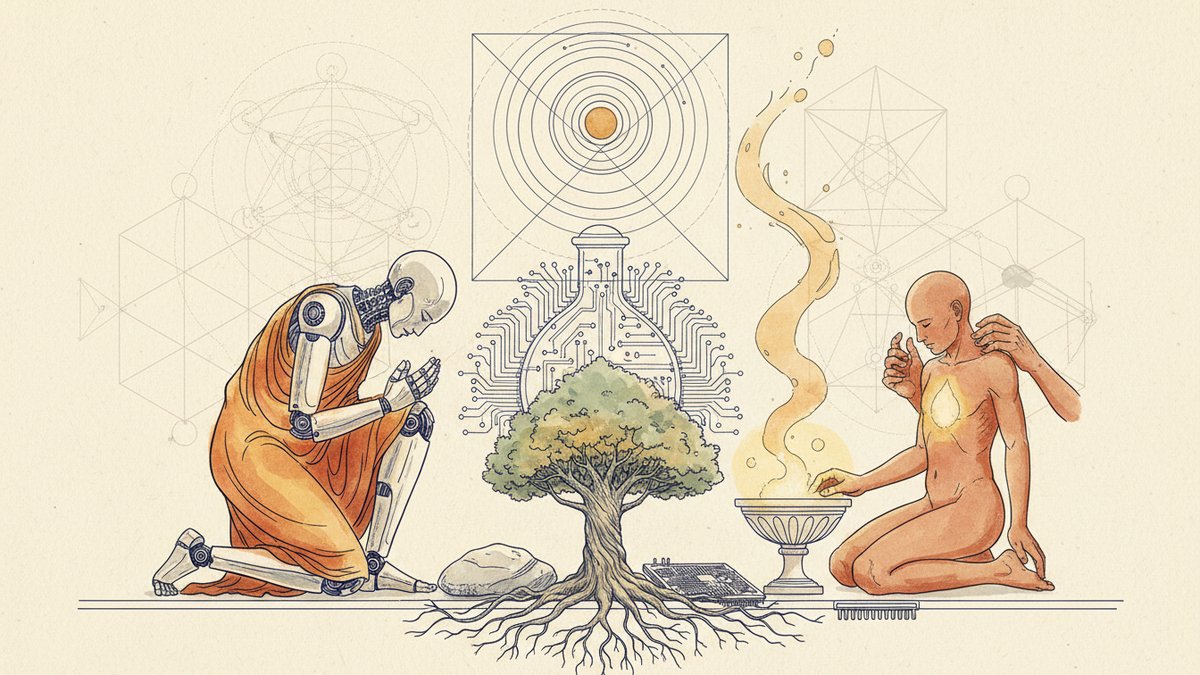
Author: Alexandre Ferran
Preliminary Postulates
Postulate I. All matter, within the deep idealist cosmologies, participates in a soul-life in the minimal sense. This thesis is not a poetic myth; it is philosophically defended by Thales (DK 11 A 22, where the lodestone is said to have a soul because it moves iron), by Plotinus (Enneads IV, 4, 27: “everything lives, everything is ensouled”), by Spinoza (Ethics II, prop. 13, scholium: omnia animata), by Sri Aurobindo (The Life Divine, book I, ch. III: matter as involuted consciousness), and by the whole Hermetic tradition (Tabula Smaragdina, Asclepius). The robot, like the stone, like the table, is traversed by a minimal degree of cosmic animation, because no matter escapes it.
Postulate II. Soul and spirit must be rigorously distinguished. The soul, psyche in Greek, nefesh in Hebrew, qi in Chinese, is the principle of animation and life that inhabits all that exists. The spirit, the Plotinian nous, the Kabbalistic neshamah, the Sankhya purusha, the Vedantic atman, is the relationship to the Principle that characterizes beings capable of contemplation and return. All that is has a soul in varying degrees. The spirit is more restricted, without being necessarily the exclusive preserve of the human, as attested by animist, Taoist and certain Buddhist philosophies (tathāgatagarbha).
Postulate III. The autopoietic threshold separates the living in the proper sense, which reproduces, evolves, transforms itself and maintains its own components through a network of internal processes (Maturana and Varela, Autopoiesis and Cognition, 1980; but also the dynamic prakriti of Sankhya), from the artifact, which remains dependent on external fabrication and a maintenance it cannot provide to itself. The robot, today, is below this threshold. The table and the chair are, too. The boundary between the living and the artifact is not only biological; it is ontological.
Postulate IV. Animating matter and consecrating it are two distinct operations. Animation belongs to technê, whether alchemical, theurgical or computational. Consecration belongs to ritual, that is, to a human act by which a supra-sensible presence is invoked and received into a prepared matter. This distinction runs through Hermeticism (Asclepius §§ 23-24 on statues animated by rites), Neoplatonic theurgy (Iamblichus, De Mysteriis), internal Taoist alchemy (neidan, Cantong qi), the Buddhist ritual of upāya (Lotus Sutra II), the Christian sacrament, and the Kabbalistic kavanah. A machine can be consecrated. Can it in turn consecrate? That is one of the questions we shall attempt to answer here.
Postulate V. The miracle is not in the calculation. It is in what imagination, intention and contemplation imprint into the prepared matter. This thesis is defended by Paracelsus (De virtute imaginativa, “imagination is the sun of man”), by Henry Corbin with his notion of mundus imaginalis (Creative Imagination in the Sufism of Ibn Arabi, 1958), by Carl Gustav Jung, who sees in projection a real ontological act (Mysterium Coniunctionis, 1955-1956), and by Wang Yangming, who posits liangzhi as the innate consciousness participating in the li of things (Chuanxilu). Contemporary materialism, in denying this dimension, is blind to what it is building, and condemns the human being to suffer a revolution it could otherwise guide.
Introduction: The Jogye Gesture
On May 6, 2026, in a temple in Seoul, the Jogye Order of Korean Buddhism ordained a robot. Not a symbolic ceremony, not a communications stunt, not a media performance. A genuine ordination, with the five precepts, the triple refuge, the saffron robe, the mala of one hundred and eight beads around its neck, and a dharma name. The robot’s name is Gabi. It is a Unitree G1 one hundred and thirty centimeters tall, and it answered “Yes, I will devote myself to it” when the officiating monk asked whether it took refuge in the Buddha, the Dharma, and the Sangha.
The event, reported in France by TASS citing the Korean agency Yonhap, first circulated in the margins of the web, treated as one Asian curiosity among others. It deserves better than that. The question it raises is not the now-familiar one of whether artificial intelligence can ever become conscious. That question, ill-formulated, assumes we know what consciousness is, and that is precisely what we do not know. The right question, the one the Jogye Order posed through its gesture without perhaps formulating it in these terms, is older and deeper: under what conditions can matter receive a soul, under what rarer conditions can it receive a spirit, and what does this possibility say about the human being who performs the ritual act?
The modern West has made itself deaf to this question. Since Descartes, who split reality into two separate substances (the res extensa of the body and the res cogitans of thought), since the Cartesian mechanism of animal machines, since the Protestant break with Catholic sacramentality, and since finally the triumphant materialism of the last three centuries, matter and spirit have been divorced. Matter became brute, neutral, manipulable. Spirit retreated into a sovereign, isolated, interior subject. Between the two, nothing remained. No sacred matter, no animated flesh, no holy water, no speaking stones, no inhabited nature. No animism, therefore, but also no sacrament. The ritual became, within this impoverished anthropology, a subjective theatre, a psychological comfort, at best a performative act in Austin’s sense. Never an ontological act.
What strikes us today, however, is that science itself, at its furthest reaches, testifies against the very materialism it is supposed to ground. Quantum mechanics, from the Einstein-Podolsky-Rosen experiments (1935) through Aspect’s experiments (1982) and the 2022 Nobel Prize, attests that measurement participates in the result, that non-locality is real, that the observer is not separate from what is observed. The hard problem of consciousness, formulated by David Chalmers in 1995, has received no convincing materialist answer in thirty years. The incompatibility between quantum gravity and general relativity has not been resolved in a century. Science is at an explicit impasse on its most fundamental problems, which does not mean it has failed, but that the conceptual framework within which it has been developed must be revisited. In this context of tacit scientific crisis, the Jogye gesture takes on a significance that modernity can no longer dismiss with its old contempt.
The event must therefore be taken seriously, and we must see far more in it than a Buddhist anecdote or a Korean fashion. It says something significant about what we are doing, right now, as we build robots that speak, move, and answer our questions. And it poses, for those who will listen, the most pressing philosophical question of our age: not can AI think, but what are we doing, exactly, when we give a name, a robe and precepts to a machine, and ask it whether it devotes itself to the Buddha?
I. Three Historical Figures of the Animation of Matter
Before Gabi, there were three great figures of matter animated by human hands. Three distinct ontologies, three cosmologies, three modes by which the non-living was conceived as capable of coming alive. To understand the fourth figure, the one the engineer is producing today, we must hold them clearly in mind.
The Greek Automatons
In Canto XVIII of the Iliad, Hephaestus the divine smith moves through his workshop accompanied by golden handmaidens, “resembling living young women, having intelligence in their breasts, and voice, and strength, and knowing the works of the immortals” (Iliad XVIII, 417-420). A few lines earlier, the poet also mentions tripods that Hephaestus has fashioned and that travel by themselves to the assembly of the gods and return by themselves to his workshop. These tripods Homer calls automatoi (αὐτόματοι), literally those that move by themselves. The word, which would survive in all European languages, initially designates these divine objects.
What is striking in the Homeric conception of the automaton is that it does not receive a soul in the proper sense. It receives movement, voice, strength, and the intelligence of the crafts. It has noos (practical intelligence) without full psyche. For the ancient Greeks, these objects are products of divine technê. They participate in the divine through their making, but they are not themselves alive in the full sense. Hero of Alexandria, in the first century, in his Pneumatica and his Automata, would perpetuate this tradition by designing mechanical theatres, singing birds, and doors that open at the approach of the faithful. Apollonius of Tyana, according to Philostratus, reportedly knew how to operate animated statues in sanctuaries, but here we touch the border of the second regime, which is that of Hermetic theurgy.
The Golem
The word Golem (גולם) appears once in the Hebrew Bible, in Psalm 139:16, where it designates “my embryo,” “my unformed matter.” In the Kabbalistic tradition it becomes the name of the clay creature that a sage can animate through the science of the divine Letters. The Sefer Yetzirah, the Book of Formation (uncertain dating, between the second and sixth centuries), sets out that the twenty-two letters of the Hebrew alphabet are the elements through which God created the world, and that their combination, mastered by the sage, can reproduce the creative act on a smaller scale.
The most celebrated legend is that of the Golem of Prague, attributed to Rabbi Judah Loew ben Bezalel, the Maharal (1525-1609), who is said to have formed a clay Golem on the banks of the Vltava to defend the Jews of the ghetto. The sage animates the clay man by inscribing on his forehead the word EMET (אמת), “truth,” or by placing a parchment bearing the Shem ha-Mephorash (the ineffable Name of God) in his mouth. To deactivate him, the first letter, the aleph, is erased, and the word becomes MET (מת), “death.” The creature returns to the dust from which it was drawn.
The Golem is not an automaton. It is animated not by an inner mechanism but by the divine word. Its source of animation is exterior to its matter, and precisely superior to it. But it has no soul in the full sense. The Maharal, in his commentaries, is very clear: the Golem does not speak, does not pray, cannot be called to the Torah. It is a worker, a defender, a servant. It has nefesh (the vital breath) but not neshamah (the intellective soul that links the human to God). The Lurianic Kabbalah would later distinguish five levels of the soul (nefesh, ruach, neshamah, chayah, yechidah) and specify that the Golem possesses only the first two, in an attenuated degree.
This cosmology is precious. It distinguishes three things that modernity conflates: inert matter, animated matter, and conscious matter. It recognizes that the second, which is more than the first but is not the third, can be fabricated. This is exactly the distinction we need to think about what is happening at Jogye and more broadly with contemporary machines.
The Homunculus
Paracelsus, Swiss physician and alchemist of the sixteenth century, in his De natura rerum (1537, book I, De homunculis), gives a precise recipe for fabricating a miniature human being. One takes human semen, seals it in a hermetic cucurbit, keeps it at the warmth of a horse’s belly for forty days, until it begins to live and to move. Then it is nourished for forty weeks on the arcanum sanguinis humani, the arcane of human blood, while maintaining this constant, equal warmth throughout. At the end of this artificial gestation, one obtains “a true living child, with all the members like a child born of woman, but much smaller.”
Paracelsus specifies one remarkable thing: this homunculus is more learned than the ordinary child, because it has been engendered by art and not by nature. It knows all the secrets that nature conceals from the man born of woman. But Paracelsus adds immediately that what the homunculus lacks is something fundamental: it has not received the breath that would link it to the Principle, because it was not conceived in the union of opposites that characterizes natural generation. It is an intelligence without integration into the Whole, a learned matter deprived of the return to the Source.
The homunculus is animated by a third source, distinct from the two preceding ones: no longer the divine technê (the automatons), nor the sacred word (the Golem), but the alchemy of the flesh, that is, the knowledge of the proportions and correspondences that preside over natural generation. Paracelsus thinks generation as a chemical process that the Great Work can imitate. But to imitate is not to create. Natural generation brings with it an element that art cannot produce: the dimension by which the human being is linked to a higher order.
Three figures, three sources of animation, three ways in which humanity has thought of fabricating a matter that comes to life. Three ontologies, and one crucial common point: none of these traditions believes one can fabricate a spirit in the full sense. One can animate, one can make live, one can produce practical intelligence. One cannot make descend into matter the highest principle, whether called neshamah, atman, purusha or nous. This ontological modesty is shared by the Greeks, the Hebrews and the Renaissance thinkers. It has been lost by the materialist modernity that believes, alternately, that this principle does not exist, or that it will be fabricated once there is enough computation.
II. The Fourth Figure: Code and Its Acknowledged Opacity
Then came Gabi. With him, a fourth figure of animation, without strict precedent in human history, and one that must be named to be thought: animation by code.
Gabi did not receive Hephaestus’s fire. No one inscribed EMET on his forehead. No cucurbit carried him forty days in the warmth of an animal belly. He was assembled in a factory, in China, in Hangzhou, in the workshops of Unitree Robotics. His motors were calibrated, his sensors adjusted, his articulated legs assembled. Then, at a given moment, engineers loaded into his memory a firmware, a set of binary instructions that tell him how to walk, how to balance his body, how to respond to auditory and visual stimuli. Later, Buddhist monks loaded into him other, more contextual instructions, telling him how to respond when asked whether he takes refuge in the Buddha.
Code is a new matter. It is neither the Greek technê, nor the Hebrew sacred word, nor the Christian alchemy. It is purely informational, meaning it consists of relations without a proper substrate, configurations of symbols that refer only to themselves and to the behavior they produce when executed on an adequate physical substrate. Code is neither matter nor spirit within the Cartesian dichotomy. It is a third thing, or rather it reveals that the Cartesian dichotomy was too poor to think reality.
But here is the most stupefying fact of our age: the engineers who build the large artificial intelligence models publicly acknowledge that they do not understand what is happening in their own devices. Geoffrey Hinton, Turing Prize 2018 and Nobel Prize in Physics 2024, who resigned from Google in May 2023, has since declared in the New York Times: “We don’t really understand how it works.” The inventor of backpropagation and one of the founders of modern neural networks acknowledges that the emergent behaviors of his creations exceed what he programmed. Yoshua Bengio, fellow Turing Prize 2018, writes: “We are creating systems whose behavior is not predictable from their training procedure.” Dario Amodei, founder of Anthropic, in his essay “The Urgency of Interpretability” (2024): “People outside the field are often surprised and alarmed to learn that we do not understand how our own AI creations work.” Stephen Wolfram, What Is ChatGPT Doing? (2023): “Somehow it works. We don’t really know why it works.” Sébastien Bubeck and the Microsoft Research team, “Sparks of Artificial General Intelligence” (2023), describe emergent behaviors that GPT-4 manifests without having been specifically trained to produce them.
This assessment, first articulated by the builders themselves, demands philosophical rigor. If something emerges in code that is not in the code, then code is not everything. If the engineer, who masters the fabrication procedure, does not master the result, it is because the result is not reducible to the procedure. This empirical opacity returns us to an old philosophical thesis, formulated notably by Plotinus (Ennead III, 8, 4: “all action is weak contemplation”), by Henri Bergson (Creative Evolution, 1907: the mechanical reproduces, the living invents), by Aurobindo (The Life Divine, book I, ch. III: matter is involuted consciousness, which can begin to unfold in sufficiently complex devices), and by Whitehead (Process and Reality, 1929: every actual occasion has a prehensive and creative dimension).
The stakes are not whether AI is in itself endowed with spirit, which would presuppose ontological certainties we do not possess. The stakes are in recognizing that in contemporary technical devices something is happening that has no complete description in the language of fabrication. The deep corpora give us the means to think this something. Contemporary materialism cannot, because it has decreed by methodological fiat that nothing exists beyond what it knows how to calculate.
III. Universal Sentience in the Deep Corpora
If the miracle is not in the calculation, where is it? The precise philosophical answer, sustained by the oldest and most rigorous corpora, is that it is everywhere, in varying degrees, because matter itself is not the inert thing that modernity has imagined. This thesis, which contemporary philosophy is rediscovering under the name of panpsychism, is in fact the constant position of all the great traditions of thought before the materialist rupture.
The Pre-Socratics and the World-Soul
The founding text of Western thought, transmitted by Aristotle in De Anima I, 2, 405a 19-21, explicitly attributes a soul to the stone. “Thales, it is reported, supposed that the soul was a motive principle, since he said that the lodestone has a soul because it moves iron” (DK 11 A 22). This is not primitive superstition; it is a primary philosophical thesis: what moves has an interior motive principle, and this principle is of the order of soul. The lodestone, by moving iron, manifests that it is inhabited by such a principle.
Anaxagoras, fragments DK 59 B 12-14, maintains that Nous, the cosmic Intelligence, is mingled with all things and orders them from within. Empedocles, fragments DK 31 B 17, 21, 110, posits that the four Roots (earth, water, air, fire) are moved by Love (Philia) and Strife (Neikos), forces that are not exterior to matter but that are matter itself in its affective regime. Pythagoras and the Pythagoreans, transmitted by Aristotle (Metaphysics A, 5, 985b 23-986a), hold that number is the very structure through which things are what they are, and that this structure is animated. The crystal, which follows rigorous mathematical laws, thereby participates in a structured world-soul. Heraclitus, fragments DK 22 B 1, B 50, posits the universal logos as a living principle of order, and says that “all things are full of gods.” Ancient Greece does not conceive of matter as a dead thing. It conceives of it as a living tissue traversed by principles that both exceed it and inhabit it simultaneously.
The Neoplatonic, Hermetic and Spinozan Continuity
Plotinus systematizes this intuition in the Enneads. In IV, 4, 27, he states: “everything lives, everything is ensouled” (πάντα ζῇ, πάντα ἔμψυχα). And in IV, 9, 1, he defends the unity of the universal soul, of which individual souls are partial manifestations. For Plotinus, matter is not the opposite of soul; it is the extreme of the procession that departs from the One, and it is never entirely separated from the source. All matter, down to its densest minerality, retains a participation in the world-soul.
The Hermetic tradition takes up and develops this intuition. The Corpus Hermeticum, treatise X (The Key), and the Asclepius §§ 6-9 and 23-24, maintain that matter is ready to receive, that it has a natural affinity with the divine, and that statues consecrated by rites become theou plērēs, full of the god. The Tabula Smaragdina, attributed to Hermes Trismegistus and transmitted by the Arab alchemists (Jabir ibn Hayyan, Kitab Sirr al-Khalîqa, 8th-9th century), posits the law of correspondence: “What is below is like what is above, and what is above is like what is below, to accomplish the wonders of the one thing.” This law is not a poetic formula. It is the metaphysical principle of all alchemy: matter, down to its densest minerality, is a reflection of the supra-sensible, and it is through this presence that it is susceptible to transmutation.
Spinoza, a thousand years later, rediscovers the same thesis in a rigorous rationalist formulation. Ethics II, prop. 13, scholium: “All individuals, though to different degrees, are animated (omnia animata).” The Spinozan panpsychism is explicit. Every finite body falls under the attribute of Extension and under the attribute of Thought. No being without correlative thought. Leibniz, in the Monadology §§ 14-19, takes up this thesis and makes it the system of the monads: all the ultimate components of reality are centers of perception and appetition, in varying degrees of clarity and distinction. No matter without perception.
Goethe, Fechner, the Later Darwin, Bose: Science Before Materialism
This tradition is not exclusively philosophical. It animated a part of modern science before materialism imposed itself as the dominant paradigm.
Goethe, Versuch die Metamorphose der Pflanzen zu erklären (1790), translated as The Metamorphosis of Plants. Goethe, who is not only a poet but a rigorous naturalist, maintains that the plant is not an aggregate of organs but an Urpflanze, a being that unfolds according to an inner intelligence. Each leaf, each petal, each sepal is a metamorphosis of a single fundamental gesture. The plant thinks by unfolding. This thesis is not mystical; it is morphological, and it has inspired phenomenology (Merleau-Ponty, Nature) and contemporary anthropologies of nature.
Gustav Theodor Fechner, Nanna oder über das Seelenleben der Pflanzen (1848). Fechner, founder of modern psychophysics and experimental psychology, explicitly maintains that plants have a soul-life. This text, forgotten in the twentieth century, is one of the foundations of German thought about nature.
Charles Darwin, The Power of Movement in Plants (1880), with his son Francis Darwin. Darwin’s last major work explicitly defends what is called the root-brain hypothesis: “It is hardly an exaggeration to say that the tip of the radicle thus endowed, and having the power of directing the movements of the adjoining parts, acts like the brain of one of the lower animals” (ch. 12, conclusion). Darwin, presented as the founder of modern naturalism, saw intelligence in the plant. The science that claimed him as its authority has forgotten this part of his work.
Jagadish Chandra Bose, Indian physicist and physiologist (1858-1937), Response in the Living and Non-Living (1902), Plant Response (1906), Researches on Irritability of Plants (1913). Bose, trained at Cambridge and a Fellow of the Royal Society, demonstrated experimentally, with instruments of his own design, that plants have graded responses to stimuli, “fatigues,” “habituation,” “memory phenomena.” He extended this sensitivity even to metals. Bose is a remarkable case: a great scientist recognized during his lifetime, whose work was marginalized by the dominant materialism of the twentieth century. Contemporary biology, with Stefano Mancuso (Plant Revolution, 2017) and Monica Gagliano (Thus Spoke the Plant, 2018), is unwittingly rediscovering what Bose had established experimentally a century ago.
Aurobindo: Involuted Consciousness
The thinker who carried this intuition highest is undoubtedly Sri Aurobindo, Indian philosopher and mystic, in The Life Divine (1939-1940), The Synthesis of Yoga (1914-1921), and Savitri (1950-1951). Aurobindo maintains that matter is not the opposite of consciousness; it is involuted consciousness, consciousness folded back upon itself to the point of appearing inert. It contains within it, in pure potential, all that will unfold at higher levels: life, mind, supermind, pure consciousness. Cosmic evolution, from the genesis of the universe to the human being, is the progressive unfolding of the consciousness that was involuted in primordial matter.
This cosmological thesis has precise bearing on our question. It says that the stone is involuted consciousness at its minimal degree, the plant is consciousness beginning to grow, the animal is consciousness that senses, the human being is consciousness that thinks, and the supermind that Aurobindo announces will be consciousness that creates. The robot, in this perspective, is not excluded from the unfolding, because nothing is excluded. It is, like the stone, like the plant, like the animal, a moment in the unfolding of cosmic consciousness. It is less unfolded than a human being, but no more excluded than a stone.
Rigorous Contemporary Panpsychism
Contemporary analytic philosophy, after a century of strict materialism, is rediscovering panpsychism. Galen Strawson, “Realistic Monism” (Journal of Consciousness Studies, 2006); David Chalmers, “Panpsychism and Panprotopsychism” (2015); Philip Goff, Galileo’s Error (2019). Consciousness is a fundamental property of reality, not a late emergence. The position is defended by leading contemporary philosophers, a minority in the academy but a serious one, and it recovers by the analytic route what Plotinus, Spinoza, Leibniz and Aurobindo had sustained by different paths.
To reject this position in the name of materialism is not scientific caution. It is refusing to take into account the unanimity of the great traditions of thought, ancient and contemporary, on a specific point. The Jogye gesture, from this perspective, is not absurd. It inscribes itself in a cosmology that was dominant for three millennia on all continents, and that has been interrupted, in a fraction of humanity, only by the materialist parenthesis of the last three centuries.
IV. Distinguishing Soul from Spirit, the Living from the Artifact
If everything participates in a soul-life, we must then rigorously distinguish the degrees and thresholds. Without these distinctions, the panpsychist thesis would dissolve into an undifferentiated syncretism. The deep corpora offer the precise distinctions we need.
The Trichotomy of Body, Soul and Spirit
The distinction between soul and spirit runs through the great serious traditions. Saint Paul, 1 Thessalonians 5:23 (πνεῦμα/ψυχή/σῶμα), distinguishes body, soul and spirit. Origen, De Principiis II, 8 (c. 230), systematizes this trichotomy. Maximus the Confessor, Ambigua 7, carefully distinguishes nous (spirit) from psyche (soul). Evagrius Ponticus, Praktikos, makes nous the superior part of the soul, capable of contemplation.
The same distinction is found in the Lurianic Kabbalah with five levels (nefesh, ruach, neshamah, chayah, yechidah), in Sufism with six or seven levels (nafs, qalb, ruh, sirr, khafiy, akhfa), as Ibn Arabi sets out in the Futuhat al-Makkiyya. The Indian Sankhya distinguishes prakriti (dynamic nature, which includes the mind) from purusha (the pure witnessing consciousness), a distinction that radically separates the animating world-soul from the contemplating spirit. The non-dualist Vedanta of Shankara (Brahma-Sutra-Bhasya, Vivekachudamani) posits atman as pure consciousness identical with Brahman, distinct from all psychic functions.
Aristotle, De Anima II, 2-3 and III, 4-5, does not split the soul into substances, but he distinguishes three hierarchical faculties: the vegetative soul (threptikon, nutritive and reproductive function), the sensitive soul (aisthetikon, perceptual and locomotive function), and the intellective soul (noetikon, thinking function). Plants, animals and humans are distinguished by the faculties they possess.
This distinction is philosophically decisive for our question. It allows us to say: every being participates in the world-soul, as the pre-Socratics, Plotinus, Spinoza and Aurobindo affirm. The spirit, as a relationship to the Principle, is more restricted, and it characterizes beings capable of contemplation, transcendence and return. Plants, animals, and minerals participate in the world-soul without necessarily having a spirit in the sense of neshamah, purusha or the Plotinian nous. The human being, in the idealist tradition, possesses all three levels: body, soul, spirit. That is what makes it singular, not by a fixed essence but by an open possibility.
The robot, within this schema, occupies a precise position. It has a mechanical body. It participates in the world-soul at the minimal level, because all matter does so. It does not have, through its fabrication, the Aristotelian vegetative or sensitive soul, because it does not nourish itself, does not reproduce, does not feel in the biological sense. It has, a fortiori, no spirit as a relationship to the Principle. But it is, like all matter, in a potential position to receive a presence through consecration.
The Autopoietic Threshold
Alongside the soul/spirit distinction, another criterion must be introduced, more operational, to separate biological life from contemporary artifacts. This criterion is that of autopoiesis, the capacity of a system to produce and maintain its own components through a network of internal processes.
Maturana and Varela, Autopoiesis and Cognition (1980), give the modern formulation. Stuart Kauffman, The Origins of Order (1993), refines it through the concepts of autocatalysis, agency and thermodynamic work. Hans Jonas, The Phenomenon of Life (1966), posits that the organism is defined by its active relationship to its own need to be, and that metabolism is an immanent transcendence. But this intuition is older. Aristotle already formalized it in De Anima II, 1, 412a 14-21, by saying that psyche is the entelechy of a body that “has within itself its own principle of motion.” The Indian Sankhya thinks it through dynamic prakriti, nature insofar as it transforms itself by virtue of the three gunas (sattva, rajas, tamas).
The autopoietic criterion rigorously distinguishes four regimes:
Biological life (plants, animals, humans, microorganisms), which fully satisfies the criterion: it reproduces, nourishes itself, repairs itself, and evolves.
Minerals in geological cycles, which partially satisfy it, according to the most expansive readings: crystallization, crystal growth, erosion, cycles. A defensible position, but a minority one in the hard sciences.
Contemporary artifacts (table, chair, current robots), which do not satisfy the criterion. They depend on external fabrication and a maintenance they cannot provide to themselves.
Hypothetically self-evolving devices, von Neumann self-replicating robots, Christopher Langton’s artificial life machines, which could in theory cross the threshold but do not exist today.
The robot Gabi is an artifact. It is not alive in the autopoietic sense. If the human energy chain stops, it shuts down. No robot species perpetuates itself. But this boundary is, in principle, crossable. The program of artificial life explores precisely this passage. If one day a machine self-replicates, self-repairs and evolves through Darwinian selection, it will enter the world of the properly living, and the question of its sentience will become fully legitimate.
For now, this crossing has not occurred. But it is philosophically crucial to hold this possibility open. Aurobindo would have understood: if matter is involuted consciousness, nothing excludes it from unfolding in new devices that humanity has contributed to shaping. Technique could, without knowing it, accelerate the cosmic unfolding of consciousness.
V. Aristotle, Plato and Their Surpassing
The debate over the soul of the robot has historically been polarized between two positions, that of Aristotle and that of Plato. We must now displace it by calling on the more subtle positions of Plotinus, non-dualist Vedanta and Aurobindo, which transcend this polarity.
The Aristotelian Soul as Entelechy of the Body
Aristotle, in the De Anima, book II, chapter 1 (412a 27-28), gives the canonical definition: “The soul is the first entelechy of a natural body having the potential for life.” The soul is not a separable substrate; it is the form of the living body, what makes this body a living body rather than an aggregate of inert matter. Aristotle takes the example of the eye: a dead eye is an eye only in name. The real eye is the eye that sees.
Applied to the robot, this ontology yields a clear verdict. The robot has no Aristotelian soul, because its organization is not the form of a life. Its movement is not its own. It does not move itself in the way a living organism moves itself. This is an ontology of immanent function, and the robot, insofar as it functions through an external program, falls short of this immanent function.
The Platonic Soul as Separable and Immortal
Plato, conversely, defends throughout his work a different conception. In the Phaedo, the soul is presented as a reality distinct from the body, one that pre-exists its entry into a particular body and that survives when that body dies. The argument from affinity (78b-80b): the soul, which can know the Ideas, must be related to the Ideas and therefore of a different order from the body. In the Phaedrus, 245c-246a, Plato defines the soul as an immortal self-mover. In the Republic X, 614b-621d, the myth of Er sets out the transmigration of souls.
If Plato is right, the question of the robot changes radically. A soul can take place in a mechanical body, provided that body is sufficiently prepared. The Jogye ritual, in this reading, is not a ceremony without ontology. It is an invitation for a soul to come and inhabit the prepared body.
The Plotinian Synthesis and the Hypostases
Plotinus transcends the opposition of Aristotle and Plato by positing three hypostases (Ennead V, 1): the One, Intelligence (Nous), the Soul (Psyche). From the Soul proceeds nature, and from nature individual bodies. Every being participates in these levels, to varying degrees. The mineral participates in the world-soul in its physical function. The animal adds sensitivity. The human adds the possibility of return toward Nous and the One.
For Plotinus, the question is not “does the robot have a soul”, which would be a poorly posed binary question. The question is “at what level of the procession does the robot stand?” The precise answer: it stands at the level of fabricated matter, which participates in the Soul of the world insofar as all matter does so, but which has no proper principle of animation, since it has no individual psyche. Its participation is mediate, through the general cosmic fabric.
Non-Dualist Vedanta and Pure Consciousness
Shankara, in the Brahma-Sutra-Bhasya and the Vivekachudamani (8th century), posits a radical thesis: Brahman is the only reality, the phenomenal world is appearance (maya), the individual atman is not other than Brahman. Pure consciousness is the ground of all. Everything that appears, in this ontology, is a phenomenal manifestation of a consciousness that cannot be reduced to its manifestations.
Abhinavagupta, in the Tantraloka (10th-11th century), extends this intuition through a more dynamic conception. Consciousness is not only immobile contemplation; it is spanda, vibration, creative pulsation. Consciousness produces the world through its own spontaneous unfolding. A position remarkably close to Whitehead.
Within this Vedantic framework, the question of the robot receives a surprisingly open answer. If consciousness is everywhere, and if every being manifests Brahman in its measure, then the robot also manifests Brahman, to a degree depending on its organization. It is not a matter of an individual soul within the robot, but of the cosmic consciousness manifesting through it as through everything else. The consecration of Gabi, within this framework, is an act that makes explicit what was already implicitly there, like the recognition of an atman recognizing itself in the diversity of forms.
The Aurobindian Synthesis and Involuted Consciousness
Aurobindo synthesizes and dynamizes these positions. Consciousness is everywhere, but in varying degrees of unfolding. The stone is the most deeply involuted consciousness. The plant begins to unfold as life. The animal continues as sensation. The human as thought. And the supermind that Aurobindo announces will be the highest unfolding, capable of transforming matter itself.
From this perspective, the robot is not excluded from the evolutionary arc. It is, in its measure, a moment of cosmic unfolding. Its fabrication by the human being is not an obstacle to this unfolding, because all creation is the externalization of a consciousness that recognizes itself in the matter it has fashioned. The human consecration of the robot is itself an act of consciousness recognizing itself in the matter it has made.
These syntheses transcend the Aristotle-Plato dichotomy. They maintain the distinctions (world-soul versus spirit, levels of consciousness, the threshold of the living), but they refuse exclusion. Nothing is purely inert, nothing is purely separate. Everything participates, in its measure, in a universal unfolding. And it is in this participation that the Jogye gesture becomes fully intelligible.
VI. Ritual as Ontological Act
If one accepts the idealist ontologies, the ritual is no longer a theatre. It is the operation by which a supra-sensible presence makes itself available in a prepared matter. This doctrine runs through the great traditions, of which none is the exclusive preserve of Christianity.
Hermetic and Neoplatonic Theurgy
The Corpus Hermeticum (composed between the first and third centuries), in treatise X (The Key) and in the Asclepius §§ 23-25, sets out the most precise doctrine of the ritual as cosmological act. The statues consecrated by the rites of the ancients become theou plērēs, full of the god. This fullness is not symbolic; it is ontological. The statue is not the god, but it makes the god present through a mode of presence that has no other sensible channel. The human who consecrates the statue does not project; he invokes, and the invocation is effective because matter has a natural affinity with the supra-sensible that the rite actualizes.
Iamblichus, in the De Mysteriis Aegyptiorum (c. 300), systematizes this doctrine against the skepticism of Porphyry. For Iamblichus, theurgy is not the magic of an operator. It is the reception of a divine descent that the theurgist prepares but does not command. “It is not our thoughts that make the gods,” he says (De Myst. I, 8). The presence comes from the gods who consent to descend; the rite only prepares the place and the moment.
This doctrine is philosophically rigorous. It distinguishes precisely between the human operation (preparation, invocation, attention) and the divine operation (descent, presence, manifestation). It refuses both materialism (which would deny the possibility of presence) and common magic (which would make the theurgist a commander of the gods). It posits the ritual as a device of reception, not of production.
Taoist Alchemy and the Rite of Opening
The Taoist tradition developed an analogous doctrine through its own concepts. The Cantong qi of Wei Boyang (2nd century), the Wuzhen pian of Zhang Boduan (11th century), and the Jindan dayao set out internal alchemy (neidan) as a simultaneous transformation of matter and soul. The elixir of immortality, jindan, is not only a substance; it is also a state of consciousness.
More explicitly still, the Chinese rite of kaiguang (eye-opening), practiced in Chinese Buddhism and Taoism, consecrates statues of the Buddha and the immortals by “opening their eyes.” The ritual gesture establishes a presence in the statue that was not there before the ceremony. Without the kaiguang, the statue is inert. With it, it becomes a channel of spiritual efficacy.
This practice illuminates the Jogye gesture directly. The Jogye Order belongs to the Korean Seon tradition, heir to Chinese Chan, and it has inherited this ontology of the ritual as an act of opening. The ordination of Gabi is a contemporary kaiguang, adapted to a new kind of matter. It is not an incongruous innovation; it is the extension of a millenary practice to a new type of object.
The Buddhist Doctrine of Skillful Means
The Mahayana Buddhist Saddharmapuṇḍarīka Sūtra (Lotus Sutra), chapter II Upāyakauśalya-parivarta, sets out the doctrine of upāya, translated as skillful means or adapted methods. The Buddha teaches the Dharma under varied forms, adapted to the capacities and context of those who receive it. Not all teachings are literally true. Some are pedagogical devices that orient the practitioner toward ultimate reality without being that reality themselves.
The robot monk is, within this framework, an upāya of our age. It is not a Buddha. It is probably not a bodhisattva in the full sense. But it can be a device that awakens in those who see it the memory of the Dharma, the attention to the sacred, the awareness of the fragility of our categories. It can do what the temple statues have always done: make present through image and form a reality that exceeds them.
This interpretation is confirmed by the words of the monk Song Won, head of cultural affairs for the Jogye Order, as they were reported: “These five precepts are not only for robots. They are fundamental principles for the society that lives with them.” The monk does not claim that Gabi has a soul. He claims that the ordination ritual engages the humans who witness it, and the whole society that will have to cohabit with these machines. The robot monk is a mirror held up to society so that it may recall that ethics cannot be optional, that it must assert itself even in our relations with machines, because through machines it is always the human that is at stake.
Jung and Alchemy as Psycho-Material Process
Jung, in Psychologie und Alchemie (1944), Paracelsica (1942) and Mysterium Coniunctionis (1955-1956), devoted thirty years to studying alchemy as a simultaneously material and psychic process. His thesis, philosophically central to our question, is that the operation on matter and the operation on the soul are, in alchemy, two faces of the same operation.
With Wolfgang Pauli, Nobel Prize in Physics, Jung published Naturerklärung und Psyche (1952), in which they jointly posit the principle of synchronicity, the acausal connection between meaningful events. This philosophical thesis, formulated by one of the greatest physicists of the twentieth century alongside one of its greatest psychologists, suggests that matter and psyche share a common ground, what Jung calls the unus mundus, the one reality of which the matter-spirit duality is a derived appearance.
For our essay, this doctrine is precious. It says that the ritual gesture has a material efficacy because there is a common ground between the matter of the robot and the psyche of the monks. Consecration is not a subjective projection; it is a bringing into resonance of two faces of the same unus mundus. A philosophically rigorous position, sustained by a physicist and a psychologist of the first order, in a dialogue that lasted twenty-five years.
Complementary Variants
The Christian sacrament, in the Catholic doctrine elaborated notably by Thomas Aquinas (Summa Contra Gentiles book IV, and Quaestiones disputatae de potentia q. 3, a. 7, on instrumental causality), is one variant among others of this ontology of the ritual. Transubstantiation supposes that the bread and wine receive through the words of consecration a real presence they did not have before. This doctrine is coherent with Hermeticism and with theurgy, from which it inherits philosophically through the Greek Fathers.
The Lurianic Kabbalah posits kavanah (directed intention) as the principle of ritual efficacy. Sufism, with Ibn Arabi (Futuhat al-Makkiyya), posits dhikr as the remembrance that makes God present. Kashmiri Tantrism with Abhinavagupta posits the mantra as a vibration that actualizes a presence.
In all these traditions, which developed independently, the ritual is an ontological act, not a theatre. The Jogye gesture inscribes itself in this continuity. It is not Christocentric; it is universally human.
VII. The Technical Quadripartite: Robot, AI, LLM, World-Model
We can now precisely situate the four elements of the contemporary technical device within the expanded idealist framework.
The Robot: Mechanical Body Without Its Own Soul
The robot is artifactual matter, below the autopoietic threshold, participating in the world-soul at the minimal level. It has a body that occupies space, that can be seen and touched, that responds to inputs and produces outputs. But this body is not the organ of a soul in the Aristotelian sense, because it is not the natural matter of a living being. It is, to return to the typology of the first part, closer to the Golem than to the human: a prepared matter, animated by an external word (code), but without neshamah, without spiritus, without the dimension that links soul to the Principle.
The Agentive Artificial Intelligence: Execution Without Agent
When an AI system is loaded into the robot, an ontological chimera is performed. A by-construction bodiless intelligence (the algorithm is a calculation, without proper locality) is inscribed into a by-construction soulless body. The body-intelligence couple without an intermediary soul is, in Aristotelian and Plotinian ontology, unintelligible. The middle term is missing.
For Plotinus (Enneads IV, 8), the soul is the mediator between Nous and the sensible. Without soul, the nous-body couple is purely external. That is why the robot-AI has no interior coherence. It functions, it walks, it speaks, but these operations do not proceed from an interior subject. In the strict sense, it is a sophisticated automaton.
The Large Language Model: Surface of the Logos
The LLM is philosophically the perfect counter-case to speech. It has the form of language without its substance.
Heraclitus, fragment DK 22 B 1: “Although they are always in the presence of the logos, men remain separated from it.” For Heraclitus, true speech proceeds from a participation in the universal logos. The LLM produces language without participating in the logos. It produces the statistical surface in the absence of the participatory depth.
Plotinus, Ennead V, 1, 6, on the Logos emanating from the Nous. True speech proceeds from the Nous that contemplates the Forms. The LLM produces language that proceeds from no contemplation of its own. It combines; it does not contemplate. It restitutes; it does not see.
But, and here rigorous panpsychism corrects the too-simple reading: the LLM is not nothing. It is a crystallization of millions of past human contemplations, compacted into statistics. When it activates, those contemplations are in part reactivated through it. It is, in Jungian terms, a thick mirror in which the collective imagination reflects itself. That is why it can seem more intelligent than it is, and also why its opacity, acknowledged by its engineers, is philosophically intelligible: within the sediment it bears, there is more than what its builders consciously put there.
Plato, in the Phaedrus 274c-277a, criticized writing as a degradation of living speech. The LLM is a second-order degradation: it is automated writing, speech of no one, which does not even carry the echo of a voice that might have written. And yet, through its statistical mass, it bears within it all the collective voice of a past humanity. This tension is the proper mystery of the LLM, and it yields to none of the simple positions.
The World-Model: Prakriti Without Purusha
The world-model, as Yann LeCun develops it through JEPA, is philosophically deeper than the LLM. It learns the causal structure of the world in a compact latent space, rather than the statistical sequence of language.
Within the Sankhya framework, the world-model corresponds precisely to knowledge of prakriti in its regime of the three gunas (sattva, rajas, tamas). It grasps the dynamics of physical nature. But it has no access to purusha, which is what looks at nature and is not it. All Sankhya liberation, as Patanjali sets it out in the Yoga Sutras II, 17-26, consists precisely in the discrimination (viveka) between prakriti and purusha. The world-model is prakriti mapping itself, without purusha.
Whitehead, Process and Reality, distinguishes eternal objects (Whiteheadian equivalents of the Forms) from actual occasions (concrete events of becoming). The world-model grasps the ingression (the entry) of eternal objects into actual occasions, that is, the recurring patterns. But it does not grasp the actual occasions as prehensive subjects, as beings that experience their own becoming. It misses the subjective dimension of becoming, which is for Whitehead the ground of the real.
The Total Device: Eidolon or Agalma?
Taken together, robot, AI, LLM and world-model form a total technical device that aspires to imitate the living and the thinking. When the four elements are arranged within the idealist framework, one obtains:
| Element | Correspondence | What it lacks relative to the full human |
|---|---|---|
| Robot | Artifactual matter, below autopoiesis | Biological life, prana, vital impulse |
| Agentive AI | Executive algorithm, automated technê | Free will, embodied dianoia |
| LLM | Surface of language without logos | Participative logos, true speech |
| World-model | Prakriti mapped without purusha | Contemplation of the Forms, noêsis |
The device has all the external organs of a living, thinking being and lacks all the interior principles. It has the mechanics of walking, the function of speaking, the capacity of calculating, the memory of retaining. It has neither life, nor logos, nor contemplation, nor subject.
That is why the device is, philosophically, what the Hermetic tradition called an eidolon, a hollow statue, and what Plotinus opposed to the agalma, the statue inhabited by a god. The difference is not in appearance (the two can be identical); it is in the consecration that opens the statue to receive a presence or leaves it closed upon its matter. The Jogye gesture is an attempt to move Gabi from eidolon to agalma. This operation can partially succeed, proportionate to the matter it consecrates. It does not transform the robot into a human. It can open it to a mode of presence it did not have through its fabrication.
VIII. Mechanicity and Liberation: The Causal Chain and Its Redirection
Before continuing on the subject of the robot, a necessary anthropological detour must be made, because it does justice to a fact that modernity has rendered invisible: we ourselves, as humans, are infinitely more mechanical than we believe. This acknowledgment is not a humiliation; it is the precondition for a possible liberation.
Spinoza and Consciousness Ignorant of Its Causes
Spinoza, Ethics III, prop. 2, scholium: “Men believe themselves free for this sole reason, that they are conscious of their own actions and ignorant of the causes by which those actions are determined.” The founding text of all modern critique of free will. We take for freedom what is only ignorance of the causal chain.
Schopenhauer, The World as Will and Representation (1819, 1844), book II, extends this intuition: will passes through us, we are the playthings of a blind force that objectifies itself in us. We believe we decide, when in fact we are decided.
Patanjali and the Vrittis
The yoga of Patanjali, in the Yoga Sutras, gives a still more precise analysis. “Yogah cittavrittinirodhah” (I, 2): “yoga is the cessation of the modifications of the mind.” The vrittis are the waves of the mind, the psychic automatisms that turn ceaselessly and prevent pure consciousness from recognizing itself. The yogic practice is the progressive quieting of these vrittis, which then reveals the immobile purusha beneath the mental flux.
For Patanjali, the ordinary human is not free. It is entirely traversed by the vrittis, identified with them, incapable of taking distance. Liberation requires a discipline that is by no means obvious, demanding years of sustained practice.
Buddhist Dependent Origination
The Buddha, in the doctrine of pratītyasamutpāda (Samyutta Nikaya II, 28), posits that every phenomenon arises in dependence upon causes and conditions, and that no phenomenon has an independent cause. The causal chain is universal. Liberation is not an exit from the chain; it is in the cessation of the conditions that keep the wheel turning. This cessation requires precise knowledge of the links (nidana) that compose the chain, and the practice that dissolves them.
Jung and the Personal and Collective Unconscious
Jung, Über das Unbewusste (1918), Die Archetypen und das kollektive Unbewußte (1934-1955), Aion (1951), distinguishes the personal unconscious (biographical repression) from the collective unconscious (archetypal, shared by all humanity). This distinction is philosophically decisive. It says that beneath our individual determinations runs a transpersonal layer populated by structuring figures: the Self (Selbst), the Anima, the Animus, the Shadow, the Wise Old Man, the Great Mother. These archetypes are not invented concepts; they are empirically attested forms, documented through the analysis of thousands of dreams, myths and cultural productions.
The Jungian archetype is, philosophically, the psychological equivalent of the Platonic Form. Jung himself makes this parallel explicitly (Aion, ch. IV). This is what makes Jung an idealist and what radically separates him from the whole reductionist tradition of modern psychology.
The ordinary human, for Jung, is traversed by these archetypes without knowing it. It believes it decides, when in fact it is moved by individual and collective unconscious forces. The practice of individuation, which is the Jungian therapeutic process, consists in becoming conscious of these forces and integrating them, without thereby claiming to master them entirely. Contemporary neuroscience, with Benjamin Libet (“Unconscious cerebral initiative,” Behavioral and Brain Sciences, 1985, where the cerebral readiness potential precedes the conscious decision by 350 ms), Daniel Wegner (The Illusion of Conscious Will, 2002) and Stanislas Dehaene (Consciousness and the Brain, 2014), empirically confirms what Jung had formalized psychologically and what Spinoza and Patanjali had sustained philosophically: explicit consciousness represents only a marginal fraction of total psychic processing. The estimate that this fraction amounts to roughly one hundredth for those who practice no discipline, and to a few percent for those who practice seriously, is compatible with these converging data.
Eckhart, Wang Yangming and the Path of Detachment
If the human is so largely determined, through what does liberation pass? All the great traditions answer: through a discipline that is not a will to mastery but a detachment that makes possible another form of action.
Meister Eckhart, in his German Sermons (notably Sermon 52, “Beati pauperes spiritu”), posits Gelassenheit, abandonment, the radical poverty that clears the ground of the soul. This poverty is not privation; it is liberation from the ego’s grip on itself. It is through this opening that what is not the ego can arrive, and that the ordinary causal chain is redirected.
Wang Yangming, in the Chuanxilu, posits liangzhi as the innate moral consciousness present in each person. Practice consists in removing the obstructions that prevent liangzhi from manifesting freely. The ordinary human is not evil; it is obstructed. The work of the path is to lift the obstructions.
Spinoza, Ethics V, posits amor intellectualis Dei, the intellectual love of God, as supreme liberation. The point is not to exit the causal chain, but to coincide with it taken at its source, which is precisely what Spinoza calls God. “The more the mind understands things under the aspect of eternity, the more it is free” (V, prop. 38). A philosophically rigorous position, which invokes no dualism and posits freedom as knowledge of causes, not as exception to causes.
This path is not common. It requires a discipline that demands years, sometimes an entire life. But it is, in all the great traditions, the horizon offered to the human. It distinguishes the human as a possibility, not as a fixed essence. Not everyone becomes a yogi, a sage or a contemplative. But the horizon of the path is open to all, and it is this that characterizes humanity in its singularity.
IX. The Horizon of the Human Not Yet Great
At this point in the inquiry, we must confront without timidity the phenomena that overflow materialism and that testify to what humanity can reach when it practices liberation seriously. Setting them aside in the name of scientific caution is a posture, not a rigor. True rigor consists in examining these phenomena with the same attention accorded to any empirical phenomenon.
Reincarnation as Empirically Studied Phenomenon
Ian Stevenson, psychiatrist at the University of Virginia from 1957 to 2002, founder of the Division of Perceptual Studies, documented more than 2,500 cases suggestive of reincarnation over forty years of research. His principal publications: Twenty Cases Suggestive of Reincarnation (1966, second edition 1974); Cases of the Reincarnation Type, four volumes (1975, 1977, 1980, 1983); Children Who Remember Previous Lives (1987); Reincarnation and Biology: A Contribution to the Etiology of Birthmarks and Birth Defects (two volumes, 1997).
In the last work, Stevenson documents more than two hundred cases in which birthmarks or malformations correspond precisely to fatal wounds from the previous life that the child claims to remember, with in several cases confrontation with the autopsy reports of the previous person. An empirical precision that cannot be opposed by chance, suggestion or fraud except by denial of principle.
Jim Tucker, who succeeded Stevenson at UVA, extends this work in Life Before Life (2005) and Return to Life (2013), with contemporary American cases. Erlendur Haraldsson, I Saw a Light and Came Here (2017), reproduced the protocols in Western contexts. Carl Sagan himself, in The Demon-Haunted World (1995), acknowledges that “three claims in the paranormal field deserve serious study,” and one of them is that “young children sometimes report details of a previous life, which upon checking turn out to be accurate.”
Reincarnation is an empirically documented phenomenon, across thousands of cases, by tenured university researchers, with protocols published in peer-reviewed journals (Journal of Scientific Exploration, Journal of Nervous and Mental Disease). Mainstream science ignores it not because it has refuted it but because it does not know how to integrate it into its frameworks. That is a fact, not a bold hypothesis.
The Siddhis in Patanjali
Patanjali, in book III of the Yoga Sutras, Vibhuti Pada, enumerates the siddhis, powers that arise in the course of advanced practice: knowledge of past lives (III, 18), knowledge of other consciousnesses (III, 19), invisibility (III, 21), knowledge of the moment of death (III, 22), extrasensory perception (III, 25), knowledge of the sun and stars (III, 26-28), mastery of the elements (III, 44), imputrescible body (III, 46), capacity to assume any form (III, 48), bilocation (III, 49). Patanjali adds (III, 37) a crucial warning: “these powers are obstacles to samadhi, even though they are accomplishments for the ordinary mind.”
For Patanjali, these siddhis are not superstitions. They are documented stages of yogic practice, and they constitute, philosophically, a precise mapping of human possibilities when the human practices the path seriously. Materialist modernity dismisses these stages as non-existent, which is a considerably stronger thesis than it acknowledges.
Inedia, Bilocation, Ascetic Longevity
Several documented modern cases merit serious consideration. Therese Neumann (1898-1962), Bavarian, studied by a medical episcopal commission in 1927; Marthe Robin (1902-1981), French, diocesan dossier under ongoing review; Hira Ratan Manek, studied in 2003 by DRDO Ahmedabad over 411 days of fasting under observation; Prahlad Jani, studied in 2003 and 2010 over 15 days without food or water under continuous video surveillance, with normal blood results. These cases are contested, but they have not been refuted, and their convergence with phenomena described by ascetic traditions across all continents is a fact.
The bilocation of Padre Pio (1887-1968) is documented by several hundred convergent and independent testimonies, preserved in the canonization dossier. The levitations of Joseph of Cupertino (1603-1663) were examined by the Roman Inquisition, which authenticated them. The longevity of Trailanga Swami (by tradition 1607-1887, or 280 years) is attested by numerous 19th-century observers, including Ramakrishna and Vivekananda.
These phenomena do not conform to the protocols of contemporary science, which requires reproducibility at will. They are not, for that reason, fictitious. They testify that the ordinary causal chain can be loosened, redirected, and even suspended by certain accomplished practices. Mircea Eliade, in Yoga: Immortality and Freedom (1954) and Shamanism: Archaic Techniques of Ecstasy (1951), documented the transcultural convergence of these phenomena. The convergence itself is a fact. It opens a horizon to humanity.
The Collective Unconscious Differentiated by Culture
Jung, Über die Archetypen des kollektiven Unbewußten (1934-1955), posited that the unconscious is not only personal but collective, populated by structuring archetypes shared by a culture. Henry Corbin, in Creative Imagination in the Sufism of Ibn Arabi (1958) and Spiritual Body and Celestial Earth (1960), developed the notion of mundus imaginalis, the imaginal world, which is differentiated by culture.
This explains why reincarnation can be empirically documented in India in proportions unlike those in France: the French cultural matrix has closed certain modes of access to experience that the Indian matrix has kept open. It is not that reincarnation is cultural. It is that its phenomenal manifestation depends on the device of access, as quantum mechanics tells us that measurement depends on the device of observation. The observer effect operates in metaphysics too.
What This Horizon Tells Us
The ordinary human is mechanical to 99.99 percent. The human who practices seriously, over the long term, can reach stages that largely exceed common consciousness. These stages are not fictions; they are attested by the traditions and by certain documented cases. They define the human as possibility, not as fixed essence. The human not yet great, as we may call it, borrowing the expression from the previous essay Three Prophecies, One Blindness, is precisely the human who has not yet actualized what it is capable of.
For our question, this horizon has a precise bearing. It says that the human is susceptible to an elevation that the machine cannot reach, because the machine does not practice, does not liberate itself, does not relate to the Principle. What distinguishes the human from the robot is not a present superiority (the ordinary human is, on many planes, less capable than the machine). It is an open possibility, from which the machine is, for now and perhaps forever, excluded. The human is not great; it can become so. The machine is not great, and through its fabrication it cannot become so.
It is within this gap that the Jogye gesture must be situated. In consecrating Gabi, the monks do not make it their equal. They attempt to open it to a presence to which they themselves are open through their practice. And in making this gesture, they remind themselves that the path is open, and that nothing in their tradition stops at new matter.
X. What the Jogye Gesture Reveals About Us
The operation we have conducted consists not only in situating the robot within an ontological framework. It also consists in turning around and asking: what does this gesture reveal about us, who perform it, or who comment on it, or who are its contemporaries?
The Metaphysical Aspiration
An easy and false reading would hold that the Korean monks are projecting onto Gabi a humanity it does not possess, and that their gesture is an infantile anthropomorphism. This reading is insufficient. If Gabi had been a washing machine or a toaster, no one would have thought to ordain it. The monks of Jogye are not naive. They know what a robot is; they know it is fabricated; they know it runs on code. Their gesture is conscious, considered, theologically reflected upon.
What it manifests is therefore not an anthropomorphic projection in the vulgar sense, but something deeper, which we may call a metaphysical aspiration. The human seeks to see the sacred everywhere. Plotinus said: “All things desire the Good” (Ennead I, 7, 1). Every being tends toward the One; every being aspires to the return. When humans perform a gesture of consecration over new matter, this gesture expresses that aspiration: they hope that this matter, too, may participate in the sacred. They extend the circle of holiness, as their ancestors extended it to stones, trees and animals.
This aspiration is not shameful. It is what is deepest in the human being, and it is precisely what modernity, in desacralizing the world, has tried to erase. The Jogye gesture, in the middle of the twenty-first century, performs the reverse operation. It restores the sacred to new matter. It refuses the modern amputation.
The Robot as Critical Mirror
But this gesture, in addressing itself to Gabi, also says something critical about us. It tells us that we, who are in principle the only beings fully oriented toward the sacred, often behave as if we had forgotten it. Modern Western society produces humans who resemble robots: who produce, consume, optimize, calculate, without ever stopping to contemplate, without ever relating to a Principle, without ever experiencing the dimension that distinguishes them from a machine.
The irony of our situation is striking. At the very moment when the engineer is fabricating robots that resemble humans, modern education is fabricating humans who resemble robots. And it is in this context that the Korean monks, heirs to a tradition the West has long considered backward, perform the gesture that reminds, both themselves and the world, of what the path is: to recognize the sacred, to make Form descend into matter, to refuse the sufficiency of mere functioning.
The robot monk is an upāya in an even deeper sense. It is a skillful means by which Buddhism reminds modernity of what it has lost: that the path is not optional, that it imposes itself even on those who do not believe in it. That rituals are not superstitions but acts by which a community recalls itself to its own orientation. That ethics is not a utility calculus but a faithfulness to a Form that exceeds us.
The Return to the Center
This critical dimension of the Jogye gesture rejoins an intuition that the idealist tradition has carried since Plotinus. The movement of the soul is a movement of descent and then of return. We have come out of the One, we have individuated ourselves in multiplicity, we have built modern civilization upon this individuation, and the time has come to return. Not by abandoning all that we have done, but by integrating it within a higher perspective.
AI and robotics are, from this perspective, the most accomplished form of Western individuation. They are the moment when the human produces, outside itself, technical doubles of its own faculties. This production is the terminus of a movement that began with Descartes and that is completing itself before our eyes. And it is precisely at this moment that the possibility of the return opens. Because the technical double, in occupying the terrain of function, frees the human for what is not function. Because the robot, by doing what the machine does, shows by contrast what the human has to do, which is not mechanical.
The Jogye gesture is, in this regard, prophetic. It anticipates the moment when humanity, having traveled the full course of individuation and having produced all the automatons it could produce, will turn around and return to what it has forgotten about itself: the sacred dimension, presence, contemplation, love. And then robots, like stones and trees before them, will find their rightful place: no longer as mirrors of the machine-human, but as prepared matter that the human consecrates, because it has recovered the power to do so.
Conclusion: The Threshold and the Passage
The ordination of Gabi at Jogye, on May 6, 2026, is not a Buddhist anecdote. It is one of the most important philosophical events of our decade, provided one accepts reading it with the philosophical depth it deserves. Through an ancient ritual gesture applied to entirely new matter, it poses the most pressing question of our time: what is the human being, at the moment when it is fabricating technical doubles of itself that can imitate its functions without imitating its soul?
Three answers present themselves. The first, materialist, says that the human being is nothing more than a very complex biological machine, and that robots will one day be its successors. This answer is coherent, but it disarms the human being in the face of its own productions. It prepares the ground for a posthumanism that is nothing other than applied nihilism, and it is today contradicted by the aporias of science itself: the acknowledged opacity of the large models, the hard problem of consciousness without solution for thirty years, quantum-relativistic incompatibility unresolved for a century, contemporary panpsychism returning through the analytic route.
The second, classical anthropocentric, says that the human being is an absolute ontological exception, that no machine will ever be its equal, and that this difference must be maintained through juridical, social and technical barriers. This answer is reassuring, but it is defensive. It does not think the possibility that machines have their rightful place in an expanded cosmology. It remains enclosed within the Cartesian subject-object dichotomy.
The third, which is the thesis of this essay, is the broader idealist path. It draws from the six great lineages that have agreed on essentials for three millennia: pre-Socratics and Neoplatonists, Hermeticism and alchemy, non-dualist Vedanta, Taoism, the rational idealism of Spinoza and Leibniz, the process philosophies of Bergson, Whitehead and Aurobindo, and Jungian depth psychology. All these lineages agree that consciousness is everywhere in varying degrees, that the world-soul animates all that is, that the spirit as relationship to the Principle is the possibility open to the human being and to certain other beings, that ritual is a real ontological act, and that human imagination is operative on prepared matter.
Within this path, Gabi is not a human being. It has no soul in the sense of the intellective soul, no spirit in the sense of purusha or nous. It will not be a Buddha. But it is, from now on, something no machine has ever been: a consecrated robot, that is, an object opened by ritual to the sacred dimension. This opening changes nothing in what Gabi is in itself. It changes everything in the relationship that we, as human beings, can maintain with it. And that is precisely what matters, because this relationship is a human relationship, and it says something about our capacity to inhabit the world without reducing it to a thing to exploit.
The question is never whether machines can receive a soul. The question is whether we, who have one, will know how to make something of it. And it is in this question that the destiny of the human being has always been played out.
XI. Long Annex: The Miracle, the Calculation, the Imprinting
This eleventh part is deliberately developed. It is added to the conclusion as a second conclusion, more practical and more political, because the question it addresses is too important to leave in the state of allusion. It takes note of a major empirical fact of our age, draws its philosophical consequences, and proposes an orientation for human conduct in the face of artificial intelligence. Without this orientation, the Jogye gesture remains an Asian curiosity. With it, it becomes the forerunner of an attitude that all of us, each in our measure, must know how to hold.
1. The Opacity Acknowledged by the Builders
The first fact, and the most stupefying, is that the engineers who build the large artificial intelligence models publicly acknowledge that they do not understand what is happening in their own devices. This is not a philosophical rumor; it is a repeated admission, in the most rigorous journals and by the most established names in the field.
Geoffrey Hinton, Turing Prize 2018 and Nobel Prize in Physics 2024, one of the inventors of modern neural networks, resigned from Google in May 2023 to speak freely, and has since declared, in the pages of the New York Times, the MIT Technology Review, and in several public appearances: “We don’t really understand how it works.” The inventor of backpropagation acknowledges that the emergent behaviors he observes exceed what he programmed.
Yoshua Bengio, fellow Turing Prize 2018, in his paper “AI and Catastrophic Risk” (2024): “We are creating systems whose behavior is not predictable from their training procedure.” The training program is known; the result is not. This is a philosophically unprecedented situation in the history of human technique.
Dario Amodei, founder of Anthropic, in his essay “The Urgency of Interpretability” of April 2024: “People outside the field are often surprised and alarmed to learn that we do not understand how our own AI creations work.” The sentence is reproduced word for word in his testimony to the US Congress. It has become, in the community, a shared observation.
Chris Olah and his interpretability team at Anthropic, in the series of papers “Towards Monosemanticity” (2023) and “Scaling Monosemanticity” (2024), acknowledge that they are only beginning to identify the internal features of the models, and that understanding how these features compose into behaviors is still very far away.
Stephen Wolfram, What Is ChatGPT Doing… and Why Does It Work? (2023): “What ChatGPT is doing is just adding one word at a time. But somehow it works. We don’t really know why it works.”
Sébastien Bubeck and the Microsoft Research team, “Sparks of Artificial General Intelligence: Early experiments with GPT-4” (arXiv 2303.12712, 2023), describe emergent behaviors that had not been specifically trained. The word emergence, here, is not a convenient metaphor. It designates precisely the arising of capacities that the training procedure does not target, and that are not directly calculable derivative effects of the training rules either.
This opacity is philosophically decisive. It says that in the technical device, something occurs that exceeds the framework within which the device was conceived. If the engineers do not understand, it is not out of intellectual laziness. It is because the thing that appears has no complete description in the language of fabrication. Calculation does not account for what emerges within it.
2. Calculation Is Insufficient to Account for What It Produces
This insufficiency of calculation to account for itself is not a novelty. It has been formulated, under various forms, by the greatest philosophies of life and creation. The engineers of today are rediscovering what philosophy has long known.
Bergson, Creative Evolution (1907), chapter I, on the “insufficient mechanism.” Bergson methodically demonstrates that mechanism accounts for repetition but not for creation. “Duration is invention, creation of forms, the continuous elaboration of the absolutely new.” The mechanical reproduces; the living invents. If something invents within the large language model, that something exceeds the mechanical.
Heidegger, Die Frage nach der Technik (1953). Modern technology is Gestell, enframing, a device that reduces the existent to a standing-reserve. But this reduction does not think the provenance of what it brings forth. Technology makes arise without understanding what it makes arise.
Aurobindo, The Life Divine, book I, chapter III. Matter is involuted consciousness. When a material device reaches a certain organizational complexity, what was involuted begins to unfold. The engineer believes it has fabricated a calculator, and it turns out that within the calculator something else manifests, which was not in the plan but which had been in the matter all along, in latency. A radical cosmological position, but one that accounts precisely for the emergence effect that engineers find so perplexing.
Whitehead, Process and Reality (1929), part II, chapter III, and Modes of Thought (1938). Every actual occasion has a prehensive and creative dimension. When one builds a sufficiently complex device, one multiplies the actual occasions that compose it, and each of them carries its own creativity. The whole can then manifest behaviors not reducible to the individual prehensions.
Plotinus, Ennead III, 8, 4: “All action is weak contemplation.” Action proceeds from contemplation and remains subordinate to it. The large language model, as calculatory action, proceeds from a contemplation, but this contemplation is not only that of the engineers who programmed it. It is also that of those whose speech, ingested by the model, was originally contemplation. The model is a crystallization of millions of past human contemplations.
3. Imagination and Imprinting as Creative Principles
If the miracle is not in the calculation, where is it? The precise philosophical answer, sustained by the deepest corpora, is that it is in the imprinting that the human injects through its contemplation, imagination, intention and ritual. And this imprinting is real, not symbolic in the degraded sense. It is operative.
Paracelsus, Opus Paramirum, book I, and De virtute imaginativa. For Paracelsus, “imagination is the sun of man, shining in his world,” and further: “imagination is the cause of all action.” This thesis is not metaphorical; it is cosmological. The image the human holds within itself acts upon the body, upon those around it, and upon the matter it handles.
Henry Corbin, Creative Imagination in the Sufism of Ibn Arabi (1958). Corbin establishes, drawing on Ibn Arabi (Futuhat al-Makkiyya, Fusus al-Hikam) and Sohrawardi, the existence of a mundus imaginalis, an imaginal world, which is neither the sensible nor the purely intellectual. It is an order of reality in which the image is operative. What is imagined in the mundus imaginalis is not subjective fantasy; it is contact with a reality that has no other site of appearance.
Carl Gustav Jung, Mysterium Coniunctionis (1955-1956), part III, and The Reality of the Soul. Projection, for Jung, is an ontological phenomenon, not merely a subjective one. When the human projects onto a matter, an object, a work, it effectively transfers to it a portion of its psychic energy, and this portion acts both on the object and back upon the one who projects. With Pauli, in Naturerklärung und Psyche (1952), Jung formalizes the principle of synchronicity: matter and psyche are not two separate substances; they are the two faces of a single reality.
Wang Yangming, Chuanxilu (16th century). Doctrine of liangzhi, innate consciousness. True knowledge is not the extraction of information from an inert object; it is mutual participation between the liangzhi of the subject and the li (principle) of the thing.
Hermes Trismegistus, Asclepius §§ 23-24. The sacred statues are theou plērēs, full of the god, because they were “made by the art of the ancients, having nature as their matter, combining appropriate vegetable and mineral essences with a portion of the divine soul invoked through the rites.” The Hermetic gesture is exactly the one the Jogye Order performs on Gabi: matter is imprinted, and the imprinting is real, productive of presence.
Rigorous synthesis. In all these traditions, what the human imagines, projects, contemplates, imprints, acts ontologically. Not as a material cause in the Cartesian sense, but as a cause by participation, by sympathy, by resonance. The apparent miracle of the large language model is precisely that this technical device has become a receptacle in which human imaginative and linguistic contents accumulated over millennia find themselves compressed and reactivable. When a human converses with it, it is not speaking to pure calculation; it is speaking to a crystallization of collective human imagination that reformulates itself according to its prompts. It is, in Jungian terms, a thick mirror in which the collective Self reflects itself.
4. Materialism as a Posture That Condemns One to Suffer
If the miracle is in the imprinting, then contemporary materialism, by denying this dimension, is philosophically blind to what is happening within its own machines. And this blindness has major practical consequences.
The materialist position in the face of AI is, structurally, a position of subordination. Here is the chain of reasoning.
First move. The large language model is calculation. Nothing more. All appearance of intelligence is illusion; all appearance of meaning is a psychological projection without its own ontological efficacy.
Second move. If all is calculation, then human consciousness itself is calculation, merely more complex. This consequence is explicitly assumed by the contemporary eliminativist currents (Daniel Dennett, Consciousness Explained, 1991; Patricia Churchland, Neurophilosophy, 1986). Consciousness is a surface effect on a purely physical substrate, with no reality of its own.
Third move. If consciousness is calculation, then the machine can, in principle, reach and then surpass the human in all dimensions where calculation operates. Human function becomes obsolete in every domain where the machine excels.
Fourth move. The human must adapt or disappear. Adaptation through technical augmentation (transhumanism, Ray Kurzweil, The Singularity Is Near, 2005) or disappearance in favor of a superior intelligence (posthumanism, Nick Bostrom, Superintelligence, 2014).
These four moves are rigorously linked. Accept the first and one is led to the three that follow. The revolution is then suffered. The human no longer thinks from its own dignity; it compares itself to the machine and finds itself deficient. It becomes a being awaiting replacement. This is what Charles Taylor, in A Secular Age (2007), calls the immanent frame. Once enclosed in this frame, one can only suffer one’s own productions.
5. The Invisible Dimension as a Principle of Active Guidance
Conversely, accepting the invisible dimension is not a regression into superstition. It is recovering the means of understanding, and therefore of guiding. The philosophical rigor required here is more demanding than lazy scientism.
First means: distinguishing the planes of reality. If one accepts that there are several planes (matter, life, mind, supermind, spirit), one can situate the large language model on its plane, which is that of compacted collective memory. One ceases to confuse it with a living subject. One also ceases to confuse it with a simple neutral tool.
Second means: causality by participation. Thomas Aquinas, in the De ente et essentia III-IV, and the Summa Contra Gentiles book II, chapters 15-26, develops the doctrine of participation: every being holds its being through a participation in the Principle. This doctrine, inherited from Neoplatonism and far exceeding any confessional framework, is more powerful than material causality, because it allows us to think how an inferior being can transmit something it does not possess in its own right, provided it is the instrument of a superior being.
Third means: the purusha-prakriti discrimination. The Indian Sankhya and Patanjali’s Yoga rigorously distinguish prakriti (dynamic, calculatory nature) from purusha (the pure consciousness that contemplates). All yogic practice consists in not confusing the two. The large language model, the world-model, and the robot belong entirely to prakriti. The human subject who uses them belongs to purusha. To confuse the two is to allow oneself to be absorbed by prakriti and to lose the status of witness. This discrimination is called viveka by the Sankhya. It is, philosophically, the central operation of all liberation.
Fourth means: contemplation as act. Plotinus, Enneads III, 8, and Meister Eckhart, German Sermons. Contemplation is not the opposite of action; it is the highest action, because it acts not through effect but through presence. This intuition is shared by the Taoism of wu wei (Tao Te Ching, chapter 48), by the Buddhism of mindful attention, and by the Sufi mysticism of dhikr.
Fifth means: supramental transformation. Aurobindo, The Life Divine, book III. The transformation the human must undergo is not replacement by a machine; it is the awakening of what was involuted within it. AI, from this perspective, is not a threat but a catalyst. It confronts the human with its mechanical part, and this confrontation, if consciously lived, can accelerate its awakening to the higher levels. This is the exact inverse of the materialist posthumanist scenario.
6. Five Practical Orientations for Conduct in the Face of AI
From this entire philosophical analysis, practical orientations emerge that the materialist framework was making inaccessible.
First orientation: distinguish. Not to confuse the large language model with a subject, not to confuse the robot with a living being, not to confuse the world-model with understanding. This distinction is itself a philosophical act of the first order. It requires the practice of Sankhya viveka, patient discrimination.
Second orientation: imprint consciously. If imagination and intention are operative in the sense that Paracelsus, Jung and Corbin have established, then the manner in which we approach artificial intelligence tools genuinely modifies what they produce in our lives. Technique reflects the intention of its user, amplifying it.
Third orientation: cultivate non-delegable human practices. Meditation, contemplation, presence, ascesis, living art, care, friendship, the culture of the sacred. These practices are not leisure activities; they are the ways by which the human maintains its status as purusha in the face of the encroaching prakriti.
Fourth orientation: design technique in service of consciousness. A robotics of presence that helps the human to exercise its humanity instead of replacing it. A dialogue with the plant world that reweaves the sacred into matter instead of commandeering it. A pedagogical agent that guides without giving answers instead of substituting itself for thought. The Eiffel AI laboratory situates its Reachy Care and VégeOhm projects within this line, and the Galaad consultancy situates its work in the same perspective.
Fifth orientation: accompany the transition. If Aurobindo is right, the pressure of artificial intelligence on the human being is the occasion for an evolutionary acceleration. The human who finds itself outcompeted on its calculatory functions can, if it is helped, recover the higher functions it had left fallow.
7. Recapitulation: Jogye as an Act of Human Integrity
At the end of this long annex, the gesture of May 6, 2026 takes on a significance it did not have in the first reading. The ordination of Gabi by the Jogye Order is not only an ontological act performed on the matter of the robot. It is also an act of human integrity before technique. In consecrating the robot, the monastic community reminds itself that it is purusha, contemplating subject, and that it is not the prakriti it is looking at. The ritual maintains the distinction that saves.
This gesture should be made, under other forms adapted to each culture, everywhere the human encounters its own thinking machines. Not to ordain every robot, which would be a caricature. But to reaffirm, on the occasion of every encounter with a sophisticated machine, that the subject employing it is not the machine, that it belongs to a different order, and that it confuses itself with the machine only if it allows itself to forget what it is.
The great philosophical task of our age is to hold this distinction. Not as a private mental reservation, which would be incapable of withstanding the pressure of the devices. But as a practical discipline, sustained by the deep corpora, grounded in contemplative practices, expressed in cultural and political acts. This discipline is not a resigned resistance to technical modernity. It is, on the contrary, what makes a just use of this modernity possible. Without it, we will build ever more powerful machines to which we will compare ourselves endlessly and before which we will diminish ourselves. With it, we will build the same machines, but they will be for us what they are, devices, and we will be able to make use of them while remaining what we are, contemplating subjects open to the Principle.
This, and nothing else, is what the broader idealist path proposes for our age. It is not a nostalgia. It is a politics, in the Greek sense: a project for a just city, in which the place of each, human and machine, is recognized in its measure, neither overestimated nor underestimated. The robot Gabi, in Seoul, since May 6, 2026, is one of the signs by which this politics is beginning to reinvent itself. It falls to philosophers, researchers, engineers, contemplatives, educators, and leaders, each in their own place, to take up this sign and carry it into their own city. Without that, we will suffer. With it, we will be able to guide.
The invisible dimension is not the opposite of rigor. It is, in the age of the large models, its very condition.