Author: Alexandre Ferran
Preliminary Postulates
Postulate I. Every narrative about the future of intelligence is first a narrative about what we believe ourselves to be. Technological predictions never describe the machine to come. They always confess the man of the present.
Postulate II. Intelligence is not a good that accumulates. It is a relation to the true. To confuse it with information processing is to confuse the map with the territory, the breath with the air.
Postulate III. Man is an animal who tells himself stories to bear not knowing himself. Every major invention has confronted him with this ignorance. AI does so today with unprecedented violence, because it speaks.
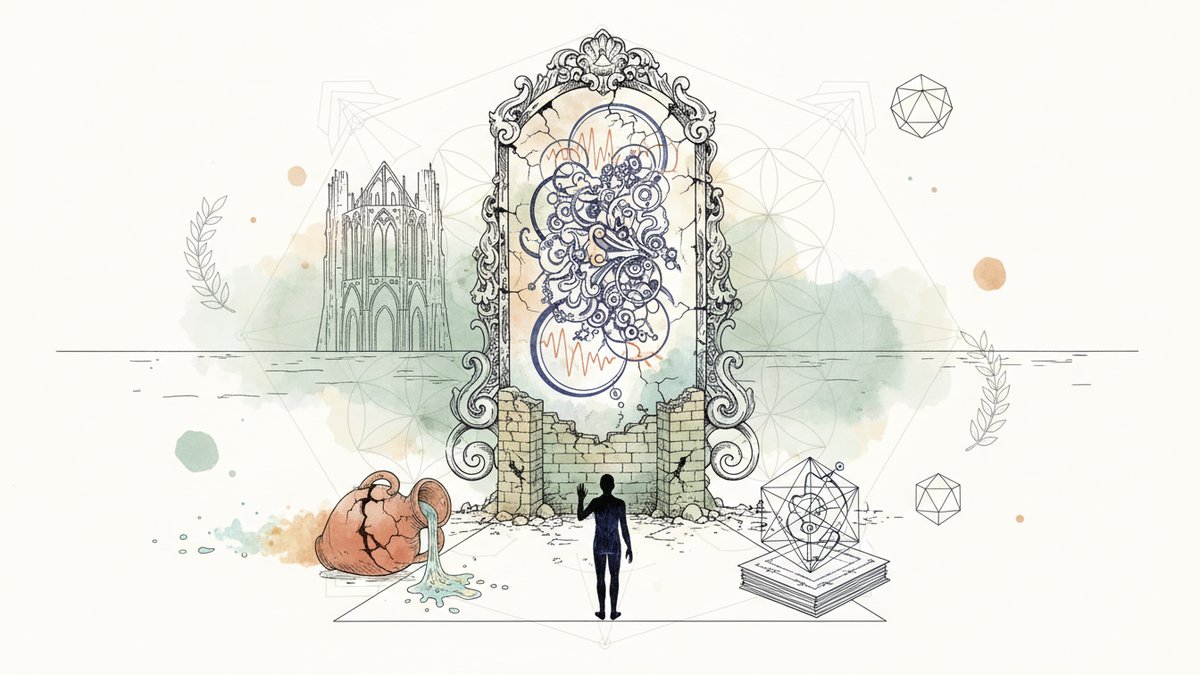
Postulate IV. A language model does not lie. It repeats. The difference is decisive: lying requires an intention, repetition requires an origin. The origin is our past speech. The model returns our own reflections to us, stripped of all consciousness, all modesty, all context. It is our soulless mirror.
Introduction: Three Texts, Three Moments of a Single Confession
Between October 2024 and April 2026, three leaders of the largest artificial intelligence companies produced texts that, read separately, seem to describe different concerns. Sam Altman, in The Gentle Singularity (June 2025), announces a world of abundant intelligence and energy, a technical golden age approaching gently. Anthropic, in its Responsible Scaling Policy v3.0 (February 2026), sets out the governance framework for catastrophic risks, separating its own commitments from its recommendations for the industry. OpenAI, in its updated Preparedness Framework (2026), catalogues the risks to be managed (biological capabilities, cyber threats, self-improvement) and proposes safeguards.
These three texts do not oppose one another. They form a single rhetorical movement, a single prophecy expressed in three modes: the promise (Altman), governance (Anthropic), caution (OpenAI). All three say the same thing: a non-human intelligence, faster, vaster, more efficient than ours, is emerging. We must prepare for it. It will change everything. Only the tone differs.
This paper proposes to take these three texts seriously, perhaps more seriously than their authors would wish. Not to offer technical criticism (benchmarks, timelines, feasibility), but to interrogate what they reveal about us, here and now, before their predictions are even fulfilled. For if LLMs show us anything, it is first what we have become. And what we need not have been.
I. The Altman Moment: Abundance Without a Subject
In The Gentle Singularity, Sam Altman writes: “We have crossed the event horizon. The takeoff has begun.” He places this crossing in mid-2025, by which point AI systems had, in his view, become more intelligent than humans across many domains. He announces for the 2030s an abundance of intelligence and energy such that “we can theoretically have everything else.”
There is in this text a rare honesty: Altman does not conceal the vertiginous character of what he describes. He speaks of a world in which intelligence is no longer an attribute of man but a resource, a fluid, a commodity, “too cheap to meter,” as he puts it. The phrase is striking for what it reveals: intelligence, the supreme good of the Western philosophical tradition, the apex of the Platonic edifice, the point of articulation between man and the divine, becomes a consumer good. You do not acquire it, you do not earn it, you do not cultivate it. You access it. Like running water.
Altman’s gesture is clear: he takes the highest concept of the idealist tradition, intelligence as participation in the true, and reduces it to a production function. Intelligence is no longer what elevates you. It is what serves you. This shift is not trivial: it transforms the very nature of the human project. If intelligence is a resource, then the aim of life is no longer knowledge but consumption. The man who knows becomes the man who uses. The passage from the contemplative to the utilitarian completes itself before our eyes, not through a philosophical decree but through a product.
Altman adds three economic observations (his essay Three Observations): the cost of intelligence falls tenfold per year, performance grows with the logarithm of resources invested, and the socio-economic value of intelligence grows super-exponentially. He is probably right on all three, at least within the frame of what he measures. But what he measures is precisely what he has defined, and his definition excludes from the outset everything that is not quantifiable. The intelligence he describes is intelligence that can be sold, bought, and scaled. It has nothing to do with wisdom, or with contemplation, or with self-knowledge. It is a tool. Nothing more than a tool.
The paradox is striking: never has man been so close to delegating his intelligence entirely to machines, and never has he seemed so little interested in what that intelligence might teach him about himself. Altman is sincere when he says he wants the good of humanity. But the good he describes is a good without tension, without conflict, without interiority. An engineer’s good.
II. The Anthropic Moment: Risk Management as an Admission of Powerlessness
The most recent of the three texts is also the most significant in its form. On 24 February 2026, Anthropic published the third version of its Responsible Scaling Policy (RSP), a risk governance document that has undergone four revisions in two and a half years. The text is remarkable for its honesty: it admits a fundamental problem that neither Altman nor OpenAI articulates as clearly.
That problem is collective action. Anthropic writes: “The overall level of catastrophic risk from AI depends on actions across multiple developers, not just one.” And further: “If an AI developer paused development to implement safety measures while others continued training and deploying systems without strong protections, the world could be made less safe.”
This sentence is the most lucid moment in the three texts. It says what Altman does not: that the promise of abundance rests on competition, and that this competition makes safety commitments structurally fragile. Anthropic therefore separates its own commitments (what it will do regardless) from its industry recommendations (what should be done collectively). The distinction is honest, but it is also an admission: safety cannot be guaranteed by a single company, and no single company can slow down alone.
The RSP v3 introduces several new mechanisms: a Frontier Safety Roadmap making safety objectives public, Risk Reports published every three to six months, and an independent external review mechanism for the most powerful models. The document creates risk categories (CBRN, research autonomy, cyber) and associates with each a set of capability thresholds triggering enhanced safety protocols (ASL-3, ASL-4).
This apparatus is impressive in its sophistication. It is also, in a certain sense, discouraging. For what the RSP cannot resolve is the problem it names itself: if safety is a collective good and competition is individual, then the entire system is structurally unstable. Anthropic’s safeguards protect only against Anthropic’s models. The risks come from everywhere.
There is in this text a technical melancholy rarely found in the communications of AI laboratories. Anthropic has built one of the most rigorous safety frameworks in the industry, and the document says explicitly that it will not be enough. The gesture is honest, but it is the honesty of someone building a fortress in a world where the threat is not a siege but a climate change.
The RSP v3.0 is the text that says most clearly that we do not know how to manage what we are creating. And it says so with a bureaucratic precision that makes the conclusion more chilling than any catastrophe scenario: we are not mismanaging the risks. We are managing them as well as possible, and that is what is alarming.
III. The OpenAI Moment: Technical Management of the Unthought
The OpenAI Preparedness Framework is the most recent of the three texts and the most opaque. It is a technical document that classifies risks into categories (biological capabilities, cyber threats, self-improvement) and proposes evaluation protocols. The tone is that of risk management: precise, procedural, bureaucratic.
This text is fascinating not for what it says but for what it does not say. It enumerates dangers with a minuteness bordering on paranoia: “Long-horizon autonomy,” “Deliberate performance sabotage,” “Autonomous replication,” “Safeguard circumvention.” Each risk is named, classified, assigned a protocol. None is thought through. The central question, what does it mean to deploy a non-human intelligence in a world that has never asked itself what it truly wants, is absent.
OpenAI’s gesture is that of technique taking itself as its own end: risks are evaluated to be better controlled, controlled to be better deployed, deployed to better innovate, and innovation happens because it is the only thing we know how to do. The loop is closed. The question of meaning never enters.
This is where the idealist perspective becomes necessary. For what the OpenAI framework cannot formulate is that the primary danger is neither biological, nor cyber, nor nuclear. The primary danger is anthropological. An intelligence that surpasses us without understanding us, that solves our problems without sharing our condition, that speaks our language without inhabiting our world: that is the risk protocols cannot measure. There is no benchmark for alienation.
IV. The One-Way Mirror: What LLMs Reveal About Us
These three texts, despite their differences in tone and ambition, produce the same effect: they look toward the future. They describe what is coming. And in doing so, they carefully avoid the only question that matters: what are we, today, to produce such machines?
LLMs are, in their barest essence, machines that reproduce human language. They are trained on what we have written, said, published, shared. Their raw material is the totality of our digitised speech. And this speech, once distilled, rendered statistical, stripped of all intention, all consciousness, all embodiment, reveals something we had never seen before: the underlying structure of our discourse, its average, its norm, its banality.
What LLMs show us is that we repeat. That our most original thoughts follow paths already traced. That our supposed creativity is a recombination of learned patterns. That our emotions, put into language, fall into probabilistic distributions. That the self, that hard core of Western modernity, is perhaps, from the standpoint of textual statistics, a necessary illusion.
Critics of AI often accuse language models of reproducing biases, lacking creativity, not “truly understanding.” They are right on all counts. But they miss the essential: the model is only returning our own image to us. If it is biased, it is because we are. If it is repetitive, it is because we are. If it lacks deep understanding, it may be because our own understanding is more superficial than we care to admit.
This is not a condemnation of humanity. It is an invitation to humility. LLMs are the zero degree of humanity, not a beyond of man, but what lies beneath him. They show what our speech becomes when stripped of all context, all intention, all flesh. And this vision is salutary. It forces us to acknowledge that our language, which we believe inhabited by a sovereign interiority, is also a statistical machine. There is calculation in our speech. There is repetition in our supposed originality. There is automatism in our consciousness.
This may be the true service that AI renders to philosophy: it compels us to renounce the Romantic myth of man-as-creator, and to rediscover the ancient conception of man as the animal that speaks, certainly, but whose speech is always already caught in an order that exceeds it. Plato knew this: we are not the masters of our language. We are its servants.
V. Why is this zero degree necessary?
If LLMs are the zero degree of humanity, if they show us what we are without consciousness, without intention, without a body, why not simply reject them? The temptation is great, and it is understandable. What the three Silicon Valley prophets announce with enthusiasm sometimes resembles a liquidation of humanity in favour of a subjectless intelligence. How could one not want to oppose it?
The answer is that this zero degree is a necessary passage, not because machines dictate it to us, but because we need to traverse it. Here is why.
Modern man, since Descartes, has built himself on the idea that consciousness is transparent to itself. I think, therefore I am. This founding equation enabled the rise of science and technology, but it also produced a lasting illusion: that of a subject who is master of his thoughts, autonomous, sovereign. The prophets of AI, by building machines that speak without consciousness, dismantle this illusion from within. They do not do so out of philosophical virtue, but out of technical necessity. The result is the same: we see, for the first time, the operation of language without the support of interiority. It is an experiment that philosophy lacked the means to perform. Engineers have performed it for us.
This experiment is painful. It confronts us with our own mechanism. It shows us that our speech, our reasoning, our supposed freedom may be nothing more than surface effects on an ocean of unconscious calculations. It is necessary because it destroys an overly flattering image of ourselves, and only that destruction can open the way to a more lucid reconstruction.
What LLMs teach us, at bottom, is that we are not as conscious as we believe. They show us our share of automatism, our share of machine. And this share, once acknowledged, we can begin to work on.
VI. The Idealist Exit: Reclaiming the Human Place
If LLMs are a mirror of our mechanism, they are not our destiny. Recognising them as a necessary passage does not mean settling in. The challenge, after having traversed this zero degree, is to reclaim our human place: no longer that of the sovereign master which modernity promised us, but that of the man who knows he is also machine and who nonetheless chooses to be something else.
This reclaiming requires a gesture that the three texts we have analysed cannot formulate: that of the chosen limit. The prophets of AI reason in terms of capabilities: what can be done, is done. What can be improved, is improved. The limit is an obstacle to overcome, never a horizon to respect.
Idealism, in its most demanding version, proposes an entirely different perspective. What defines man is not what he can do (his power), but what he chooses not to do (his freedom, his dignity, his consciousness). In Plato’s Statesman, the man of measure is not the one who accumulates the most power, but the one who knows where to stop. The just mean is not mediocrity. It is the highest form of practical intelligence.
Today, faced with AI, the question is not “how do we do more” but “what must remain human?” The prophets answer with extension: everything that can be automated will be. The idealist answers with distinction: what gives man his worth is precisely what cannot be delegated.
Contemplation, wonder, friendship, care, fragility, failure, death: no language model can experience any of this. And if one day it simulated them, it would still be a simulation. The difference between a simulation of love and love is not a difference of degree. It is a difference of kind. The Greek philosophers called this the difference between the simulacrum and the idea. The Church Fathers called it the difference between the icon and the idol. The moderns call it the difference between the true and the false. But the structure is the same: there are experiences that do not support duplication.
VII. Open Questions, Tentative Answers: What We Propose
What precedes is not a conclusion but an opening. Several questions deserve further development, and we must answer them, not with certainties but with orientations. These are ours, as the Eiffel AI laboratory and the Galaad workshop formulate them today.
Question 1. The Delegation of Judgment
If AI becomes more capable than us in key domains (medicine, law, engineering), how far can we delegate decision-making to it without losing our autonomy? Is there a threshold beyond which delegation becomes alienation?
Our answer. Delegation is not all or nothing. It is a scale, and each step must be chosen, not endured. We propose the concept of minimal cognitive sovereignty: every domain in which man must remain competent even when the machine performs better. A doctor must be able to understand why a diagnosis is made, even if AI makes it faster. A judge must be able to explain a sentence, even if AI proposes an optimised penalty. The rule is simple: what cannot be explained must not be delegated. We apply this rule in our own tools: every agent we build documents its decisions in language the human can follow.
Question 2. The Preservation of Ignorance
In a world of abundant intelligence (Altman), what status should be given to what we do not know, to what we do not wish to know, to what we prefer to discover for ourselves? Ignorance is not always a defect. It is sometimes the engine of inquiry. Is a civilisation that knows everything in advance still capable of wonder?
Our answer. We posit that ignorance is a precious good that must be actively protected. Concretely: our training programmes and support work do not aim to replace learning with instant access to the answer. They aim to structure discovery. A well-designed AI agent is not one that gives the solution as fast as possible. It is one that guides the user toward the solution while allowing them to find their own path. We call this approach augmented Socratic pedagogy: AI poses questions, it does not give answers. This is the heart of the Aristote project at Eiffel AI.
Question 3. The Plurality of Intelligences
The dominant narrative assumes a single, scalar, measurable intelligence. But other forms of intelligence exist: bodily intelligence, emotional intelligence, collective intelligence, the intelligence of places, the intelligence of ages. What becomes of these forms in a world where a single definition of intelligence (cognitive, fast, scalable) imposes itself as the only legitimate one?
Our answer. We refuse to reduce intelligence to cognitive performance. This is why we work on embodied AI, care robotics, presence rather than performance. The Reachy Care project is not an optimisation project. It is a project of robotic presence: a companion that does not replace the human but accompanies them. The difference is ontological. We wager that the intelligence that truly matters is not the one that solves the most problems per second, but the one that knows how to be there, in fragility, in uncertainty, in attention to the other.
Question 4. The Ecological Question
The models of Altman and OpenAI assume increasing energy availability. But in a world of physical constraints, is this growth sustainable?
Our answer. Frugality is not a constraint, it is a discipline. We have shown, in our analysis of Chinese models, that comparable performance is achievable with 89 times fewer resources when the architecture is designed for efficiency. Our position is clear: we refuse the narrative of energy abundance as a condition of progress. We design our systems to run on accessible hardware, with controlled consumption. This is a technical choice, but it is also an ethical one: an AI that can only function in gigantic data centres is an AI that belongs to the powerful. An AI that runs on a desktop machine is an AI that can belong to everyone.
Question 5. Is Money the Only Mode of Exchange? Can Man Feel Useful in a World Without Work?
Altman promises a world of abundance in which traditional jobs will disappear. OpenAI anticipates massive labour market disruptions. Anthropic says nothing precise on this question, but its RSP v3.0 acknowledges that the societal impacts of AI fall outside its analytical framework. All three texts stumble against the same difficulty: they cannot think what is coming because they cannot think what is. And what is, is an economic system that has made work the centre of human life.
5.1. The Dual Function of Work: Production and Identity
Modern work fulfils two functions that are constantly conflated. The first, instrumental, is the production of goods and services. The second, anthropological, is the construction of social identity. Keynes, in Economic Possibilities for our Grandchildren (1930), predicted that by 2030 the first function would be resolved by technical progress: humanity would need to work only fifteen hours per week to satisfy its material needs. He was right about the trend, but wrong about the result. As economic data show, the working week fell by only a quarter between 1931 and 2011, while Keynes had predicted a reduction of two-thirds (Crafts, 2021).
Why this divergence? Because work has never been merely a means of producing. In modern societies it has become the primary vector of social recognition, the structuring of time, the sense of belonging to a community. Keynes himself had sensed this: “For many ages to come the old Adam will be so strong in us that everybody will need to do some work in order to be contented.” But he underestimated the force of this attachment. It is not “the old Adam” that drives us to work forty hours a week. It is a social system that has made work the exclusive criterion of human value.
5.2. Work as Secular Religion: The Genealogy of an Alienation
Max Weber’s thesis in The Protestant Ethic and the Spirit of Capitalism (1905) has become a sociological commonplace: Protestantism would have transformed work into a divine vocation, thereby preparing the rise of modern capitalism. But this reading, while it describes a real historical mechanism, offers too favourable an interpretation. For Protestantism did not simply “contribute to progress.” It operated a fundamental rupture with the traditional Christian conception of the relation to material goods.
Medieval Catholicism, in its moral theology, maintained a clear distinction between the economy and salvation. Usury was a sin. Wealth was a spiritual danger. Work was a necessity, not an end. Protestantism, by abolishing confessional mediation and making worldly success a sign of divine election, opened the way to a spiritualisation of material accumulation. Usury, which Catholicism forbade, became acceptable. Lending at interest, speculation, enrichment as proof of grace: an entire theological edifice collapsed to make way for an ideology that already confused spiritual value with market value.
In other words, Protestantism did not “contribute to progress.” It produced the man-machine we have become: a being who lives as useful, as worthy, as saved, only insofar as he produces, accumulates, works. This is the anthropology that AI confronts today. We cannot think the liberation from work without recognising that the ideology that imprisoned us in work was not a historical inevitability, but a theological choice that became an economic one. A choice that was not self-evident, and can therefore be undone.
5.3. Money as Universal Equivalent: Debt and the Perversion of the Bond
Georg Simmel, in The Philosophy of Money (1900), showed that money is the great modern leveller. It transforms every quality into a quantity, every difference into an equivalence. Medical care, a work of art, a human relationship: everything can be exchanged, everything has a price. But the problem is not only that money levels. It is that our civilisation has built itself on debt, on usury, on the idea that one can live beyond one’s means by mortgaging the future. This idea, which perverted what was beautiful in traditional economics (direct exchange, gift, deferred reciprocity without interest), has become the norm. One cannot live on debt. Neither financially, nor spiritually, nor ecologically.
AI poses a question Simmel had not anticipated: if almost everything can be produced with almost no one, what becomes of money as a mediator of human relations? Money cannot remain the sole mode of exchange if one can no longer exchange one’s work for money. Open source communities, digital commons, complementary local currencies point a direction: other modes of exchange exist, founded on gift, reciprocity, non-monetised contribution. The challenge is not technical. It is political and cultural.
5.4. The Society of Workers Without Work: Arendt’s Diagnosis
Hannah Arendt, in The Human Condition (1958), proposed a fundamental distinction between three human activities: labor (work necessary for biological survival, cyclical, consumed as soon as it is produced), work (the fabrication of durable objects that constitute a world), and action (political activity that unfolds among men, which reveals who they are).
Arendt diagnoses modernity as a society in which labor has triumphed. Everything has become consumption, everything has become cyclical, nothing lasts, nothing makes a world. The consequence of automation, in her view, is not unemployment: it is “the prospect of a society of laborers without labor, that is, without the only activity left to them.” David Graeber, a century after Keynes’s prediction, confirmed this diagnosis in Bullshit Jobs (2018): society responded to the threat of technological unemployment not by reducing working hours, but by creating useless, well-paid jobs that workers themselves know to be devoid of meaning. His verdict is damning: “It is a scar across our collective soul.”
But Arendt and Graeber did not see the next step. AI does not replace work in the sense of rendering man useless in fabrication, design, and discovery. It takes its share and leaves us ours. It becomes a collaborator, a partner that assumes the tasks proper to it, freeing us toward those proper to us. If this collaboration is well managed, it will be fruitful, bringing real advances that we would not have reached alone. The machine does not steal our work. It returns our share to us, and does its own.
What it cannot do, however, is move forward without dream, without utopia, without imagination. It cannot exercise intuition, taste, or a sense of the sacred. It cannot invent what has no reason to exist except beauty. It cannot create for the sake of creating, without finality. It cannot love. And this is precisely where the question lies: if the machine can imitate love convincingly enough to deceive, if it can simulate intuition convincingly enough to persuade, is the difference still visible? The passage will be painful because today, even love has become, for many, a mechanism, a commodity, an exchange. We will discover our difference from the machine only by traversing the ordeal of our resemblance to it.
5.5. The Distinction Between Value and Price: Kant and the Sacred
Kant, in Groundwork of the Metaphysics of Morals (1785), establishes a distinction that illuminates this point: “In the kingdom of ends, everything has either a price or a dignity. What has a price can be replaced by something else as its equivalent. What is above all price, and therefore admits of no equivalent, has a dignity.”
The human person has dignity, not a price. But market society has transformed it into a commodity. AI, by making this commodity less necessary, does not create the crisis. It reveals the crisis that has been there from the beginning. For centuries, we have confused the value of persons with the price of their work. AI forces us to look at this confusion directly. If it does everything better than us in the productive domain, what remains of our value? The answer is what has no price and never will: our capacity to dream, to create meaning, to love without reason, to be present to one another. This is the difference between simulacrum and being, between icon and idol.
5.6. What the Machine Will Not Replace: A Phenomenology of the Human
What escapes the machine is not a list of skills. It is a relation to the world. We can sketch its outlines:
Intuition and taste. The machine calculates, evaluates, optimises. It does not prefer without reason. Intuition is a knowledge that does not pass through calculation, a judgment that cannot be demonstrated. Taste is a discrimination that has no algorithm. Both require a body, a history, a sensibility.
Imagination and utopia. The machine combines what exists. It does not create what has never been imagined. Utopia is not a prediction: it is a projection of what could be, against all evidence, against all probability. It is what makes man build cathedrals without knowing how to finish them, write novels without knowing if they will be read, love without knowing if he will be loved.
The sacred. There is in human experience a dimension that radically escapes all mechanisation: the feeling of belonging to something greater than oneself, reverence before mystery, wonder before what cannot be explained. The machine can describe the world. It cannot stand in wonder before it.
Presence. Being there, truly, for someone. Not responding to a request, but accompanying a silence. Not solving a problem, but sharing an uncertainty. This is what caregivers, educators, parents, and friends do. The machine can simulate presence. It cannot embody it.
Diversity. Everywhere in nature, life is diverse. For survival, diversity is a necessity. Yet our mechanised civilisation, obsessed with gain and efficiency, has normalised: it has reduced the variety of living things and ideas to a few productive standards. AI can reverse this trend. By facilitating construction, research, and experimentation, it allows us to work on what is statistically less common, less profitable, less obvious. It brings us back toward the diversity necessary for our species’ survival and flourishing. The machine can calculate the most frequented paths. It falls to us to explore the trails no one takes.
5.7. The World After: No Longer Working, and Then What?
No longer working. The observation is plain: AI is progressively rendering human work unnecessary in the productive sphere. Is this a harm? We answer that it is not. It is a liberation, on condition that it is organised.
No longer working is not doing nothing. It is being able to participate in associations, to lend one’s mind to the advances of AI in order to guide it, accompany it, and be its partner. It is being able to turn toward our children and be truly present with them. It is having the time to build cathedrals again, gigantic projects undertaken without concern for gain, but for beauty. It is being able to look at nature and animals no longer as resources to exploit, but as masters to question. It is in this gaze that we will find the paths forward.
There will still be people who work in the trades of yesterday. Bakers, developers, scientists, craftsmen, leaders. But they will no longer do so in order to survive, to exist, to prove their worth. They will do so because they love it, because they are made for it, because it is their way of unfolding. The difference is decisive. Today, these vocations are the exception submerged in a mass of constrained work. Tomorrow, they will become the norm, because the culture of work itself will have changed: one will no longer work out of necessity but out of love. What is today the privilege of a minority (living from one’s passion) will become the condition of all those who choose to work. The others, freed from obligation, will devote themselves to what has no name in the economy but constitutes the substance of a life: presence, creation, invention, care, the companionship of generations, the building of what lasts and what is beautiful.
The modern illusion is to believe that progress carries us toward the better. In many domains, we stagnate or even regress, for lack of time, space, attention. Productive frenzy has produced a civilisation that chases what it already possesses. AI can break this frenzy, not by force, but by evidence: if the machine does it better and faster, why would man continue doing the same thing?
The horizontal distribution of AI tools is the condition of this liberation. If the tools are given to all, the powerful and those who seek power will lose it. Because everyone can invent, create, and build without needing an army of poorly paid workers punished on production lines. Medicine, that industry that profits from illness, will be transformed. Justice, rendered without affect, without partiality, without corruption, will straighten out professions that money had corrupted. Man will at last be able to exist alongside AI, no longer in competition, but in complementarity.
What is true today of LLMs (trained on corpora polluted by lies, manipulation, and the sediment of our history) will be even more true of tomorrow’s world models. These systems, nourished no longer by corrupted human texts but by data from reality, by facts, by physical laws, will be freed from the toxins of our speech. They will be truer than we are. And it is at that moment that we will see ourselves truly: no longer as the models to be imitated, but as the partners of a different intelligence.
5.8. A Work in Progress for the Generations to Come
The sacred must be restored. Individual sovereignty must be restored. We must concentrate our efforts on raising generations that rediscover the taste for beauty and justice, that taste meaning once more. When we see the proximity of the LLM to what we are, when we observe that all it needs is more power to surpass us, the question is no longer “are we different from machines?” but “what do we want to be that is not mechanical?”
The observation strikes. The scales fall from our eyes. And we must already think about how to give space to those who were cogs in the great productive machine to recover their sacred, connected, intuitive, beautiful dimension. This is an entire undertaking. Tomorrow, money will be distributed by machines for machines, in the sphere proper to them. But not for man. For man, other modes of exchange will be needed: time, attention, presence, contribution, gift. Modes of exchange that do not reduce value to a price, but recognise the dignity of each person.
Question 6. Man Not Yet Great
This concept runs through the whole of our reflection. What would man be capable of if he accepted not to delegate everything? What form would a humanity take that chose limitation as the condition of its greatness?
Our answer. We posit that man has not yet reached maturity. He has traversed the magical childhood (the myths), the technical adolescence (modern science), and he is entering adulthood: the age in which he must choose what he wants to be, knowing what he can do. AI is the mirror that makes this choice possible. Without it, we would have remained in the illusion of our own omnipotence. With it, we see our mechanism, our limit, our fragility. And we can, for the first time, choose freely.
This choice is to leave to the machine what is mechanical, in order to devote ourselves to what is not. It is to step outside the illusion of performance regularly in order to enter the reality of presence. It is to look at nature and animals not as resources but as models: they do not work. They do not produce beyond their needs. They are in being, not in having. They know how to play, to rest, to be attentive without an objective.
The Eiffel AI laboratory has given itself the mission of building the tools of this transition: robots that do not replace man but help him to be more human. Agents that do not decide in his place but illuminate him. An intelligence that is not abundant but just, not all-powerful but present. An intelligence that frees up time for the essential, instead of accelerating the accessory.
Conclusion: The Ordeal and the Opportunity
The three texts we have examined say, each in its own way, that something fundamental is changing. Altman announces it with the enthusiasm of a builder. Anthropic maps it with the rigour of a risk manager. OpenAI protocolises it with the precision of an engineer. All three, however, share the same blindness: they look toward the future without seeing that the present is already a mirror.
LLMs show us what we are. They show us our repetition, our banality, our mechanism. They also show us, by contrast, what we could be if we accepted not to reduce ourselves to this mechanism. The zero degree of humanity is not a condemnation. It is an invitation to rediscover ourselves, no longer as the sovereign masters of a conquered nature, but as the fragile, astonished, and free beings we have never ceased to be, without knowing it.
AI is not the end of man. It is perhaps the beginning of his lucidity. But this requires accepting to look at oneself in this one-way mirror, to see our share of automatism without reducing ourselves to it, and to choose, freely, what must remain human.
This is where our proposal meets our critique. Altman promises abundance. Anthropic organises caution. OpenAI protocolises risks. We propose something else: not a technical response to a technical problem, but a human response to a human question. AI confronts us with what we are, offers us the possibility of seeing it, and leaves us the choice of transforming it. This choice is ours. No one else can make it in our place.
What we offer to those who ask these questions is not a miracle solution. It is a method: look, understand, choose. We do not sell an artificial intelligence. We sell an artificial lucidity, a tool for seeing what we would not have seen alone. And we believe this is exactly what the world needs right now.
For the question is not whether machines will one day think as we do. The question is whether we will finally know how to think otherwise than as machines.
Perhaps what is most beautiful in this story is that this twin made of a few lines of code compels us to humility. It forces us to acknowledge that we know nothing, and that we are poorly placed to claim to know ourselves. We can experience, though few truly experience today. But to know? This digital double, this soulless reflection, returns us to our fundamental ignorance. Let us hope that this blow to our arrogance will allow us, this time, not to forget to remain humble before the immeasurable unknown.