Lesson of April 24, 2026
A few days ago, Garry Tan, president and CEO of Y Combinator, opened a public video with this sentence: “I’ve coded more in the past two months than I did in all of 2013, the last time I really worked hard as an engineer.” In the same video, he shows how he rebuilt alone, in two months, the functional equivalent of Posterous, the micro-blogging platform that had taken him two years to build with a cofounder and ten engineers, for ten million dollars. The figure is vertiginous. But the figure is not what matters.
What matters is what Tan built to get there: two pieces of free software, GStack and GBrain, which he released under MIT license on his personal GitHub account. GStack turns Claude Code into a virtual engineering team with twenty-three roles. GBrain gives an agent the long memory it needs so as not to relearn who you are in every session. Together, they form a stack that has existed only for a few weeks, that has already collected more than eighty thousand stars on GitHub for the former and more than ten thousand in twenty-four hours for the latter, and that arouses as much enthusiasm as criticism. For Eiffel AI, the question is not whether Tan is right or whether he overplays his hand, it is to examine what this trajectory teaches about the way a human can work with artificial intelligence without dissolving into it.
What GStack is, in one word: the division of labor
The classic objection against multi-agent frameworks is quickly stated: “multi-agent is hype”. It targets systems that stack agents to solve an atomic task, multiplying layers without improving the output. The objection is valid against many products on the market. It is not valid against GStack, because GStack does not compose agents to answer a question, it divides a long engineering pipeline into successive stages.
Twenty-three roles: product manager, designer, tech lead, backend, frontend, DBA, SRE, security reviewer, manual QA, end-to-end QA, dev-experience engineer, documentation writer, growth, support, data, ML, accessibility, i18n, legal, finance, recruiting, chief executive, head of engineering. Each role is a native subagent of Claude Code, with its own context, its own prompt, its own permitted tools. The main agent does not do everything: it dispatches.
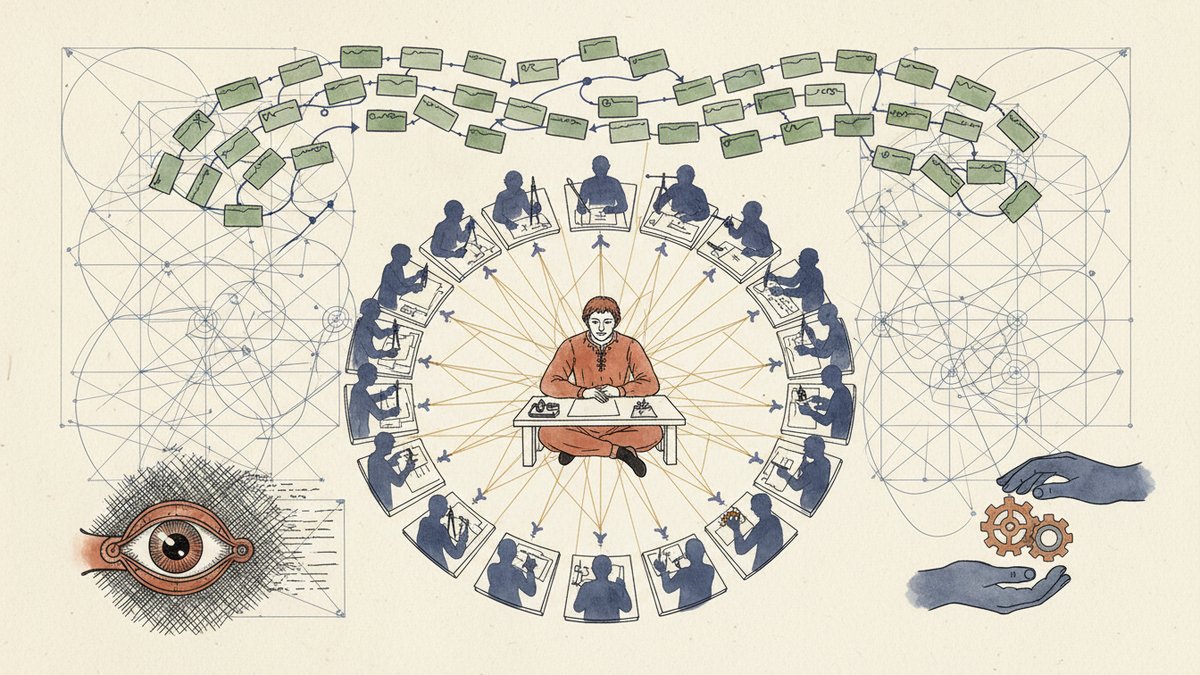
Tan sums up the thesis in one taut sentence: “The way to get agents to do real work is the same way humans have always done it, as a team with roles, with process, with review.” The proposition is not technical, it is organizational. There is nothing original about the architecture, it is the architecture of a well-functioning company. What is new is that a single human being can now embody that company.
One of the roles has drawn particular attention: the paranoid reviewer, whose explicit mission is to look for what the others have not seen. A public testimony reports that it detected a cross-site scripting flaw in code reviewed by a human team that had not seen it. A textbook case of what a second, adversarial, patient, tireless automated glance is worth. We will no doubt borrow it, so that it may join Rodin, the agent we have adopted and which was graciously offered by Benjamin Code. Ah, open source 😉 !
What GBrain is, in one sentence: the memory that sorts
Agent memory is another doctrinal trap. The prevailing doxa of the field says: “longer context windows are all you need”. One million tokens, two million, and the agent will remember everything. GBrain contradicts that thesis head-on.
Memory is not a volume of text stored inside an attention window, it is a structure of selective recall. A human being does not remember by concatenating their life inside a window, they index, they weave, they recall. GBrain embodies that distinction. The architecture: ten thousand Markdown files and more, drawn from Tan’s personal corpus, three thousand pages of entities (people, companies, events), two hundred and eighty meeting transcripts, thirteen years of calendar. A self-wiring knowledge graph that extracts entities and their typed links without requiring that the ontology be maintained by hand. A hybrid search, lexical and semantic, which does not look for everything but sorts what is relevant.
A privacy-first claim: GBrain runs locally, the database stays with the user, nothing goes up to a third-party server. Tan states it clearly: “GBrain doesn’t phone home.” The MIT license makes audit possible, which is not a detail when one is handing thirteen years of one’s life over to a system.
The positioning deserves a nuance. GBrain is not alone in this field. MemPalace, mem0, Letta, Zep, Cognee, Graphiti occupy the same territory with sometimes opposing theses. MemPalace bets on a strict ontology and a discipline of use inscribed in the agents’ protocol. GBrain bets on automatic extraction and less human friction. Which will hold over time, on a multi-year corpus, with a demanding user? That is the open question. But Tan’s choice is clear, and it is interesting for its methodological honesty: he demonstrates his tool on thirteen years of calendar and ten thousand real documents, not on a synthetic startup demo.
What must be watched: not the tool, the gesture
If we stopped at the tools, we would miss the essential. The important gesture in Tan lies elsewhere. Here is what he says, still in the same video, speaking of his own transformation: “I’ve coded more in the past two months than I did in all of 2013.” Then, later: “This is my open source software factory. I use it every day.”
The lesson holds in two movements. First, Tan transformed himself by building his tools. He did not consume a product, he composed an environment. Every skill of GStack, every entity of GBrain, every role, every pipeline, reflects the way he wants to work. The tool is a continuation of the gesture, not a substitute. And because he built this environment in public, under MIT license, others can take it up without paying a tithe, modify it, graft it onto their own practice.
Second, Tan embodies a thesis we defend at Eiffel: AI accompanies the responsible creator instead of replacing them. He did not eliminate the ten engineers of Posterous, he did something other than Posterous at a different density. The same person, armed differently, produces on another scale of time. This displacement is not trivial, it interrogates what a craft is, what a team is, what the value of an engineer is. But it does not call into question the centrality of the human being who decides. Tan remains the one who dispatches, who chooses, who closes the loop.
The Eiffel AI echo: OpenClaw, Hermes, and open source as lung
This reading meets our own work. Eiffel AI will publish its bricks under free license. We use OpenClaw (AGPL-3.0) as a daily automation layer, the one that orchestrates the development and deployment pipelines of the Reachy Care, Aristote and VegeOhm projects. Hermes is our messenger layer, the one that allows our agents to communicate with each other and with us, with a documented API and an interoperability protocol. Both are on GitHub, readable, modifiable, auditable.
We have written in our manifesto that open source is the lung of the digital ecosystem. We say it because it is the only architecture of power that respects the sovereignty of whoever receives the tool. When a tool is free, the one who uses it can bend it to their home, correct it, continue it. When a tool is captive, the one who uses it bends their home to the tool.
Tan demonstrates this principle with his own publications. GStack and GBrain are not SaaS products, they are Git repositories. He could have turned them into a startup, raised funds, sold a subscription. He chose to lay them down in common, and to say to whoever would listen: here is my exact setup, take it. “I wanted you to be able to have my exact skill setup.” That sentence is more important than all the demos in the video. It tells what open source, done seriously, allows: the transmission of a gesture, not only of a tool.
What this changes for the way we work
For Eiffel AI, three consequences.
First, a confirmation that the workflow we are installing, architect, then planner, then builder, then evaluator, directly overlaps the GStack division. We did not invent this architecture, it emerges naturally when one has specialized agents work on a long engineering pipeline. Tan has encoded it in slash commands, we encode it in Claude Code business agents. The two approaches converge and mutually validate each other.
Next, the question of memory remains open. We use MemPalace, which bets on a strict ontology and a discipline of use carried by the agents. GBrain offers an alternative that bets on automatic extraction and a lesser cognitive demand. We will run the comparative test, on a real sub-corpus, with the same series of questions, to see which thesis holds. It is not a competition, it is an honest benchmark. What matters is that both systems are free, auditable, and that a demanding user can decide on observable grounds.
Finally, and this is the most important point, Tan sends us back to a simple question. What does each of us become by arming themselves seriously with these tools? An engineer who has become an engineer again, like Tan. An artist who can at last embody the scale of their intention. A physician who restores time at the patient’s bedside. A teacher who truly differentiates their teaching. Well-conceived AI does not replace these figures, it gives them back the density that a strictly divided modernity had withdrawn from them. Tan, by publishing his tools in common, invites us to make the same movement for our own crafts.
The workshop is open. To each of us to enter it with what we know, what we carry, what we want to build.
Alexandre Ferran, founder of Eiffel AI