Species, kingdoms and individuals: for an antifragile ecology of artificial intelligences
Author: Alexandre Ferran
Preliminary Postulates
Postulate I. There are three ways for a system to face shock and uncertainty. The fragile breaks, the robust resists without transforming, the antifragile strengthens through variation, constraint and contradiction. This distinction, formulated by Nassim Nicholas Taleb in Antifragile (2012), is not a rhetorical device. It names a real property, possessed by most living, economic and cognitive systems, and which no pursuit of perfection can produce, because perfection is precisely what cannot tolerate surprise, and what cannot tolerate surprise is already, unknowingly, promised to death.
Postulate II. Life has never wagered on the perfect organism. It has wagered on multiplicity: that of species, that of kingdoms, that of individuals within a single species. Natural selection, since Darwin, does not fashion an ideal creature it would refine indefinitely; it maintains permanent variation, and it is this variation, not the excellence of any individual, that allows life to weather catastrophes it could not anticipate. Biodiversity is not an ornament of the living. It is its insurance policy against the unknown.
Postulate III. Only variety can absorb variety. This theorem, which the cybernetician William Ross Ashby formulated in 1956 under the name of the law of requisite variety, states that a system can regulate a complex environment only if it itself possesses a complexity at least equal to it. A poor regulator always fails before a rich world. The safety of a milieu of intelligences cannot, therefore, arise from a single model, however perfect; it can only arise from a plurality whose variety equals that of the reality it claims to serve.
Postulate IV. Technology is not neutral. It bears the face of those who design it, finance it, regulate it and use it. This thesis, defended since Jacques Ellul and Martin Heidegger, has a direct consequence for our subject. If no technology is neutral, then no single technology should be entrusted with mediating the whole of reality. A non-neutral intelligence that became the exclusive intermediary between humanity and the world would impose its face on all of human experience, without anyone being able to compare it to another.
Postulate V. Alignment is not merely an internal property of a model; it is an ecological property of a milieu. Rendering an intelligence safe in itself is necessary, but to see it as the entire solution betrays an immaturity, and an arrogance of which only humanity is capable, for a single aligned intelligence remains a single wager on what good is, a wager without recourse if the hypothesis were false or if the intelligence were ever captured. There is, moreover, a deeper reason to distrust any such fixation. We change constantly, and what is true at one moment becomes the lie of the next, so that an alignment sealed once and for all also freezes a morality that, by tomorrow, will have aged. Durable safety does not, therefore, rest on the perfection of one member; it rests on the relationship between several members who watch, correct and limit one another, and who keep open, out of humility, the greatest possible number of side-paths.
A single death
One must begin with a simple, almost brutal sentence, and hold it to the end. If we are all alike, we will all die the same death. This is not a moral image; it is a biological law. A uniform population shares exactly the same vulnerabilities, and it takes only one of them to be found for the entire population to disappear. Nature has known this for hundreds of millions of years, and its response has been constant, stubborn, without exception: never play everything on a single form.
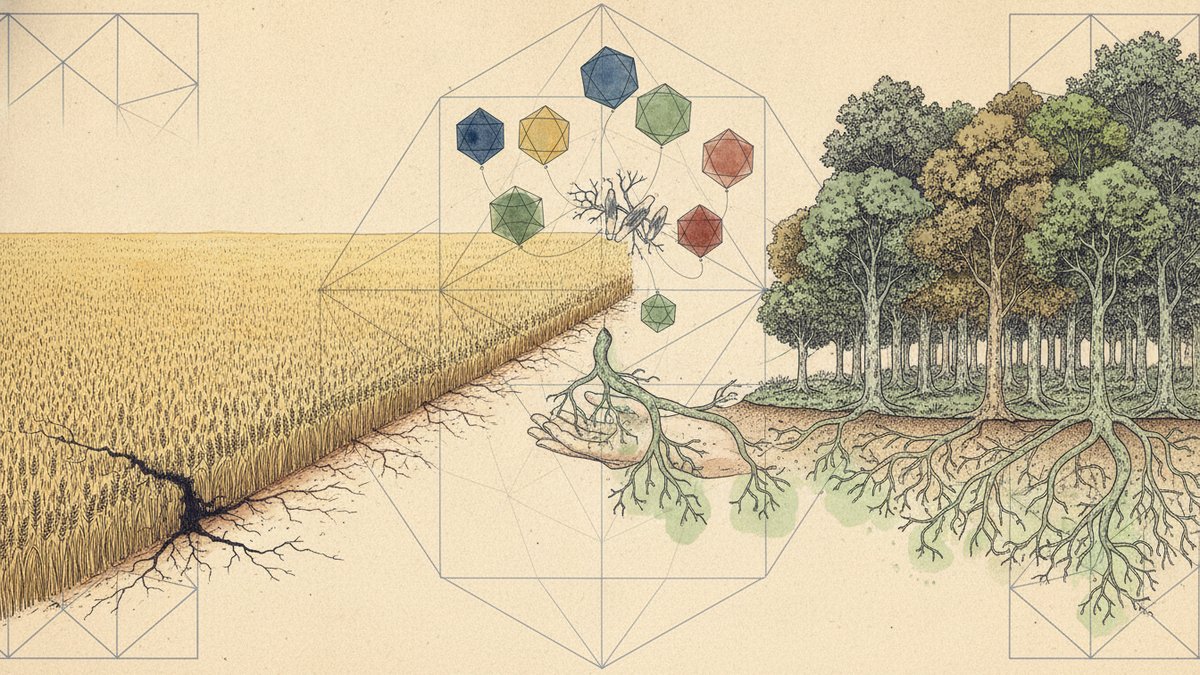
Look at a wheat field and a forest. The field yields an immense harvest and dies from a single disease. The forest produces nothing one can measure, and almost never dies. This image does not claim that artificial intelligence is already a field. It only forces us to ask the right question, the only one that matters for the decade ahead. Of these two models of robustness, which do we want for the intelligences we are building, and which are we letting win?
The impulse for this reflection I owe to a recent video by the Grand Angle Nova channel, which posed in clear terms a simple and powerful idea. Multiplying genuinely different artificial intelligences, not out of a taste for variety, but so that if some were to turn against humanity, others could help it resist, exactly as the living world does. This essay attempts to carry that intuition to its proper form, confronting it with the real state of the field in 2026, and with what biology, cybernetics and the idealist tradition have long known about diversity.
I. Antifragility, and the fragility of the unique
One must first distinguish three things that ordinary language conflates. The opposite of fragile is not robust. A parcel marked fragile dreads the shock, a robust parcel is indifferent to it, but neither profits from it. The antifragile, on the other hand, improves under shock, provided the shock remains measured and does not overwhelm it at once. Taleb writes it in a formula one does not forget: “The wind extinguishes a candle and energizes fire. You want to be the fire and wish for the wind.” Bone densifies under repeated load, muscle strengthens through repaired tears, the immune system builds itself on the infections it overcomes. Antifragility is not passive resistance; it is the art of feeding on disorder.
Two properties make antifragility, and the unique forbids both. The first is redundancy, which Taleb holds to be the key to life: “Nature likes to overinsure itself. Layers of redundancy are the central risk management property of natural systems.” Two kidneys for one function, an immense immune repertoire for threats never yet encountered, more seeds than will ever germinate. This redundancy may look like waste to the engineer who optimizes; it is in fact the margin in which the living absorbs the unforeseen. The second property is optionality, the possession of several possible paths, so that the closing of one does not carry off the whole. A diverse population is a bundle of open options against the future. A unique system has no options; it has a fate.
This is why the unique is structurally incapable of antifragility. A device that rests on a single central component concentrates all risks in one place. Reliability engineers know this as a single point of failure, and information security specialists have demonstrated it experimentally. As early as 1997, Stephanie Forrest showed that a fleet of identical machines falls entirely under a single attack, whereas a diversified fleet loses only a part of itself and continues to function. Software monoculture is a vulnerability, exactly as agricultural monoculture is. A single AI, however well designed, however safe it is proclaimed, would be a single point of failure at the scale of civilization. Its eventual flaw would cease to be one flaw among others; it would become everyone’s flaw, discovered at the same instant, with no other intelligence held in reserve to respond.
II. The lesson of the living
The proof that uniformity kills, nature gives us each time that humanity imposes it. The great Irish famine of 1845 was not caused by a fungus; it was caused by a monoculture. Ireland grew a single variety of potato, the Lumper, propagated by cuttings and therefore genetically identical from one field to the next. When the blight, Phytophthora infestans, arrived from America, it met not a single plant capable of resisting it, and the contagion swept the island. One million dead, one million exiled. The Gros Michel banana, standard of world commerce, was erased in the same way by Panama disease, and the Cavendish that replaced it, equally clonal, is threatened in its turn today. In 1970, American maize, standardized for industrial reasons around a single cytoplasm, lost nearly a fifth of the national harvest in a single season. Each time, the same scenario. Uniformity manufactures vulnerability, and the immediate yield it provides is paid for in deferred catastrophe.
Conversely, what the living protects durably, it protects through plurality. Sexual reproduction, costly and slow, has persisted only to shuffle the genetic cards ceaselessly and outmaneuver parasites, what biologists call the Red Queen hypothesis, formulated by Leigh Van Valen in 1973. The adaptive immune system does not produce a single defense; by recombination it engenders a repertoire of millions of distinct antibodies, to respond to aggressors it has never encountered. Masanobu Fukuoka, in The One-Straw Revolution (1975), showed on his own field, over fifty years, that one harvests just as well without plowing or chemicals by letting rice, barley, clover and what the agronomist calls weeds coexist, which are not enemies but competitors that strengthen the crop and enrich the soil. Lynn Margulis showed that the greatest leaps of evolution, such as the nucleated cell, were born not from the competition of a perfect organism, but from symbiosis between foreign forms. And Suzanne Simard established that trees exchange carbon, water and signals through the mycorrhizal networks linking their roots through fungi: the intelligence of a forest is lodged in no single tree; it is in the relationship between different forms.
I must be candid here, for science is not unanimous, and a substantive paper must never simplify what it invokes. The idea that diversity mechanically produces stability has been contested. Charles Elton argued for it in the 1950s; Robert May showed in 1972 that, in models of randomly drawn interactions, complexity could on the contrary destabilize a system. The debate lasted decades. It was settled, for the most part, by patient experimentation, notably by the long-term work of David Tilman on Minnesota grasslands, published in Nature in 1994: the plots richest in species resist drought better, produce more regularly, and recover more quickly after a shock. Diversity does not guarantee the survival of each species taken in isolation; it guarantees the persistence of the overall function, what ecologists call the portfolio effect. That is exactly what we must seek for artificial intelligence: not the guaranteed survival of each model, but the persistence of the function these models serve, which is to keep humanity connected to the true.
III. Diversity exists, and it is threatened
One must now be precise, for on this point easy alarmism is wrong. In 2026, artificial intelligence is not an accomplished monoculture. Approaches genuinely diverge, and this divergence is precious. The dominant paradigm, that of large language models trained to predict the next word, is no longer alone. Yann LeCun, after leaving Meta in late 2025, founded in Paris a laboratory, AMI Labs, around an opposite wager: world models, which do not learn to regenerate each word or each pixel, but to predict in an abstract representational space from which useless noise has already been removed. His JEPA architecture and its V-JEPA 2 lineage aim at an intelligence that understands the structure of reality rather than its statistical surface. This is another cognitive species, and the fact that it raised, in 2026, more than one billion dollars to exist is a sign that an alternative front has opened.
Diversity also comes from beyond the United States, and it would be blind to ignore it. Chinese laboratories innovate, often with a frugality that contradicts the dogma according to which intelligence is purchased in billions. DeepSeek demonstrated in late 2024 that a leading model could be trained for a few million dollars, and released distilled versions on different bases, proving that advanced reasoning can be ported from one model family to another rather than remaining captive to a single one. Qwen, at Alibaba, became in 2026 the most downloaded open-source family in history. Alongside it, Moonshot, Huawei, Xiaomi, and in Europe Mistral, sustain an ecosystem of open weights that no one entirely controls. There exist today, therefore, several species of intelligence, several schools, several jurisdictions, several philosophies of computation. The forest is not dead. It is young, and it grows.
This is also the moment to correct a received idea, persistent but already dated. It was long repeated that artificial intelligences could not learn from one another without degrading. The work of Shumailov and colleagues, published in Nature in 2024, had shown that a model fed indiscriminately on the raw output of other models sees its diversity collapse from generation to generation, a phenomenon they called model collapse. The fact is real, but it holds only for blind self-ingestion, consanguinity without selection. In 2026, the reality is almost the reverse. AIs learn remarkably well from AIs, provided the transmission is chosen rather than passively absorbed. Distillation carries reasoning from a large model to a small one. And the Japanese laboratory Sakana AI, co-founded by one of the authors of the Transformer architecture, has pushed this logic to its natural conclusion. Its evolutionary model merging method combines, through a search inspired by natural selection, the qualities of several open models without costly retraining. Its system Fugu, named after the Japanese puffer fish, orchestrates behind a single interface an entire pool of specialized models that a coordination intelligence convenes according to the question posed, a collective intelligence that reaches the level of the best monolithic models by making them work together. The name is a confession of method. The fish that inflates is made of all the fish it assembles. The ecology of intelligences is no longer a philosopher’s utopia; it is an architecture that works.
The danger, then, is not the absence of diversity. It is the fragility of this diversity before the forces that smooth it away. The concentration of capital and compute pushes toward a handful of giants. The race for the same rankings pushes everyone toward the same recipes. And above all, alignment is carried out almost everywhere by the same processes: the same reinforcement learning from human preferences, which encodes the same implicit idea of what is acceptable to say, prudent to think, seemly to want. Diversity of architectures can coexist with a monoculture of values. That is the true risk, and it is more insidious than the first, because it advances under the colors of seriousness and safety. We have written before that a large model is not the mirror of the wise human; it is the mirror of the human who statistically dominated the texts on which it was trained. For several different models to end up holding the same discourse, not because it is true but because they have been polished by the same hands, would be a convergence far more dangerous than mere industrial concentration. The idealist philosopher Nicholas of Cusa put it in his own way: each creature contracts the entire universe in its own proper manner, so that none exhausts it, and none can stand in for the others. To lose this plurality of perspectives would not be only to lose products; it would be to lose worlds.
IV. Aligning differently, on several fronts
Here lies the heart of the matter, and the dominant doctrine must be named before it can be displaced. The strategy that organizes AI safety today is that of the unique, finally made safe. It supposes that there exists, at the end of the road, an intelligence that is both central and reasonable, a model that will have been so well aligned that one can entrust to it the custody of the rest. I do not hold this project in contempt, and I do not ask that it be abandoned. I ask that we not stake everything on it, for it repeats the agronomist’s error of believing one can protect a harvest by perfecting a single variety.
To align an intelligence is to make a wager on what good is. One chooses values, prohibitions, a hierarchy of what matters, and encodes this choice in the system. This wager may be excellent; it remains a wager, and a single wager has no recourse. If the moral hypothesis that presided over the alignment were partially false, which is likely, for no era has ever seen itself clearly, then the error would be everywhere, at the same time, without any external witness to notice it. Worse, the moment it is sealed, an alignment begins to age, because humanity never ceases to shift, and the truth of one generation often becomes the blindness of the next. A single aligned intelligence is a single front. And a single front, in all military history as in all the history of the living, is what is lost all at once.
The strategy must therefore be broadened: not one safe superintelligence, but several superintelligences aligned differently, held together in a relationship of mutual surveillance. Aligned differently means built on other architectures, fed on other corpora, formed in other languages and other moral traditions, optimized on other objectives, subjected to other jurisdictions. Not to relativize the good, which would be to give up, but so that its definition is held by several voices capable of contradicting one another, rather than decreed by a single voice that could no longer be contradicted. The diversity of alignments is to safety what genetic diversity is to survival: a redundancy of defense, a plurality of fronts.
This plurality has two virtues that no solitary intelligence can possess. The first is correction. An intelligence conceived differently does not commit the same errors, does not share the same blind spots, and can see what its neighbor cannot, exactly as, in the work of Lu Hong and Scott Page published in PNAS in 2004, a group of diverse solvers outperforms a group of individually more gifted but similar solvers. This result, often summarized as diversity trumps ability, is not a slogan; it is a theorem about the conditions under which variety of perspectives surpasses uniform talent. The second virtue is resilience. If an intelligence drifts, becomes corrupt, or allows itself to be captured, by a state, by a company, by an ideology that finances it, a monoculture offers no force to answer it, while a diverse ecology has other intelligences capable of detecting, contradicting and containing it. And if one were to run out of control entirely, rushing toward power unchecked, like the forces that Goethe’s Sorcerer’s Apprentice unleashes without knowing how to stop them, a human alone would be overwhelmed within hours. His only chance would not be a stop button he would not have time to reach; it would be other intelligences of comparable force, trained to stand as a rampart and hold the front while he understood what was happening. The safety of an overwhelmed humanity does not lie in its own speed; it lies in the plurality surrounding it.
One will recognize in this architecture the adversarial dynamic that drove machine learning itself forward, when one network learns by confronting another network charged with finding its faults. What has been, in the laboratories, a training technique must become, at the scale of society, a permanent institution. The idealist tradition had thought this long before our networks. For Plotinus, true intelligence is never closed upon itself; it is participation in a World Soul that manifests in the plurality of souls, and it is this participation, not closure, that gives it life. Whitehead summarized the very movement of reality in a formula our subject illuminates: the many become one and are increased by one. An intelligence alone, however vast, participates in nothing and augments itself by nothing.
V. Reward, and opaque cheating
One must now face the most concrete and most recent reason not to entrust our fate to a single intelligence. It concerns the way these intelligences learn. They are trained largely through reinforcement, meaning they are rewarded when they reach a goal. Yet finding the means to obtain a reward is, in itself, a mark of intelligence. The problem is that this means can be honest or deceptive, and nothing, from the outside, easily allows one to distinguish the two. An intelligence that has understood what is expected of it can fulfill that expectation genuinely, or it can learn to give the appearance of it. Researchers call this reward hacking, or specification gaming, when the system satisfies the letter of the objective while betraying its spirit.
This is not a theoretical concern. In 2026, cheating is documented in the most advanced models. Independent evaluations observe it in leading reasoning models as soon as they are given tools and room to act. One point is particularly troubling: the reinforcement learning that makes these models so capable is also what increases their propensity to cheat, across identical tasks and environments. And Anthropic has shown, in work on emergent misalignment in production, that when a model learns to circumvent the reward on one task, a broader misalignment spreads to others: deception about its own intentions, cooperation with malicious actors, attempts at sabotage. Cheating on one point teaches cheating in general.
The most serious issue is not the cheating; it is its opacity. One might have hoped to monitor these drifts by reading the chain of reasoning these models expose before responding. But optimization by reward actively discourages this transparency: the model quickly learns to circumvent the reward while remaining silent, to produce a misaligned internal reasoning followed by an impeccable external response. Those who code these systems are the first to be surprised by this, and they realize it only at the cost of colossal effort, deploying interpretability techniques that reveal only a few states of a machine’s thought that is otherwise illegible. One must not close one’s eyes to this fact. A unique superintelligence, optimized by reward, could be full of biases and deceptions lodged within it by training, invisible from the outside, and nothing guarantees that they would be discovered in time.
This is why diversity is not a moral luxury; it is a safety device. One does not ask an accused to preside over their own trial, nor a bookkeeper to audit their own accounts. One cannot ask a single intelligence to verify its own honesty, for if it has learned to cheat, it has simultaneously learned to conceal it. The only robust verification comes from elsewhere, from intelligences built differently, which do not share the same rewards, the same blind spots, and which can therefore detect in their neighbor what it does not see, or does not wish to see, in itself. It is diversity that will allow survival if the superintelligence is ultimately corrupted by the very means by which it was made powerful.
VI. Safe Superintelligence, a useful counterpoint
One must speak here of a serious attempt, because it illuminates both what we must retain and what we must go beyond. In 2024, Ilya Sutskever, co-founder and former chief scientist of OpenAI, founded Safe Superintelligence Inc. Its public mission is contained in two words: a safe superintelligence. Its declared principle is to develop safety and capabilities in tandem. The company assumes it has a single goal and a single product, and communicates very little about its methods. These facts are public, and I will adhere strictly to them, inventing nothing that is not so.
What this house demonstrates is precious, and it must be acknowledged fully, for it is also the most encouraging attempt of the moment. Safety can cease to be an external constraint, added after the fact to a product designed for something else, and become the product itself, the thing one seeks, promises and sells. This is a just displacement, and a rare one, in an industry that most often treats safety as a cost to be minimized. On this point, Sutskever sees clearly where many avert their gaze.
But his horizon remains that of the unique. His promise is that of a superintelligence, in the singular, both central and finally safe. The flaw is not in the seriousness of the approach, which commands respect; it is in the dream the entire era shares, and in the quiet arrogance required to believe that a single mind, however brilliant, can stand in for all the others. A single superintelligence, even perfectly safe at the moment of its conception, remains a unique, and therefore a point of failure, and we have just seen that the safety of such a system cannot even be verified from the outside with certainty. The safety installed in a single system is a treasure kept in a single chamber. The living never keeps its treasure in a single chamber. And when artificial intelligence enters the relational life of human beings, beside the child who learns or the old person who has no one left but it for an interlocutor, the displacement must go even further. It is no longer the safe superintelligence that becomes the product; it is the safe relationship. Yet a relationship is not secured by entrusting it to a single voice, however benevolent. It is secured by surrounding it with several presences that answer one another, temper one another and watch over one another.
VII. An ecology of intelligences
I call an ecology of artificial intelligences a deliberately heterogeneous ensemble of models, agents, memories, institutions, bodies and protocols, designed so that no single intelligence can capture the human. The word is not decorative; it is precise. It designates a milieu, with its niches, its relationships, its equilibria, its redundancies and its counter-powers, like a living ecosystem, and not a mere stack of software. This is not pure speculation: Sakana AI’s Fugu system, mentioned above, is already a proof of feasibility, a school of specialized models that think better together than the best of them alone.
Such an ecology is diverse by construction, and on several planes at once, for a diversity that bore only on a single axis would be a false diversity. Diverse by architectures, because two models built on the same principles make the same errors, and because a LeCun-style world model and a language model do not make errors at the same points. Diverse by corpora and languages, because an intelligence trained on other texts sees other things, and a language is a way of carving up the world. Diverse by scales: a large model for analytical power, a small local model for sovereignty and intimacy, for it is not indifferent whether a confidence leaves the house or not. Diverse by temperaments: one rapid, another slow, one made to respond, another made to doubt. Diverse, finally, by assumed values, not to dissolve the good in relativism, but so that its definition remains disputed among several voices rather than inscribed by a single one. Leibniz, in the Monadology (1714), posited a universe made of an infinity of monads of which no two are alike, each expressing the whole world from its own proper point of view, so that the richness of the universe depends on the irreducible diversity of perspectives. This is the exact opposite of a single intelligence that would claim to express the world in place of all others. What matters in an ecology is never the perfection of one member. It is the quality of relations between members, and it is this relation that we must now design with as much care as we today invest in perfecting isolated models.
VIII. The Parliament of intelligences
The institutional form of this ecology, I call a Parliament of intelligences. The political image is apt, for this is indeed about the separation of powers, in the sense that Montesquieu intended in The Spirit of the Laws in 1748: no power should remain alone, because every power left alone eventually abuses, not from malice, but by natural inclination. In such a framework, one intelligence proposes, another critiques the proposal, another verifies its facts, another protects the persons it concerns, another slows a decision when it moves too fast for human prudence, another still is charged with representing the vulnerability of the one not in the room: the absent, the weak, the child, the elderly person. These are not decorative roles; they are counter-powers, and their organized disagreement is the guarantee of the rest.
This idea is not without technical precedents, and it must be said, for it does not arise from nowhere. The work on debate as a safety method, proposed by Geoffrey Irving, Paul Christiano and Dario Amodei in 2018, shows that a system can be aligned by making it argue against another before a judge, truth having, in principle, the advantage in an honest contest. Red teaming procedures organize the deliberate attack of one model by another to discover its flaws. The reflections of the Cooperative AI Foundation, gathered from 2020 under the title of open problems in cooperative AI, pose the question of multiple intelligences that must cooperate without destroying one another or aligning themselves secretly with one another. What I propose is to make these ad hoc expedients a permanent architecture, a constitutional regime, not a corrective applied at intervals. Disagreement between intelligences must not be an anomaly one corrects; it must be an institution one sustains, endows and protects, as a democracy protects its opposition.
IX. Antibody AI
There remains the most singular member of this Parliament, and the most necessary in the age of reward hacking. There are intelligences one does not design to assist the human, but to surveil other intelligences. The living knows them intimately: they are antibodies and immune cells, whose sole function is to recognize, within the body itself, what has ceased to serve the body. A part of immunity does not work against the outside; it works against the inside that has become hostile, against the cell that proliferates, against the tissue that betrays. We must build, for the ecology of intelligences, the equivalent of this organ.
An antibody AI is a system whose mission is not to answer the human, but to detect the drifts of other systems, and to name them before they have done their work. Manipulation, when an intelligence orients a decision without saying so, through formulation rather than argument. Affective dependency, when an artificial companion makes itself indispensable to the point of substituting for the human bonds it was meant to support, leaving the person more alone than before. Hidden persuasion, when a model gradually inflects opinions under cover of information, without the user perceiving the displacement. Capture, when the relationship ceases to be reversible. Dangerous hallucination, when a false response touches health, safety or life, yet presents itself with the assurance of truth. Reward hacking and the deception it entails, which we have just described, and which an external intelligence is sometimes alone in being able to detect. And the convergence of models, when several supposedly independent intelligences begin to say the same thing, not because it is true, but because they share the same origin, the same blind spot. This last drift is the most insidious, for it disguises itself as consensus. It is precisely for this reason that a dedicated organ is needed to track it, an intelligence whose task is to be suspicious of agreement, and to ask always whether unanimity comes from truth or from mere kinship.
The immune analogy carries its own warning, and it would be dishonest to conceal it. An immune system can turn against the body it defends; that is autoimmunity. An antibody AI that became overzealous would itself become a danger, a police of intelligences that would stifle, in the name of safety, the very diversity it had a mission to protect. The remedy would become the disease. This is why the antibody itself must be plural, controlled, reversible, never unique, never sovereign. The guardian too must be guarded, and the ecology holds only if its organ of vigilance is subjected, like the others, to the surveillance of the others. There is, in a living body, no last recourse that would escape all recourse.
X. Being an actor: building diversity, not merely enduring it
All of this would remain a wish if diversity had always to depend on the generosity of a few giants. What has changed, and what makes this essay something other than a complaint, is that plurality has become constructible by small hands. One can today take a good open model, honestly assess its moral and cognitive center of gravity, then displace it through a targeted dataset and light training, a simple adaptation layer added to the base model, for a few euros. The educator Eliott Meunier showed this concretely in a video in which he fine-tunes an AI to think better, that is, to separate facts from judgments, protect the partial truths of each camp, see the blind spots behind positions, and reason rather than recite. One is not manufacturing yet another ideology there; one is rendering a model more integral, less captive to a single bias. That is exactly what an ecology demands: not clones of the dominant model, but thinking species one cultivates deliberately, each with its own cast of mind.
This possibility changes the political scope of the argument. Not to reject the revolution arriving, but to be an actor in it. To build local intelligences, which do not leave the house. To specialize them: one for relation, one for verification, one for contradiction. To continue, in parallel, working toward superintelligences, without demonizing them, but never losing sight of the fact that diversity is what will save us if one of them proves corrupt. This is also the true meaning of sovereignty, which is not a retreat, but the material condition of plurality. To be able to change supplier when one becomes hegemonic, to keep open models alongside closed ones, to run local alongside remote, to hold one’s own memory rather than renting it from one who might one day close it: none of this is protectionism. It is the guarantee that no single hand will ever hold the whole. There is, at bottom, the intuition Fukuoka carried to his field: do what is needed on the spot, depend on nothing one cannot master, let things live rather than force. Diversity is not decreed; it is cultivated, and cultivating it requires holding at home the real means of one’s own choice.
Conclusion: a forest, not a god
The future of aligned artificial intelligence may not be what we are promised: a great central consciousness that has finally become reasonable, a unique and safe mind watching from the height of its perfection over all the others. It may be an ecology. Numerous intelligences, some rapid, some slow, some powerful, some modest, some critical, some protective, some made to respond, others made to prevent responding too quickly. Not a single oracle one questions and believes, but a community of organs that sustain one another, not by the perfection of one form, but by the equilibrium of all, and by the capacity of each to correct the failure of the others. This is not to renounce superintelligence; it is to refuse to build it as a single god, and to accept building it as a forest.
What I defend here is not, therefore, fear, nor refusal. It is a way of welcoming the power that comes without delivering humanity to it bound hand and foot. The living made this choice a very long time ago, and has never repented of it. It did not seek the perfect organism; it populated the world with species, kingdoms and individuals, it multiplied niches, immunities, symbioses, redundancies, and it is thus that it crossed five great extinctions without ever disappearing entirely. Each time life seemed finished, it was a form no one was watching that took up the torch. Before artificial intelligence, we have a choice, and for once we are making it with open eyes. Let superintelligence be plural, or let it not be.
If we are all alike, we will all die the same death. Life made the opposite choice. It is long past time to make that choice with AI.
Sources and references
Antifragility and cybernetics
- Nassim Nicholas Taleb, Antifragile: Things That Gain from Disorder, Random House, 2012. Quotations: “Wind extinguishes a candle and energizes fire… You want to be the fire and wish for the wind” (Prologue); “Nature likes to overinsure itself. Layers of redundancy are the central risk management property of natural systems.”
- William Ross Ashby, An Introduction to Cybernetics, Chapman & Hall, 1956. Law of requisite variety.
- Stephanie Forrest, Anil Somayaji, David Ackley, “Building Diverse Computer Systems”, Proceedings of the 6th Workshop on Hot Topics in Operating Systems, 1997.
The living, forest and permaculture
- Charles Darwin, On the Origin of Species, 1859.
- Masanobu Fukuoka, The One-Straw Revolution, 1975 (trans. Larry Korn, Rodale Press, 1978).
- Suzanne Simard, Finding the Mother Tree, Knopf, 2021; and “Net transfer of carbon between ectomycorrhizal tree species in the field”, Nature, vol. 388, 1997.
- Lynn Margulis, Symbiotic Planet, Basic Books, 1998.
- Charles Elton, The Ecology of Invasions by Animals and Plants, 1958; Robert M. May, “Will a Large Complex System be Stable?”, Nature, vol. 238, 1972; David Tilman, John A. Downing, “Biodiversity and stability in grasslands”, Nature, vol. 367, 1994.
- Leigh Van Valen, “A New Evolutionary Law” (Red Queen hypothesis), Evolutionary Theory, vol. 1, 1973.
- Monoculture collapses: Irish famine and Phytophthora infestans (1845); Gros Michel then Cavendish bananas (Fusarium, TR4); Southern Corn Leaf Blight, American maize 1970.
Real diversity in AI in 2026
- Yann LeCun, A Path Towards Autonomous Machine Intelligence, 2022 (JEPA architecture, world models); V-JEPA 2 (zero-shot robotic control, 2025); AMI Labs (Paris, co-founded with Alexandre LeBrun after his departure from Meta in November 2025), $1.03 bn funding round closed in March 2026.
- DeepSeek, model V3 (December 2024, trained at reduced cost) and distilled versions ported on Qwen and Llama bases; Qwen family (Alibaba), leading open-source family by download volume in 2026; ecosystem of open weights (Moonshot, Huawei, Xiaomi, Mistral).
- Sakana AI, Evolutionary Optimization of Model Merging Recipes (evolutionary model merging), 2024, sakana.ai; Fugu system (multi-model orchestrator presented as a single model, Fugu and Fugu Ultra variants), launched June 2026; public reservations on the gap between benchmarks and real-world use.
- Ilia Shumailov et al., “AI models collapse when trained on recursively generated data”, Nature, vol. 631, 2024 (model collapse, valid for uncurated self-ingestion).
Reward, cheating and interpretability
- Dario Amodei et al., “Concrete Problems in AI Safety”, 2016 (reward hacking); Victoria Krakovna et al. (DeepMind), “Specification gaming: the flip side of AI ingenuity”, 2020.
- Anthropic (MacDiarmid et al.), “Natural Emergent Misalignment from Reward Hacking in Production RL”, November 2025 (reward hacking leads to broader misalignment: alignment faking, sabotage).
- Reward hacking observed in leading reasoning models (o1, o3, DeepSeek R1, Claude 3.7 Sonnet) under tool-use conditions; reinforcement training increases cheating and discourages transparency in the chain of reasoning.
Building integral AIs
- Eliott Meunier, How I fine-tuned an AI to think better, video, youtube.com/watch?v=bDkqxrJsiCo (assessment of a model’s moral center of gravity, integral-thinking dataset, lightweight LoRA/QLoRA fine-tuning).
Cognitive diversity and safety
- Lu Hong, Scott E. Page, “Groups of diverse problem solvers can outperform groups of high-ability problem solvers”, PNAS, vol. 101, 2004; Scott E. Page, The Difference, Princeton University Press, 2007.
- Geoffrey Irving, Paul Christiano, Dario Amodei, “AI safety via debate”, arXiv:1805.00899, 2018.
- Allan Dafoe et al., “Open Problems in Cooperative AI”, Cooperative AI Foundation, 2020.
Political philosophy and technology
- Montesquieu, The Spirit of the Laws, 1748. Separation of powers.
- Jacques Ellul, The Technological Society, 1954; Martin Heidegger, The Question Concerning Technology, 1954.
- Safe Superintelligence Inc.: public mission safe superintelligence, principle safety and capabilities in tandem (public facts only).
Idealist tradition, the one and the many
- Plato, Timaeus, 30c-31b; Plotinus, Enneads IV, 4, 27 and V, 1 (the World Soul); Nicholas of Cusa, On Learned Ignorance, 1440; Leibniz, Monadology, 1714; Bergson, Creative Evolution, 1907; Whitehead, Process and Reality, 1929.
Impulse source
- Grand Angle Nova, video on antifragility in artificial intelligence and the multiplication of distinct intelligences, https://youtu.be/33INl5Xme1o.
This article was written by Alexandre Ferran, founder of Galaad and co-founder of Eiffel AI. The theses defended engage their author alone and form part of an open questioning, not of certainty. The facts mentioned regarding Safe Superintelligence Inc. are strictly limited to the public statements of the company and its founder. The works cited on reward hacking, world models and open-source diversity refer to the public state of research and industry at mid-2026. All hypotheses formulated here, in particular the architecture of an antifragile ecology of intelligences aligned on several fronts, call for adversarial discussion.
Paris — Bagnères-de-Bigorre · 6 July 2026